
If you’re comparing Aventon vs Tern in 2026, you’re actually comparing two very different ideas of what an e-bike should be.
One brand wants to be your everyday ride. The other wants to be the most practical bike you can own for real-life errands, kids, cargo, and utility.
Aventon has built a broad lineup around commuting, cargo hauling, lightweight city riding, fat-tire bikes, and electric mountain bikes. It also puts more emphasis on torque sensing, connected security, and practical everyday features.
Tern has built its identity around cargo e-bikes, folding bikes, low-step frames, Bosch-powered systems, safety, durability, and accessories that can turn a bike into a genuine car alternative. Tern’s current support system covers the GSD, HSD, NBD, Orox, Quick Haul, Quick Haul Long, and Vektron families.
So which brand actually deserves your money?
The answer depends on what you want your e-bike to do.
Aventon gives you more ways to match a bike to your lifestyle. Tern gives you a much more specialized riding experience centered on utility, cargo, folding, and long-term ownership.
I compared the two brands across motor power, pedal-assist sensing, range, comfort, build, security, value, support, and the categories where their bikes genuinely overlap.
If you’ve read our other comparisons, such as Aventon vs Super73, Aventon vs Juiced Bikes, or Aventon vs Fiido, you already know the approach.
The goal here isn’t to force every rider into the same choice. It’s to figure out which brand makes more sense for the way you actually ride.
How We Evaluated
I focused on current models listed on the manufacturers’ websites, along with published specifications, pricing, warranty information, support options, and the practical differences between comparable bikes.
For the category comparisons, I chose specific models that are currently available rather than older bikes that may still appear in search results or third-party reviews. This matters because both brands have changed their lineups over time.
Aventon’s current catalog includes models such as the Abound SR, Abound LR, Aventure 3, Aventure M, Level 4 ADV, Level 4 REC, Ramblas ADV, Soltera 2.5, Soltera 3 ADV, and other commuter and utility models.
Tern’s current e-bike families include the GSD, HSD, NBD, Orox, Quick Haul, Quick Haul Long, and Vektron.
The comparisons also consider how these bikes are intended to be used. A lightweight city commuter and a heavy-duty cargo bike shouldn’t be judged by the same criteria.
One important note: claimed range is the manufacturer’s maximum tested range. Real-world range varies with rider weight, terrain, temperature, speed, tire pressure, assist level, throttle use, and cargo.
Aventon Vs Tern: Quick Comparison
| Category | Aventon | Tern |
| Best for | Commuting, recreation, utility, cargo, fat tires and eMTBs | Cargo, folding, low-step utility and family transportation |
| Motor approach | Hub motors plus multiple mid-drive options | Primarily Bosch mid-drive systems |
| Pedal-assist feel | Strong emphasis on torque sensing across current models | Bosch torque-sensing systems across much of the lineup |
| Ride feel | More bicycle-like and versatile | Stable, controlled and utility-focused |
| Commuter options | Excellent | Good, with more emphasis on utility and folding |
| Lightweight options | Strong, especially Soltera models | Limited |
| Fat-tire options | Strong Aventure lineup | Limited compared with Aventon |
| Cargo bikes | Abound SR and Abound LR | GSD, HSD, Quick Haul, Quick Haul Long and Orox |
| Mid-drive bikes | Multiple current options | Core part of the lineup |
| Mountain bikes | Dedicated eMTB options | All-terrain cargo rather than conventional eMTB |
| Smart security | Strong 4G/GPS features on supported models | More emphasis on Bosch and accessory-based technology |
| Dealer support | 2,000+ bike shops | Strong dealer network and dedicated support |
| Overall value | Better for most everyday use cases | Strong if you specifically want cargo/folding utility |
Aventon’s current lineup gives you a huge amount of choice. The company covers lightweight city bikes, commuter models, fat-tire bikes, cargo bikes, and increasingly sophisticated mid-drive platforms.
Tern is much more focused. Its current e-bike families are built around practical transportation, cargo carrying, compact storage, low-step access, and Bosch-powered systems.
Early takeaway: Aventon wins on variety, while Tern wins on specialization.
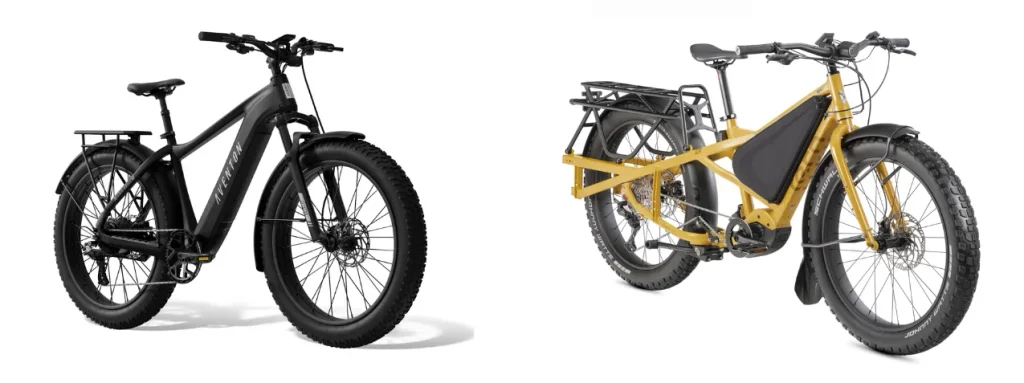
What’s the Difference Between Aventon and Tern?
The quickest way to understand these two brands is to look at what each one is actually trying to be.
Aventon builds a broad e-bike catalog. Its current lineup includes lightweight city bikes, commuter-focused models, fat-tire bikes, cargo e-bikes, and dedicated electric mountain bikes.
If you’re deciding between Aventon’s own models first, our guide to the best Aventon electric bike can help you narrow things down.
Tern takes a much more focused approach.
Much of its current lineup revolves around cargo capacity, folding frames, low-step designs, Bosch drive systems, safety testing, and long-term support. Tern also says its e-bike models are supported by a seven-year support commitment.
Neither approach is wrong.
If you want one company that can sell you a lightweight commuter today and a cargo or mountain bike later, Aventon makes more sense.
If you already know you want a serious cargo bike, a compact folding bike, or an ultra-low-step utility bike, Tern becomes much more interesting.
Motor Power
On paper, these two are closer than you might expect.
In practice, they are tuned for different experiences.
Aventon’s lineup includes rear hub motors ranging from lightweight urban systems to 750W platforms, plus several current mid-drive models.
The Soltera 2.5, for example, uses a 350W sustained hub motor with 540W peak output and 45Nm of torque. It is deliberately built around a lighter urban riding experience.
At the other end of the lineup, the Aventure 3 and Level 4 REC use 750W hub-drive systems, while the Level 4 ADV, Aventure M and Ramblas ADV bring mid-drive options into the picture. The current Level 4 ADV uses a 100Nm mid-drive system.
Tern takes a more concentrated approach. Its current e-bike lineup relies heavily on Bosch mid-drive systems across cargo, folding, and commuter models. Tern’s safety documentation specifically lists Bosch-equipped GSD, HSD, NBD and Vektron models among its current e-bike families.
That means wattage isn’t the whole story.
Aventon gives you more motor configurations. Tern concentrates more heavily on Bosch mid-drive torque, gearing, and loaded-bike performance.
For another look at how motor output translates to riding performance, our guide to how fast an electric bike goes explains why motor wattage and actual riding speed aren’t the same thing.
And if hills are part of your daily route, our guide to the best electric bikes for steep hills explains why torque and gearing matter so much on climbs.
Winner: Aventon
Aventon wins this category because it gives buyers more choices. You can get a lightweight hub-drive commuter, a powerful fat-tire bike, or move into a genuine mid-drive platform.
Torque Sensors and Ride Feel
This is where the two brands really start to separate.
A torque sensor measures how hard you’re pressing the pedals and adjusts motor assistance accordingly. The result is usually a more natural-feeling ride.
Our guide to what pedal assist is on an electric bike explains the difference between torque and cadence sensing in more detail.
Aventon has made torque sensing a major part of its newer models. The Aventure 3, Soltera 2.5, Soltera 3 ADV and several newer commuter and mid-drive models use torque-based systems. Aventon’s Abound SR, for example, uses a double-sided bottom-bracket torque sensor.
Tern takes a different route but arrives at a similar result. Bosch-powered Tern models use torque sensing as part of the Bosch drive system, giving riders natural assistance that responds to pedaling effort.
So this isn’t a category where one brand completely dominates.
Aventon gives you torque sensing across a broader variety of bike types. Tern gives you Bosch’s highly developed torque-sensing system across its utility-focused models.
Winner: Split
Aventon wins for variety. Tern wins if you specifically want the Bosch mid-drive riding experience.
Range and Battery Size
Range is one of the more complicated parts of the Aventon vs Tern comparison.
Aventon’s current lineup covers a wide range of battery sizes.
The Soltera 2.5 uses a 345.6Wh battery and is rated for up to 46 miles. The Soltera 3 ADV is rated for up to 70 miles, while the Aventure 3 reaches up to 65 miles.
Larger Aventon models go considerably further.
The Ramblas ADV is rated for up to 90 miles, while the Level 4 ADV reaches up to 110 miles under Aventon’s claimed testing conditions.
Tern also has impressive battery options, particularly in its cargo models. Some current Tern platforms can use dual-battery configurations, which can make a substantial difference when you’re carrying heavy loads or riding long distances.
If you’re planning particularly long rides, our guide to the best electric bikes for long-distance touring is worth checking out.
Actual range depends on:
- Rider weight
- Terrain and hills
- Wind and temperature
- Tire pressure
- Assist level
- Average speed
- Throttle use
- Cargo weight
If you’re a heavier rider, our guide to the best electric bikes for heavy riders is worth reading before you focus too heavily on manufacturer range claims.
You can also read our guide to why electric bikes are so expensive if you’re trying to understand why larger batteries and better drive systems raise the price.
Winner: Split
Tern has some excellent battery options for cargo and long-distance utility riding. Aventon gives you more range choices across more types of e-bikes.
Comfort and Ride Quality
Both brands can be comfortable.
They just get there differently.
Aventon generally keeps a more conventional bicycle-oriented riding position. Depending on the model, you can get suspension forks, suspension seatposts, adjustable cockpits and fat tires.
The Aventure 3 is a good example. It combines 4-inch fat tires with front suspension and a conventional e-bike layout.
Tern’s riding position is different.
Its low-step frames, cargo-optimized geometry, and compact wheels give many models a more utility-focused feel. That can be extremely comfortable for loaded riding, school runs, and errands, but it isn’t necessarily ideal for riders who want a sporty cycling position.
The GSD and HSD change the equation when cargo becomes the priority. Their compact cargo designs and accessory ecosystems give them an obvious advantage when the bike is loaded with kids, groceries, or gear.
For riders who want to compare comfort-focused options for older riders, our guide to the best electric bikes for seniors is another useful resource.
Winner: Split
Aventon is the better fit for conventional everyday comfort. Tern has the edge when loaded stability and utility-focused comfort are the priority.
Build, Weight and Durability
Both brands have loyal owners, but their bikes are designed around different priorities.
Aventon’s range includes lightweight bikes such as the 46-pound Soltera 2.5 and the 37-pound Soltera 3 ADV, along with substantially heavier cargo, fat-tire and mountain bikes.
Tern’s larger bikes take a different approach. The frames, cargo racks, wider tires, batteries and utility hardware on its bigger models are designed to create stable, load-bearing platforms.
Weight itself isn’t a measure of durability.
A heavier bike can feel extremely planted and solid. But if you need to carry the bike upstairs or put it on a vehicle rack, weight becomes a practical issue.
That is where Aventon’s broader range becomes useful. You can choose between a lightweight city bike, a practical commuter, a cargo platform, or a heavier fat-tire model depending on what matters most.
For braking considerations, our guide to mechanical vs hydraulic disc brakes on electric bikes explains the differences between the two systems.
Winner: Aventon
Aventon’s wider range of frame designs and weights makes it easier to choose a bike that fits your storage, transportation, and riding needs.
Security and Smart Features
This is one of Aventon’s clearest advantages.
Several current Aventon models offer connected features such as 4G/GPS connectivity, anti-theft functions, app integration, and other smart controls. The Level 4 REC and Level 4 ADV both include connected security features.
The Aventure 3 also includes built-in GPS tracking and app-based security features.
Tern has connected technology in its broader ecosystem, including Bosch eBike Flow compatibility on supported systems and compatibility with GPS tracking accessories. But Tern’s product strategy puts more emphasis on the bike itself, accessories, utility, and long-term ownership.
That doesn’t mean a Tern can’t be secured.
It simply means Aventon provides a more integrated security package on supported models.
Winner: Aventon
If integrated GPS and connected anti-theft features matter to you, Aventon has the stronger package.
Commuter E-Bikes: Aventon Level 4 REC vs Tern Vektron/NBD
Aventon has the stronger conventional commuter offering.
The Level 4 REC is designed specifically around everyday transportation. It combines a practical bicycle layout with suspension, connected security and a 750W hub motor. Aventon currently lists it with 4G/GPS, anti-theft features, and up to 75 miles of claimed range.
Tern bikes such as the Vektron and NBD can certainly work as commuters, but their designs put more emphasis on folding, low-step access, and utility.
The Vektron is especially interesting if you need a folding bike with a Bosch mid-drive system. Our Tern Vektron S10 review looks at that platform in greater detail.
Aventon’s broader commuter lineup also gives buyers more choices depending on riding style and budget.
For more commuter-friendly options, see our best Class 2 electric bikes guide or our best Class 3 electric bikes roundup.
Winner: Aventon
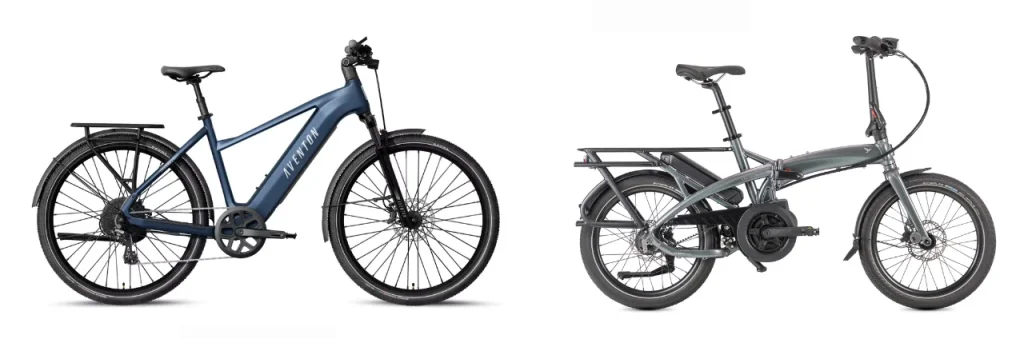
Lightweight E-Bikes: Aventon Soltera 2.5 vs Tern
The Aventon Soltera 2.5 has a major advantage here because Tern does not currently offer a true lightweight urban e-bike equivalent.
At around 46 pounds, the Soltera 2.5 is considerably easier to maneuver, store, and transport than the larger utility and cargo bikes that dominate much of Tern’s lineup.
Tern focuses more heavily on models such as the GSD, HSD, Quick Haul, Orox, Vektron, and NBD.
That makes the Soltera 2.5 a better choice for apartment living, short urban trips, and riders who still want their e-bike to feel like a bicycle.
Our best electric bikes for short people guide covers more compact options, while our best electric bikes for short females guide looks specifically at smaller rider fit.
For another lightweight comparison, our Velotric T1 ST Plus review covers another bike designed around a lighter, more conventional bicycle feel.
Winner: Aventon
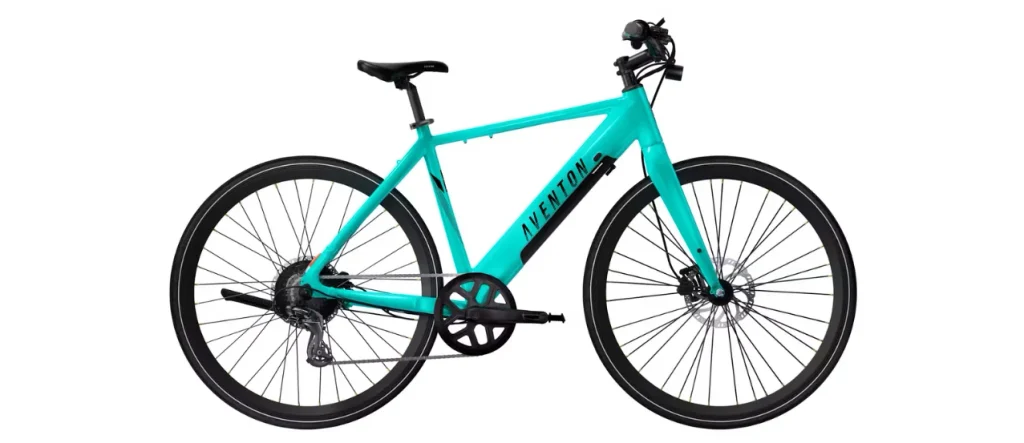
Mountain and Off-Road E-Bikes: Aventon Ramblas ADV vs Tern Orox
Aventon and Tern take very different approaches to off-road riding.
The Ramblas ADV is a dedicated electric mountain bike built around a mid-drive motor, mountain-bike geometry, suspension, and trail-focused equipment. Aventon lists it with a 100Nm mid-drive motor and up to 90 miles of claimed range.
The Orox takes a more all-terrain cargo approach. Its robust frame, wide tires, and cargo-ready design make it more appealing to riders looking for stability and a utility-focused off-road experience.
So the winner depends on how you ride.
The Ramblas ADV is the better trail bike. The Orox is more appealing if you want something closer to an all-terrain cargo bike.
Our Aventon Ramblas ADV review goes deeper into the bike’s 100Nm mid-drive motor, suspension fork, dropper post, and trail-focused drivetrain.
You can also see how Aventon compares with a premium mountain-bike brand in our Aventon vs Specialized comparison.
For more trail options, see our best electric bikes for off-road guide.
Winner: Split
Aventon wins for conventional electric mountain biking. Tern wins if your idea of off-road riding involves carrying people, gear, or cargo over rough terrain.
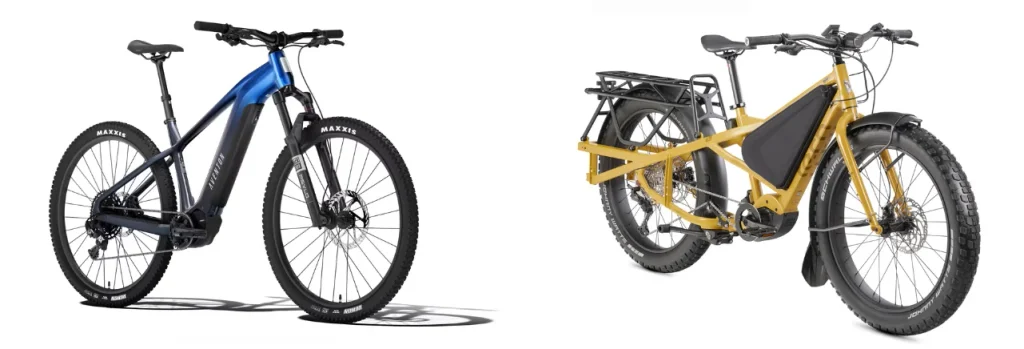
Fat-Tire E-Bikes: Aventon Aventure 3 vs Tern
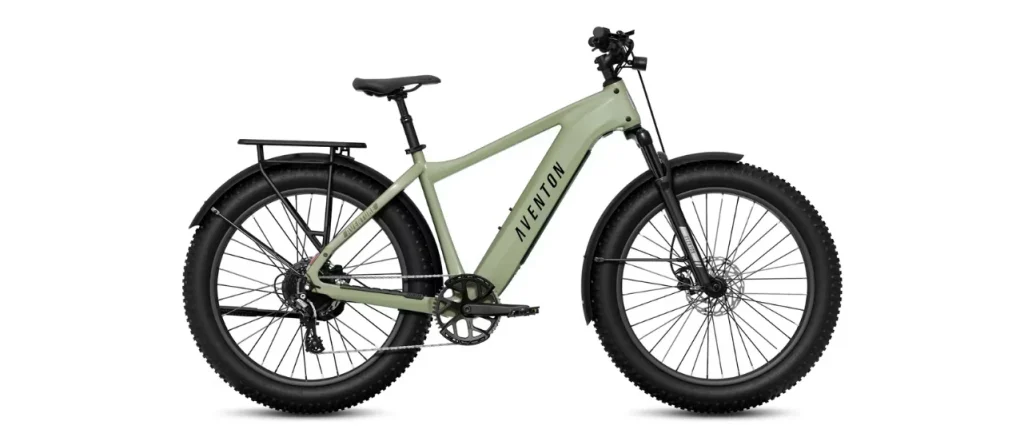
This category favors Aventon.
The Aventure 3 combines 4-inch fat tires with an all-terrain design that works for commuting, recreation, gravel, and loose surfaces. Aventon currently lists it with a 750W motor, 1,440W peak power, 80Nm of torque, and up to 65 miles of claimed range.
Tern’s current lineup emphasizes cargo and all-terrain utility rather than conventional fat-tire recreation.
Choose the Aventure 3 if you want a versatile fat-tire e-bike that can handle everyday riding as well as loose surfaces.
For more options, see our best fat-tire electric bikes guide and our comparison of Aventon vs Himiway.
You can also see how Aventon compares with another performance-oriented direct-to-consumer brand in our Aventon vs Cyrusher comparison.
Winner: Aventon
Aventon has the clearer choice for riders specifically looking for a conventional fat-tire e-bike.
Cargo E-Bikes: Aventon Abound SR vs Tern GSD/HSD/Quick Haul
This is the closest category in the entire comparison.
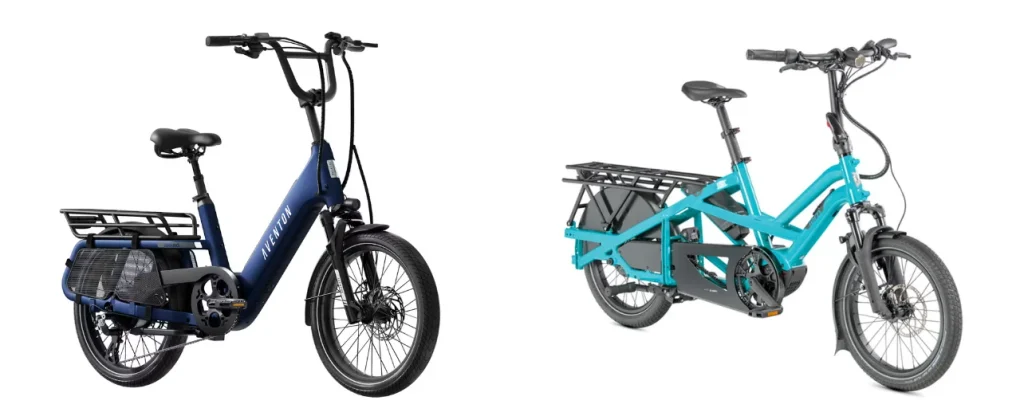
Aventon has built the Abound platform specifically around cargo carrying. The Abound SR is currently listed as a compact cargo e-bike capable of carrying a passenger, with 4G/GPS security, an 80Nm motor, a 733Wh battery, and a 440-pound total weight limit.
Aventon also sells the Abound LR, giving the company a second dedicated cargo platform.
Tern, however, has made cargo the center of its entire brand strategy.
The GSD, HSD, Quick Haul, Quick Haul Long, and Orox all give Tern a much deeper utility ecosystem.
If you need an e-bike for groceries, children, deliveries, or regular utility work, both brands have strong options.
The Abound SR makes more sense if you want integrated security and a familiar e-bike format.
Tern makes more sense if you want maximum modularity, a mature accessory ecosystem, and a bike built around the cargo experience from the beginning.
Our Aventon Abound SR review goes deeper into its cargo capacity and security features.
For another heavy-duty cargo comparison, see our Fiido T2 review.
And if you’re thinking about delivery work specifically, our best electric bikes for Uber Eats guide covers the factors that matter to full-time riders.
Winner: Tern
Aventon has an excellent cargo platform, but Tern has built an entire ecosystem around cargo transportation.
Where the Two Brands Stop Overlapping
This is where the comparison becomes much clearer.
Aventon covers more conventional e-bike categories, while Tern concentrates much more heavily on cargo, folding, and low-step utility.
Models such as the Level 4, Soltera 2.5, Aventure 3, Ramblas ADV, and Abound show how broad Aventon’s lineup has become.
Tern does something Aventon doesn’t.
It builds a recognizable family of bikes around cargo, folding, and practical transportation.
The GSD, HSD, Quick Haul, Orox, Vektron, and NBD all have their own variations, but the overall design philosophy remains easy to recognize across the catalog.
That focus is actually a strength.
If you know you want a Tern, the decision becomes more about which size, battery, motor, and accessory configuration fits you.
If you don’t know what type of e-bike you want yet, Aventon’s broader catalog gives you more room to experiment.
For another look at different e-bike formats, our RadExpand 5 Plus review covers a very different approach to folding utility.
You can also compare Aventon’s broader value proposition in our Aventon vs Ride1Up and Aventon vs Lectric comparisons.
Aventon’s broader catalog covers more everyday use cases.
Value for Money
This one leans toward Aventon, but there’s an important qualification.
Aventon’s current lineup gives buyers a wider range of practical choices.
The Soltera 2.5 sits at the lightweight end, while models such as the Soltera 3 ADV, Level 4 REC, Level 4 ADV, Aventure 3, Aventure M and Ramblas ADV cover progressively different use cases and price points. Aventon’s current comparison page shows models ranging from the lightweight Soltera family to the premium Level 4 and Aventure M platforms.
Tern’s current lineup is more specialized.
Its current models include the GSD, HSD, Quick Haul, Orox, Vektron, and NBD, with larger cargo platforms commanding significantly higher prices because of their Bosch systems, frames, accessories, and load-carrying capabilities.
That pricing can make sense if you specifically want the Tern experience.
You’re paying for the cargo capacity, Bosch drive systems, safety testing, accessories ecosystem, and overall utility.
But Aventon offers better value for buyers who prioritize everyday practicality, commuting, recreation, and having more than one type of bike to choose from.
For shoppers working with a tighter budget, our best electric bikes under $1,500 and best electric bikes under $2,000 guides provide useful alternatives.
There’s also our best electric bikes under $800 guide for buyers looking at the entry-level market.
For most practical buyers, Aventon offers more ways to get the features and bike type they actually need.
Customer Support and Dealer Network
Aventon has a meaningful advantage here.
The company currently advertises availability through 2,000+ bike shops, giving buyers more opportunities for test rides and in-person service.
That matters more than it sounds.
An e-bike isn’t just a battery and motor. You still have brakes, tires, wheels, drivetrain components, and other parts that eventually need attention.
Tern also has a dealer network and dealer locator. Its current support site directs customers toward dealers, test rides, service, warranty information, and long-term support.
So it’s not accurate to say Tern has no physical support.
The difference is that Tern’s dealer ecosystem is closely tied to its more specialized utility products, while Aventon has built a broader bike-shop presence.
For more traditional bike-brand comparisons, see Aventon vs Trek and Aventon vs Giant.
You can also see how Aventon compares with another established manufacturer in our Aventon vs Cannondale comparison.
If local service and test rides are important, Aventon’s larger bike-shop presence is a major advantage.
Aventon Vs Tern: Category Winners
| Category | Winner | Why |
| Motor variety | Aventon | Hub-drive and multiple mid-drive options |
| Pedal-assist sensing | Split | Both offer strong torque-sensing systems |
| Range and battery | Split | Tern excels with cargo battery options, Aventon offers more variety |
| Comfort | Split | Aventon for conventional comfort, Tern for loaded utility riding |
| Build and weight flexibility | Aventon | Much wider range of frame designs and weights |
| Fat-tire riding | Aventon | Stronger dedicated fat-tire lineup |
| Mountain biking | Aventon | Dedicated Ramblas ADV eMTB |
| All-terrain cargo | Tern | Orox and cargo-focused platforms |
| Lineup breadth | Aventon | More categories and motor configurations |
| Smart security | Aventon | Stronger integrated connected-security package |
| Value for money | Aventon | More choices across mainstream price points |
| Dealer support | Aventon | Larger bike-shop presence |
| Cargo/folding utility | Tern | Built around that experience |
| Long-term utility focus | Tern | Deep cargo and accessory ecosystem |
These winners don’t mean every Aventon is better than every Tern.
They simply reflect what each brand does best.
For additional brand comparisons, our Aventon vs Rad Power and Aventon vs Velotric guides are useful next steps.
You can also compare Aventon with Aventon vs Mokwheel, Aventon vs Heybike, and Aventon vs Engwe if you’re shopping among direct-to-consumer brands.
Who Should Choose Tern?
Tern makes more sense if you want:
- A cargo-focused e-bike
- Strong Bosch mid-drive performance
- Folding or low-step frames
- A stable utility-oriented riding experience
- Extensive cargo and accessory options
- Modular battery configurations on supported models
- A bike designed around carrying people or gear
- Long-term utility rather than lightweight portability
Tern is especially appealing if you already know you want the Tern experience.
You’re not buying it because it is the lightest commuter or the cheapest e-bike.
You’re buying it because you value the way Tern approaches transportation.
The GSD, HSD, Quick Haul, Quick Haul Long, Orox, Vektron, and NBD each solve different problems within that broader philosophy.
Who Should Choose Aventon?
Aventon makes more sense if you want:
- A broader range of e-bike categories
- A commuter or city bike
- A lightweight e-bike
- A fat-tire e-bike
- A dedicated cargo platform
- A mid-drive option
- A dedicated electric mountain bike
- Torque sensing
- Connected security features
- A larger dealer network
- More choices across different price points
If you’re not completely sure what kind of e-bike you need, Aventon is the safer place to start.
You can choose something as light as the Soltera 3 ADV, officially listed at 37 pounds, or move into a much more capable platform such as the Level 4 ADV or Ramblas ADV.
If you’re considering a different direct-to-consumer option, our Aventon vs Fiido comparison is also worth reading.
Aventon Vs Tern: Which Should You Buy?
So, Aventon vs Tern: which is better?
For most buyers, I’d choose Aventon.
That isn’t because every Aventon e-bike is better than every Tern.
It’s because Aventon gives you more ways to find the right bike.
If you want a lightweight city bike, Aventon has one.
If you want a commuter, Aventon has several.
If you want a fat-tire e-bike, there’s the Aventure 3.
If you want a mid-drive bike, Aventon has multiple options.
If you want cargo capacity, there’s the Abound platform.
If you want mountain biking, Aventon has a dedicated eMTB.
Tern is the better choice when your priorities are more specific.
If you want a well-engineered utility e-bike with cargo capacity, Bosch power, low-step or folding designs, and a deep accessory ecosystem, Tern is genuinely compelling.
The Vektron and NBD are the more compact options. The GSD, HSD, and Quick Haul are serious cargo choices. The Orox gives buyers an all-terrain cargo approach.
So the answer depends on the question you’re really asking.
Aventon is the better all-around e-bike brand for most buyers. Tern is the more interesting choice for riders who specifically want the Tern cargo, folding, and utility experience.
If you’re comparing more established bicycle brands, check out Aventon vs Trek and Aventon vs Cannondale.
For other performance-oriented comparisons, see Aventon vs Specialized and Aventon vs Giant.
And if you’re comparing more affordable direct-to-consumer options, Aventon vs Himiway, Aventon vs Heybike, Aventon vs Cyrusher, and Aventon vs Super73 provide useful context.
The Bottom Line
Tern wins for cargo-focused design, Bosch-powered utility, folding options, and its deep accessory ecosystem.
Aventon wins for lineup variety, smart security, lightweight options, fat-tire bikes, conventional commuter comfort, and dealer support.
But here’s the real takeaway.
Don’t pick the brand first. Pick the bike first.
If you want a cargo-focused e-bike with Bosch power and a purpose-built utility platform, Tern is the better fit.
If you want a fat-tire bike that can also handle everyday commuting and practical riding, the Aventure 3 is the more versatile choice.
If you need a commuter, lightweight city e-bike, fat-tire bike, cargo bike, or dedicated mountain bike, Aventon gives you more choices.
And if you want integrated GPS security, app connectivity, and a broad dealer network behind your purchase, Aventon is the safer long-term choice.
There isn’t one universal winner.
Aventon is the better all-around choice. Tern is the better specialized choice.
That’s the distinction I’d keep in mind before spending your money.