
If you’re comparing Aventon vs Fiido in 2026, you’re looking at two e-bike brands with very different approaches.
Aventon has built a broad lineup around connected technology, comfort, security, torque sensing, and dealer support. Its current range includes commuter bikes, fat-tire models, cargo bikes, lightweight city bikes, and dedicated electric mountain bikes.
Fiido takes a more unconventional approach. Its lineup includes lightweight carbon-fiber bikes, city commuters, touring bikes, cargo bikes, and long-range models with expandable batteries.
That makes this comparison less about picking one universal winner and more about understanding where each brand makes the most sense.
I compared the current lineups across motor performance, torque sensing, range, comfort, build quality, smart features, commuting, lightweight riding, mountain riding, fat tires, and cargo.
The goal is simple: show you what separates Aventon from Fiido and which type of rider each brand is better suited to. If you’re comparing Aventon with other major brands, our guides to Aventon vs Specialized, Aventon vs Trek, and Aventon vs Ride1Up provide useful context.
How We Evaluated
We focused on current models listed on the manufacturers’ websites, along with published specifications, pricing, warranty information, support options, and the practical differences between comparable bikes.
For the category comparisons, I chose specific models that are currently available on the companies’ websites rather than older bikes that may still appear in search results or third-party reviews.
The comparisons also consider how these bikes are actually intended to be used. A 30-pound carbon-fiber city bike and a 440-pound-payload cargo bike shouldn’t be judged by the same criteria.
One important note: claimed range is manufacturer-tested maximum range. Real-world range varies with rider weight, terrain, temperature, speed, tire pressure, assist level, and cargo.
Aventon vs Fiido: Quick Comparison
| Category | Aventon | Fiido |
| Best known for | Connected technology, security, comfort and broad lineup | Lightweight designs, unusual formats and battery flexibility |
| Commuter example | Level 4 REC | C11 Pro |
| Lightweight example | Soltera 2.5 | Air |
| Mountain example | Ramblas ADV | Nomads Pro is a cross-terrain/touring alternative, not a direct eMTB equivalent |
| Fat-tire example | Aventure 3 | Titan |
| Cargo example | Abound SR | T2 |
| Motor options | Hub and mid-drive | Hub and mid-drive |
| Torque sensing | Common across current models | Available on models including C11 Pro, Titan, T2 and Nomads Pro |
| Smart security | 4G/GPS, app connectivity and anti-theft features on many models | Simpler connected features, depending on model |
| Expandable battery | Limited compared with Fiido’s multi-battery approach | Major feature on Titan and Nomads Pro |
| Dealer/support network | 2,000+ bike shops | Direct sales plus Fiido demo/service options |
| Warranty | 2 years on current Aventon models | 2 years on current Fiido models listed on its site |
| Main strength | Complete ownership ecosystem | Hardware variety and unconventional designs |
What’s the Difference Between Aventon and Fiido?
The biggest difference is the way the two companies approach the e-bike market.
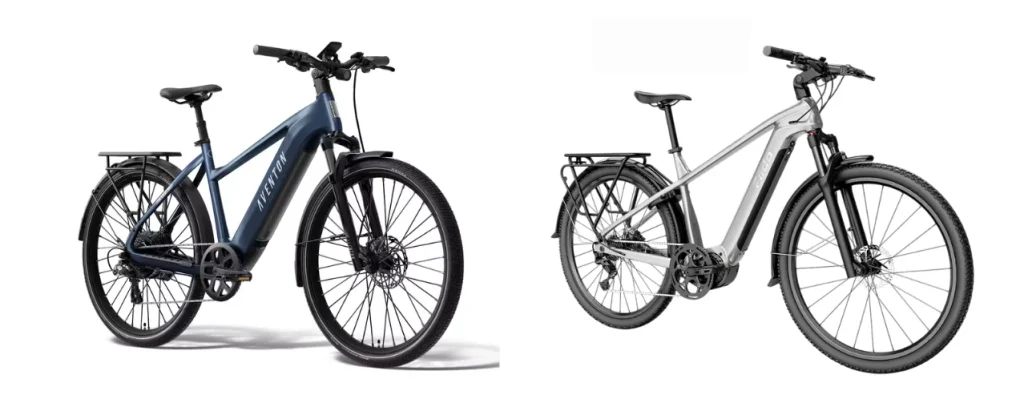
Aventon has increasingly integrated its bikes into a connected ecosystem. Current models such as the Level 4 REC and Abound SR include features such as 4G/GPS connectivity, security functions, app connectivity, and over-the-air updates.
Fiido is more willing to experiment with different formats. The current lineup includes the lightweight carbon-fiber Air, the long-range Titan, the T2 cargo bike, the C11 Pro commuter, and the Nomads Pro touring bike. Fiido’s own comparison page currently lists these models together.
So, while both brands cover commuting, cargo, recreation and longer-distance riding, their priorities are different.
Aventon puts more emphasis on a consistent ownership experience. Fiido puts more emphasis on giving riders unusual hardware choices at different price points.
Motor Power
Motor specifications can make Aventon and Fiido look similar at first, but the type of motor matters just as much as the wattage.
Aventon currently offers both hub-drive and mid-drive systems. The Level 4 REC, for example, uses a 750W hub motor with 80Nm of torque, while the Ramblas ADV uses Aventon’s A100 mid-drive motor with up to 100Nm of torque.
Fiido also has both approaches. The C11 Pro uses a 250W motor with 55Nm of torque on the current official specification, while the Nomads Pro uses a 250W mid-drive with 100Nm of torque.
That makes simple wattage comparisons misleading. A mid-drive motor’s gearing and torque delivery can make a major difference when climbing hills or riding technical terrain. Our Aventon vs Mokwheel and Aventon vs Himiway comparisons also look at why motor wattage alone doesn’t tell the whole story.
Winner: Aventon
Aventon has the broader range of high-output motor configurations in the models compared here, including a dedicated 100Nm mid-drive mountain bike.
Torque Sensors and Ride Feel
Torque sensors measure how hard you’re pedaling and adjust motor assistance accordingly. They generally produce a more natural feeling than basic cadence-only systems. Our What Is Pedal Assist on an Electric Bike? guide explains the difference between torque and cadence sensing in more detail.
Aventon has made torque sensing a major part of its current lineup. The Level 4 REC, Aventure 3 and Abound SR all use torque sensing, while the Abound SR also offers Sensor Switch so riders can choose between torque and cadence sensing.
Fiido has also expanded its use of torque sensors. The C11 Pro uses a Mivice torque sensor, while the T2 and Nomads Pro also use torque sensing.
The difference is therefore less about whether torque sensing exists and more about how broadly it is integrated across each company’s lineup.
Winner: Aventon
Aventon’s torque-sensing implementation is more consistently integrated with its broader electronic and ride-control ecosystem.
Range and Battery Size
This is one area where Fiido becomes particularly interesting.
The Aventon Level 4 REC uses a 733Wh battery and has a claimed range of up to 75 miles. The Aventure 3 also uses a 733Wh battery and claims up to 65 miles.
Fiido’s C11 Pro uses a 499.2Wh removable battery and claims up to 104 km, or about 65 miles, under its stated test conditions. If range is your main concern, our guide to how far an electric bike can go explains the factors that can change real-world results.
But the Titan is where Fiido really separates itself. Its standard configuration uses a 696Wh battery, while the company’s expandable system can use up to three batteries for a total of 2,088Wh. Fiido claims up to 215 miles with the three-battery configuration.
The Nomads Pro also supports an expandable battery setup, with a 417.6Wh standard battery and the option to use additional batteries. Fiido lists up to 139.53 miles with the expanded configuration.
Actual range will always be lower or higher depending on riding conditions. For a broader look at fat-tire options, see our guide to the best fat-tire electric bikes.
Factors include:
- Rider weight
- Cargo weight
- Terrain
- Wind
- Temperature
- Tire pressure
- Average speed
- Pedal-assist level
- Throttle use
There isn’t a reliable universal formula such as “10Wh equals one mile.” Battery capacity is only one part of the range equation.
Winner: Fiido
Fiido’s expandable-battery approach gives it a level of long-range flexibility Aventon’s current lineup does not match.
Comfort and Ride Quality
Aventon has built comfort into much of its current range.
The Level 4 REC uses an 80mm suspension fork and a suspension seatpost. The Aventure 3 adds a suspension fork and suspension seatpost, while the Abound SR uses a suspension fork and suspension seatpost for cargo riding.
Fiido takes a more model-specific approach.
The C11 Pro is designed as an upright urban bike with an adjustable cockpit and front suspension. The Air takes the opposite approach, using a carbon-fiber frame and a much lighter construction.
The Nomads Pro uses a 120mm air suspension fork and 29 x 2.1-inch tires, giving it a very different ride character from the C11 Pro or Air.
Winner: Aventon
Aventon’s comfort features are more consistently integrated across its lineup, particularly on commuter and utility models.
Build Quality and Durability
Both companies use aluminum extensively, but some Fiido models stand out for unusual construction.
The Fiido Air uses a carbon-fiber frame and weighs about 13.75 kg, or roughly 30.3 pounds, according to Fiido’s current specification. It also uses a Gates carbon belt drive and hydraulic disc brakes. For riders interested in low-maintenance belt-drive designs more generally, our Evelo Galaxy Lux review is another useful read.
Aventon’s models generally use aluminum frames, with the emphasis placed on practical features, integrated components, and established service support. The same balance of refinement and practicality comes up in our Aventon vs Cannondale and Aventon vs Giant comparisons.
The Ramblas ADV, for example, uses a 6061 aluminum frame, a RockShox Psylo fork, SRAM components, four-piston hydraulic brakes, and tubeless-ready wheels.
That doesn’t mean one brand is universally more durable. Different models use different components, and maintenance has a major effect on long-term reliability.
Winner: Aventon
Aventon’s current lineup offers a more consistent overall package, particularly for riders who value established service infrastructure and conventional component availability.
Security and Smart Features
This is one of Aventon’s clearest differentiators.
The Level 4 REC includes 4G/GPS tracking, unusual-activity detection, an integrated rear wheel lock, E-lock functionality, Ride Tune and other connected features.
The Abound SR adds GPS, geofencing, an integrated kickstand lock, startup-password functionality, keyless battery access and over-the-air updates.
The Aventure 3 also includes GPS tracking, anti-theft features, an integrated rear wheel lock and app-connected functions.
Fiido offers connected features on several bikes, but its current lineup does not present the same level of integrated cellular security across the models compared here.
Winner: Aventon
If GPS tracking and integrated anti-theft technology are important, Aventon’s current system is more comprehensive.
Commuter E-Bikes: Aventon Level 4 REC vs Fiido C11 Pro
This is one of the clearest comparisons between the two brands.
The Aventon Level 4 REC is a technology-heavy commuter. It has a 750W hub motor, 80Nm of torque, a 733Wh battery, suspension fork and seatpost, regenerative braking, integrated rack and fenders, and 4G/GPS connectivity. Aventon lists a range of up to 75 miles.
The Fiido C11 Pro takes a simpler approach. It uses a 250W, 55Nm motor, 499.2Wh removable battery, Mivice torque sensor, seven-speed drivetrain, hydraulic brakes, front suspension and rear rack. Fiido lists a range of up to 104 km.
The Level 4 REC is heavier and substantially more expensive, but it also provides more integrated technology.
The C11 Pro is easier to justify if your main priorities are everyday commuting, a removable battery and lower upfront cost.
Winner: Split
Aventon Level 4 REC for features and technology. Fiido C11 Pro for lower-cost commuting.
This is a genuine split rather than a one-sided comparison.
Lightweight E-Bikes: Aventon Soltera 2.5 vs Fiido Air
The difference here is dramatic.
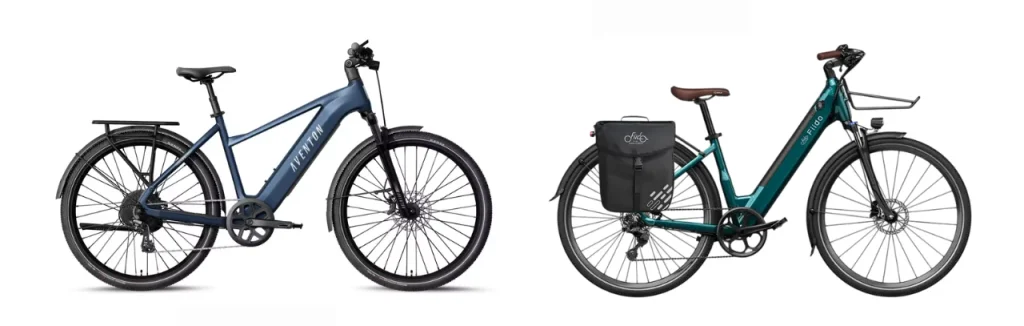
The Aventon Soltera 2.5 weighs 46 pounds and is designed as a lightweight city e-bike. Aventon lists a 540W peak motor, seven-speed drivetrain and up to 46 miles of range.
The Fiido Air goes much further in the lightweight direction. Another lightweight option worth knowing about is covered in our Velotric Breeze 1 review. If you’re comparing lightweight alternatives, our Aventon vs Heybike guide is another useful reference. Its carbon-fiber frame helps bring the weight down to about 30.3 pounds, while it uses a 250W Mivice motor, torque sensor, hydraulic brakes and Gates carbon belt drive.
The Air is therefore much easier to lift and carry than the Soltera 2.5. You can also read our Aventon Soltera 2.5 review for a closer look at the Aventon side of this comparison.
The tradeoff is that the Air’s 208.8Wh battery is much smaller than the batteries used on Aventon’s larger commuter bikes. If portability and low weight are your main concerns, our Lectric XP Lite 2.0 review offers another lightweight example.
Winner: Fiido Air
If low weight is the priority, the Air is in a different class from the Soltera 2.5.
Electric Mountain Bikes: Aventon Ramblas ADV vs Fiido Nomads Pro
This comparison needs an important qualification.
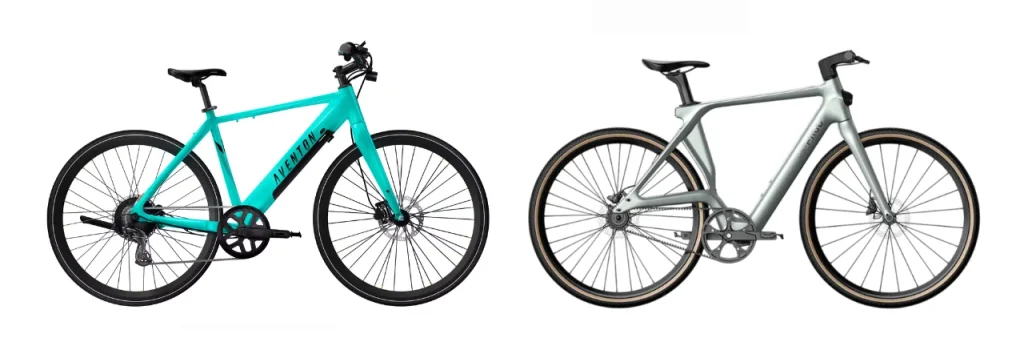
The Aventon Ramblas ADV is a genuine hardtail electric mountain bike. For more brand-level context in this category, see our Aventon vs Trek guide. It uses a 100Nm mid-drive motor, 130mm RockShox fork, 29-inch tubeless-ready wheels, SRAM 12-speed drivetrain and four-piston hydraulic brakes. Aventon lists up to 90 miles of range.
The Fiido Nomads Pro is not a direct eMTB equivalent. Fiido describes it as a mid-drive touring bike for commuting and long-distance adventures. It uses a 100Nm mid-drive motor, 120mm air fork, 29 x 2.1-inch tires, four-piston hydraulic brakes and a torque sensor.
That makes the Nomads Pro interesting for gravel, country roads, steep routes and cross-terrain travel, but it isn’t positioned as a dedicated trail mountain bike in the same way as the Ramblas.
Winner: Aventon Ramblas ADV for actual mountain biking.
The Fiido Nomads Pro is the better comparison if your idea of adventure includes touring, gravel and mixed terrain rather than dedicated mountain-bike trails.
Fat Tire E-Bikes: Aventon Aventure 3 vs Fiido Titan
Both bikes are built for riders who want stability and traction from wide tires, but they emphasize different things. Our Aventon Aventure M guide covers another current Aventon fat-tire option.
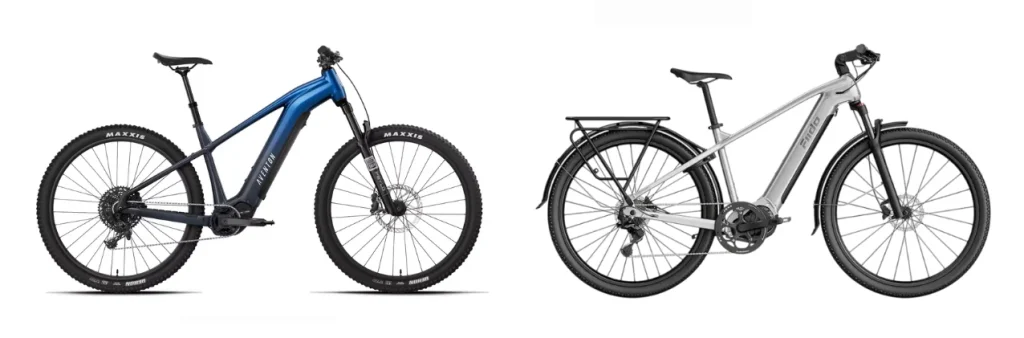
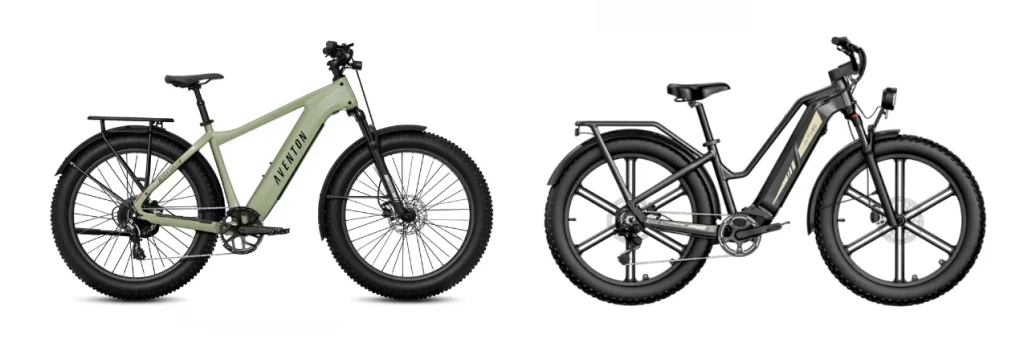
The Aventon Aventure 3 uses 26 x 4.0-inch tires, a 750W hub motor, 80Nm of torque and a 733Wh battery. Aventon lists up to 65 miles of range and a 400-pound total weight limit.
The Fiido Titan is built more around long-distance utility. It uses a 696Wh battery in its standard configuration, has a 440-pound payload rating and supports an expandable three-battery setup. Fiido lists up to 215 miles with the full battery configuration.
The Aventure 3 is a more conventional fat-tire all-terrain bike. If you’re shopping more broadly in this category, our Aventon vs Rad Power comparison is another useful point of reference. The Titan is closer to a heavy-duty touring and utility machine.
Winner: Fiido Titan for long-range touring and heavy loads.
The Aventure 3 remains a strong option if you want a conventional fat-tire all-terrain bike with Aventon’s connected security system.
Cargo E-Bikes: Aventon Abound SR vs Fiido T2
These two bikes are much closer in purpose.
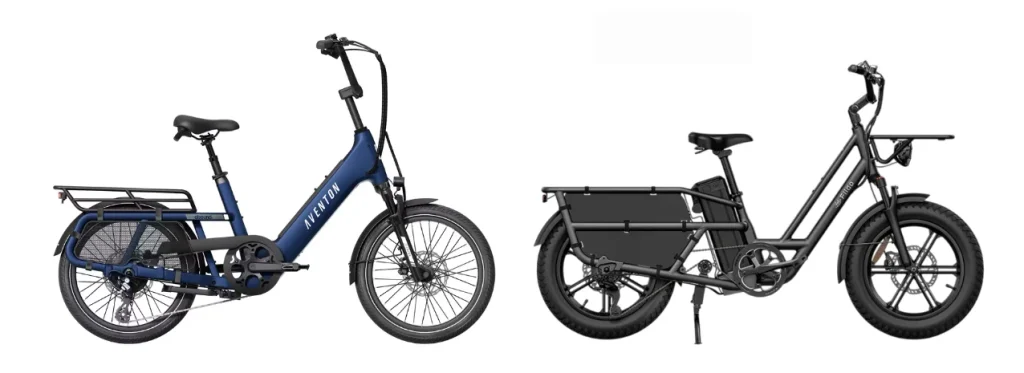
The Aventon Abound SR is a compact cargo e-bike designed to carry a single passenger. It has an 80Nm hub motor, 733Wh battery, 440-pound total weight limit, rear rack, suspension components and Aventon’s connected security system.
The Fiido T2 is a long-tail cargo bike with a 998.4Wh battery and a 440-pound payload rating. If you want to see how another utility-focused design approaches portability and rough terrain, our RadExpand 5 Plus review is also useful. We also tested the category in our Fiido T2 review. It uses a 750W, 55Nm motor with torque sensing, four-piston hydraulic brakes and 20 x 4.0-inch tires.
The T2 therefore puts more emphasis on cargo capacity and battery size.
The Abound SR puts more emphasis on security, compact dimensions and connected features. Our Aventon Abound SR review goes deeper into that platform.
Winner: Split
Choose the Abound SR if integrated security and a more connected ownership experience matter most. Choose the T2 if battery capacity, cargo flexibility and payload are higher priorities.
Where The Two Brands Stop Overlapping
At this point, the biggest differences become easier to see.
Fiido has some formats that Aventon’s lineup does not directly replicate.
The Air’s carbon-fiber construction and extremely low weight give it a distinct position. The Titan’s expandable battery system also gives Fiido a long-range option that is difficult to compare directly with Aventon’s current bikes.
Fiido also offers the Nomads Pro as a mid-drive touring bike, combining 100Nm of torque with an expandable battery system.
Aventon has a stronger focus on connected security and dedicated trail riding.
The Ramblas ADV is a genuine hardtail eMTB with a 100Nm mid-drive, 130mm fork and trail-oriented component package.
Aventon’s current connected models also integrate features such as GPS, geofencing, electronic locks, unusual-activity detection and over-the-air updates.
Neither brand completely replaces the other.
Value for Money
Fiido’s pricing can be attractive when you compare hardware directly. That’s a theme worth exploring alongside our Aventon vs Lectric and Aventon vs Engwe comparisons.
The C11 Pro, Air, Titan, T2 and Nomads Pro cover very different use cases, but they give shoppers access to features such as torque sensing, hydraulic brakes, large batteries, carbon construction or mid-drive motors at prices that can be difficult to match in some categories. For cargo shoppers, it is also useful to compare the T2 with our Lectric XPedition 2.0 cargo e-bike review and RadRunner Plus review.
Aventon tends to put more money into the overall ownership package. Current bikes combine safety certification, connected technology, integrated components, warranties and access to a large physical dealer network.
For example, Aventon currently lists the Level 4 REC at $1,999, the Soltera 2.5 at $1,199, the Aventure 3 at $1,999 and the Abound SR at $1,899. The current lineup is also covered in our broader Aventon vs Velotric comparison.
Customer Support and Dealer Network
This is an area where Aventon has a significant structural advantage.
Aventon currently says it is available through 2,000+ bike shops, giving customers access to test rides, maintenance and service through physical locations.
Fiido operates primarily through direct online sales, but it is not accurate to describe the company as having no physical support options. Fiido’s support site currently points customers to demo stores and service resources.
Fiido also lists a two-year warranty and 30-day return period on the current product pages reviewed here. Its support model is worth comparing with the more traditional dealer approach discussed in Aventon vs Cannondale.
So, the distinction is better described as Aventon’s larger established dealer network versus Fiido’s more direct-to-consumer model with regional support and demo options.
Aventon Vs Fiido: Category Winners
| Category | Best Fit | Why |
| Motor power | Aventon | Strong hub options plus the 100Nm Ramblas mid-drive |
| Torque sensing | Aventon | Broad integration with ride-control technology |
| Range flexibility | Fiido | Titan and Nomads Pro offer expandable batteries |
| Comfort | Aventon | Strong suspension and comfort focus across commuter/utility models |
| Build variety | Fiido | Carbon fiber Air and unusual touring designs |
| Commuters | Split | Level 4 REC for features, C11 Pro for lower-cost simplicity |
| Lightweight | Fiido | Air is dramatically lighter than Soltera 2.5 |
| Mountain biking | Aventon | Ramblas ADV is a dedicated hardtail eMTB |
| Fat-tire touring | Fiido | Titan’s expandable battery system |
| Cargo | Split | Abound SR for connected security, T2 for capacity and battery |
| Smart security | Aventon | 4G/GPS, geofencing and integrated anti-theft features |
| Dealer support | Aventon | 2,000+ bike shops |
| Unusual formats | Fiido | Carbon-fiber and expandable-battery options |
| Value | Depends on category | Fiido often emphasizes hardware flexibility, while Aventon adds ecosystem and support |
Who Should Choose Aventon?
Aventon makes more sense if you want:
- Integrated 4G/GPS security on supported models
- A large physical dealer network
- A dedicated electric mountain bike
- Strong suspension and comfort features
- A more consistent connected-bike ecosystem
- A cargo bike with integrated security features
- The ability to test ride through a physical bike shop
The Level 4 REC, Aventure 3, Abound SR, and Ramblas ADV each show a different side of Aventon’s current strategy.
Who Should Choose Fiido?
Fiido makes more sense if you want:
- A very lightweight e-bike
- A carbon-fiber frame
- An expandable battery system
- A long-range touring bike
- A high-capacity cargo bike
- A simpler commuter at a lower price
- More unusual bike formats
The Air, C11 Pro, Titan, T2, and Nomads Pro demonstrate how different Fiido’s current lineup can be. The Troxus Lynx cargo e-bike review provides another useful cargo comparison for readers shopping around this price range.
Aventon Vs Fiido: Which Should You Buy?
There isn’t one answer that works for every rider.
If your priority is a connected commuter with integrated security, the Aventon Level 4 REC offers a more comprehensive technology package.
If you’re looking for a lighter and less expensive city bike, the Fiido C11 Pro is a different proposition. The Velotric T1 ST Plus review is another useful lightweight-city reference.
If weight is the deciding factor, the Fiido Air is dramatically lighter than the Soltera 2.5.
For serious mountain-bike use, the Aventon Ramblas ADV is the relevant choice because it is purpose-built as a hardtail eMTB. The Nomads Pro is better viewed as a cross-terrain touring alternative rather than a direct mountain-bike equivalent.
For fat-tire touring and very long distances, the Fiido Titan stands out because of its expandable battery architecture.
And for cargo, the Aventon Abound SR and Fiido T2 take different approaches. The Abound SR emphasizes connected security and compact utility, while the T2 focuses heavily on payload and battery capacity.
The important point is to choose the model that matches how you actually ride rather than choosing the brand first. If you are considering more brands, our Aventon vs Engwe comparison is another useful starting point.
The Bottom Line
Aventon and Fiido are not trying to build exactly the same kind of e-bike lineup.
Aventon puts more emphasis on connected technology, security, comfort, dealer support and dedicated categories such as mountain biking.
Fiido puts more emphasis on lightweight construction, unconventional designs, long-range battery options and hardware flexibility.
If you want GPS security and physical dealer support, look closely at Aventon’s current models. Riders considering another established brand can also see Aventon vs Specialized and Aventon vs Mokwheel.
If you want an exceptionally light e-bike, expandable batteries or a different approach to touring and cargo, Fiido deserves a close look.
The best way to make the decision is to start with the bike, not the logo.
Match the model to your riding distance, terrain, weight, cargo needs, storage situation and access to service. Once those factors are clear, the Aventon vs Fiido decision becomes much easier.