
If you’re comparing Aventon vs Ride1Up in 2026, you’ve landed on two of the most talked-about names in the direct-to-consumer electric bike world. Both brands built loyal followings by offering real components at fair prices, and both show up constantly in “which e-bike should I buy” discussions.
But they approach that value from opposite directions.
- Aventon focuses on a polished, tech-forward ownership experience: integrated batteries, 4G-connected security, over-the-air feature updates, and a large dealer network to back it all up.
- Ride1Up focuses on pure spec-per-dollar: large batteries, name-brand mid-drive motors, and a streamlined lineup with almost no fluff, sold primarily online.
So which brand should you actually buy?
I compared the current 2026 lineups across motor performance, torque sensing, range, comfort, build quality, smart features, and the major categories both brands compete in.
How we evaluated: We looked at current specs, pricing, warranty terms, dealer and support networks, and real-world impressions from independent reviewers and long-term owners. The focus is on commuting, recreation, trail riding, and everyday utility, not just numbers on a spec sheet.
Current-model note: Model comparisons below prioritize bikes currently listed by the manufacturers. Older models are mentioned only when useful for explaining how the lineups have changed.
Here’s where each brand wins.
Aventon vs Ride1Up: Quick Comparison
| Category | Aventon | Ride1Up |
| Best for | Tech, security, and dealer support | Raw specs and performance-per-dollar |
| Representative commuter | Level 4 REC | Vorsa |
| Motor torque | 80Nm, up to 96Nm in Boost | 95Nm |
| Battery | 733Wh | 720Wh on standard Vorsa |
| Claimed range | Up to 75 miles | 30-60 miles |
| Top assisted speed | Up to 28 mph | Up to 28 mph |
| Torque sensing | Sensor Switch on compatible models | Dual torque/cadence on Vorsa |
| Folding e-bikes | No current folding model listed | Portola 02 |
| Mid-drive e-bikes | Ultro S/A100 options | Brose TF Sprinter on TrailRush |
| Cargo/utility | Dedicated Abound platform | Vorsa modular utility platform |
| Smart security | 4G/GPS, e-lock, alerts on ACU models | Apple Find My on newer models |
| Dealer support | 2,000+ bike shops | Direct-to-consumer |
| Overall value | Very good | Excellent spec-per-dollar |
What’s the Difference Between Aventon and Ride1Up?
The cleanest way to understand these two brands is to look at what each one spends its money on.
Aventon builds a genuinely cohesive ecosystem. Many current models use the Aventon Control Unit, a connected system that enables features such as GPS tracking, unexpected-movement alerts, and over-the-air firmware updates.
That last part matters more than it sounds. Aventon has used those updates to roll out new features to bikes people already own, without requiring a new purchase.
If you’re trying to decide between Aventon’s own models first, our guide to which Aventon electric bike is best for you is a good starting point.
Ride1Up takes the opposite approach. It sells primarily direct-to-consumer, allowing the company to put more of the budget into components and performance.
That’s how it can offer features such as Brose mid-drive motors, large batteries, and high-capacity components at prices that can undercut more established competitors.
Ride1Up has also actively trimmed its lineup in recent years, sunsetting older models in favor of more purpose-built replacements such as the Vorsa and TrailRush.
Neither approach is wrong. They’re just optimizing for different things.
Motor Power: Aventon vs Ride1Up
Both brands lean heavily on 750W-class hub motors for much of their lineup, while also offering mid-drive options.
Aventon’s hub-motor bikes generally deliver a refined, controlled power curve. Its mid-drive options include the A100 motor used on models such as the Ramblas and Aventure M, with up to 100Nm of torque.
Ride1Up’s hub motors tend to emphasize strong raw output, while its mid-drive bikes use the Brose TF Sprinter, a German-engineered motor known for quiet, natural power delivery.
Wattage alone doesn’t tell the whole story, though. If you’re comparing 750W-class bikes from either brand, our guide to how fast a 750W electric bike can actually go explains why tuning, gearing, rider weight, and speed class matter just as much as the number on the spec sheet.
Winner: Tie
Aventon’s hub motors feel refined and predictable. Ride1Up’s Brose-powered mid-drive bikes are genuinely excellent and offer impressive performance for the money. Neither brand has a clear overall edge here.
Torque Sensors and Ride Feel
This gap has narrowed significantly compared to a few years ago, and it’s worth understanding the difference if you’re new to electric bikes.
- A cadence sensor detects whether the pedals are turning and delivers assistance accordingly.
- A torque sensor measures how hard you’re actually pushing and scales motor assistance to match.
Our guide to what pedal assist is on an electric bike breaks this down in more detail.
Aventon now offers torque sensing across many of its current models, and compatible models with the Aventon Control Unit can use Sensor Switch technology to change between torque and cadence sensing.
Ride1Up has also closed the gap. The Vorsa offers dual torque/cadence sensing with adjustable power output per assist level. The Roadster V3 and Prodigy V2 also use torque sensors, while the Portola 02 gives buyers the choice between torque and cadence sensing.
Winner: Tie
Both brands now offer genuine torque sensing across important parts of their current lineups. Aventon’s connected ecosystem gives it some additional flexibility on compatible bikes, but Ride1Up is no longer clearly behind.
Range and Battery Size
This is one of the more interesting differences between the two brands.
Aventon uses a wide range of battery sizes depending on the model, with many of its newer bikes combining large batteries with integrated designs.
Ride1Up often specs large batteries at comparable price points, particularly on utility-focused and performance-oriented models.
That can translate into more usable range but claimed range numbers from either brand deserve some skepticism.
Actual range depends on:
- Rider weight
- Terrain and hills
- Wind and temperature
- Tire pressure
- Assist level and average speed
- Throttle use
- Cargo weight
A bike advertised at 60 or 70 miles may deliver noticeably less once you’re riding at a normal assist level with a normal-sized adult on board.
If you’re a heavier rider specifically, it’s worth checking our guide to the best electric bikes for heavy riders, since payload capacity can affect real-world range more than most spec sheets suggest.
Winner: Ride1Up
Ride1Up frequently offers large batteries and strong range figures at competitive prices, giving it an edge for riders who prioritize battery capacity and long-distance value.
Comfort and Ride Quality
Both brands build genuinely comfortable bikes, but they get there differently.
Aventon leans on consistency. Suspension components, adjustable cockpit designs, integrated accessories, and commuter-friendly geometry show up across much of the lineup, giving the brand a recognizable baseline of comfort.
Ride1Up leans on purpose-built design instead. The Vorsa is designed around utility, while the TrailRush is built specifically for trail riding with components chosen for that environment.
Rather than applying one comfort formula everywhere, Ride1Up tends to tune each model toward its intended use.
Winner: Tie
Aventon offers more consistency across its catalog. Ride1Up offers more purpose-built setups tailored to individual bikes.
Build Quality and Durability
Both companies have improved fit and finish considerably in recent years.
Aventon tends to have the edge on frame polish, paint quality, component integration, and overall presentation. Its bikes generally look and feel more considered out of the box.
Ride1Up builds sturdy, functional bikes and increasingly specs genuine name-brand components such as Brose motors, RockShox forks, and Shimano or SRAM drivetrains.
Hydraulic disc brakes are also common across the current lineup, so it’s worth understanding how hydraulic brakes stack up against mechanical ones if you’re comparing these bikes with more budget-oriented alternatives.
Ride1Up’s direct-to-consumer model also means the buyer has more responsibility for assembly and setup.
Several current Ride1Up models can also be heavier than comparable Aventon bikes once racks and accessories are added, so it’s worth checking how much the average electric bike weighs if lifting the bike regularly is a concern.
Winner: Aventon
Aventon generally gets the edge for overall fit, finish, and out-of-box polish, though Ride1Up’s component specifications are impressive for the price.
Security and Smart Features
Aventon has a clear lead here.
The Aventon Control Unit brings connected features such as GPS tracking, unexpected-movement alerts, remote security controls, and electronic locking features on compatible models.
Ride1Up has started closing the gap on newer bikes. The Vorsa and other newer models offer Apple Find My integration, giving iPhone users a practical way to track a bike through Apple’s device network.
But that feature isn’t lineup-wide, and most Ride1Up models still rely more heavily on conventional physical security.
Winner: Aventon
If integrated GPS tracking, connected security, and app-based features matter to you, Aventon’s ecosystem is currently the more complete option.
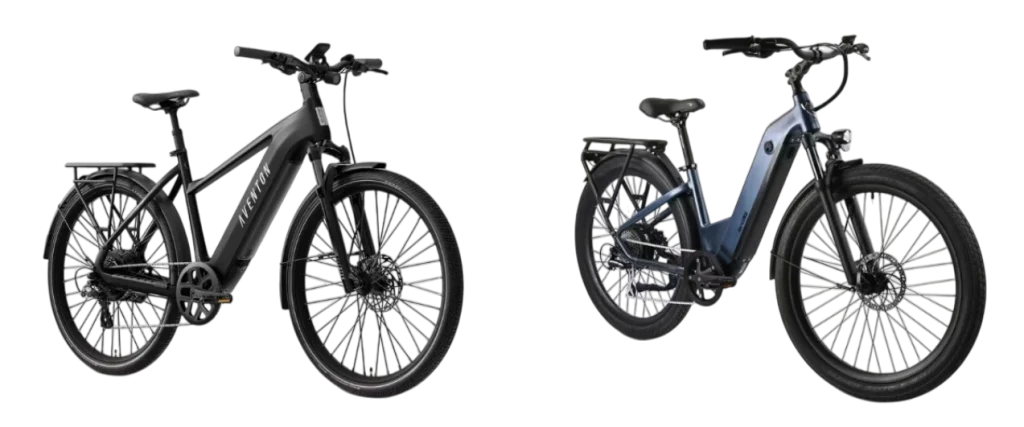
Commuter E-Bikes: Aventon Level 4 REC vs Ride1Up Vorsa
This is a much cleaner 2026 matchup than the older Level 3 comparison because both bikes are current offerings.
Aventon’s Level 4 REC is built around a 750W hub motor with 80Nm of torque and additional Boost capability. It uses a large 733Wh battery and is rated for up to 75 miles of range.
The Level 4 REC also brings connected security, integrated commuter equipment, hydraulic brakes, lighting, and Aventon’s newer smart-bike technology.
Ride1Up’s Vorsa takes the utility-first route. Its 750W hub motor produces 95Nm of torque, while the bike is designed to handle heavier loads and practical daily transportation.
It also offers a modular rear rack system, torque and cadence sensing options, and Apple Find My integration.
Winner: Split
The Level 4 REC wins for integrated security, connected features, and polished commuter equipment.
The Vorsa wins for payload capacity, utility, and strong raw torque.
If you regularly carry passengers or heavier cargo, the Vorsa becomes especially compelling.
Folding E-Bikes: Aventon’s Current Lineup vs Ride1Up Portola 02
This category has changed, and it is important not to force an outdated Aventon model into a 2026 comparison.
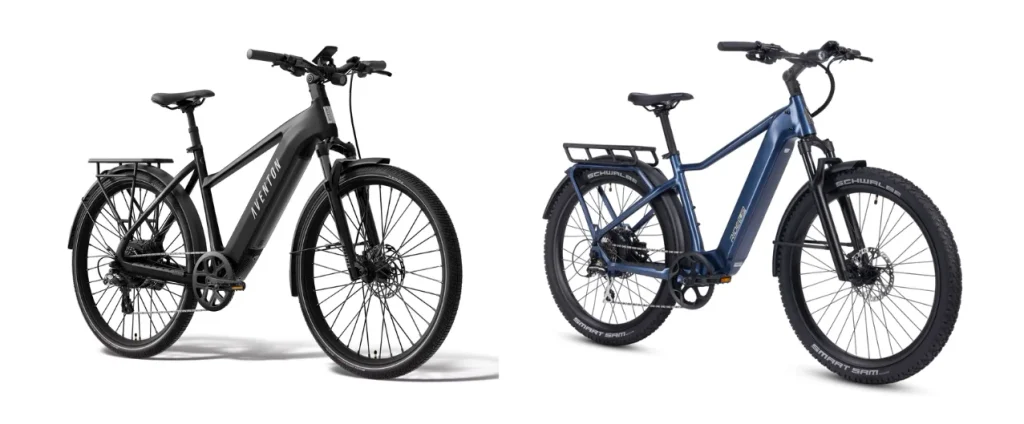
Aventon’s current lineup does not list a folding e-bike for sale, while Ride1Up currently offers the Portola 02 as a current folding model.
Ride1Up’s Portola 02 uses a 750W sustained hub motor with 90Nm of torque, a torque-or-cadence pedal-assist system, a 3.5-inch color display, hydraulic disc brakes, and a folding frame.
The 10Ah version is rated for 25-45 miles, while the 15Ah version is rated for 30-60 miles, depending on rider weight, terrain, incline, and assist level.
It can also be configured as a Class 1, Class 2, or Class 3 e-bike.
Winner: Ride1Up
There is no meaningful current-model matchup here. If folding capability is a requirement, Ride1Up has the clear advantage because it currently has a folding model available.
Lightweight City E-Bikes: Aventon Soltera vs Ride1Up Roadster V3
Both brands offer genuinely lightweight options built to feel closer to traditional bicycles.
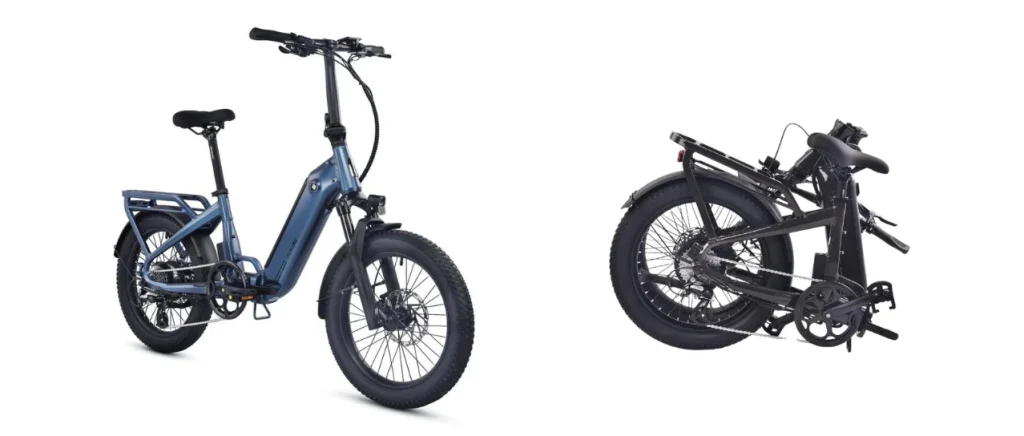
Aventon’s Soltera line includes the Soltera 3 ADV, which uses a Gates Carbon Belt Drive and weighs around 37 pounds, as well as the Soltera 2.5 with a traditional drivetrain and removable battery.
Our Aventon Soltera 2.5 review covers that version in more detail.
Ride1Up’s Roadster V3 takes a similar lightweight approach, weighing around 40 pounds, but gives buyers drivetrain flexibility.
You can choose a silent belt-drive setup or a 9-speed chain-drive configuration, depending on how you want the bike to ride.
It uses a 500W Mivice hub motor with a torque sensor and is designed to maintain a more traditional bicycle feel.
Winner: Ride1Up
The Roadster V3’s drivetrain choice is a genuinely useful advantage, and Ride1Up continues to offer an attractive combination of low weight and performance.
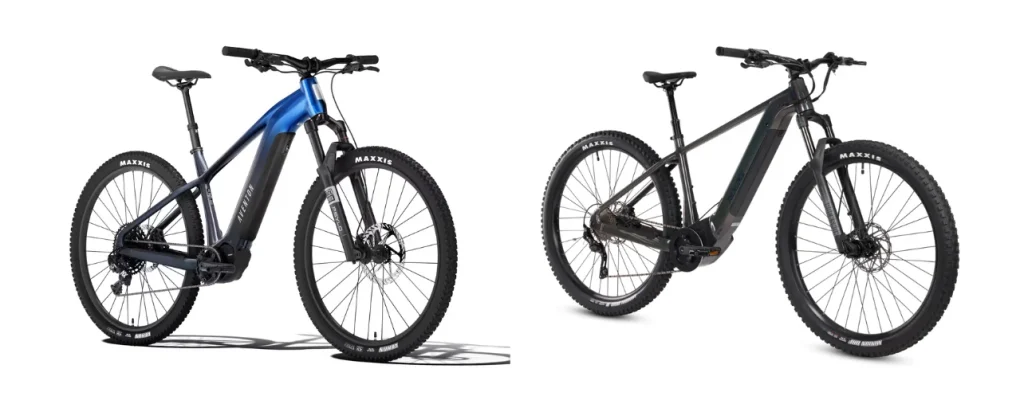
Electric Mountain Bikes: Aventon Ramblas vs Ride1Up TrailRush
This is one of the closest matchups between the two brands.
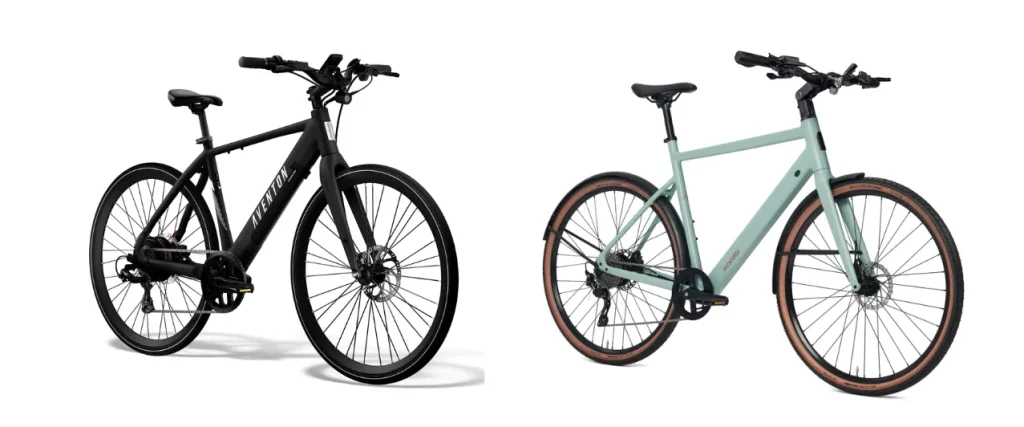
Aventon’s Ramblas runs the company’s A100 mid-drive motor with 100Nm of torque. It uses a RockShox suspension fork, SRAM hydraulic brakes, and a 12-speed drivetrain.
The Ramblas is a Class 1 electric mountain bike with no throttle and is designed around natural trail riding.
Our Aventon Ramblas ADV review covers its suspension and drivetrain in more detail.
Ride1Up’s TrailRush centers on the Brose TF Sprinter mid-drive motor, known for quiet and natural power delivery.
It comes with a RockShox Judy fork, four-piston hydraulic brakes, a Shimano Deore drivetrain, a dropper post, and tubeless-ready Maxxis tires.
That component package is difficult to ignore at its price.
Winner: Ride1Up
The TrailRush’s component specification, particularly its Brose motor and suspension hardware, gives it an impressive performance-per-dollar advantage.
Where the Two Brands Stop Overlapping
This is where each brand offers something the other genuinely doesn’t.
Aventon Builds Dedicated Cargo E-Bikes. Ride1Up Currently Doesn’t.
The Abound SR and Abound LR are dedicated cargo platforms designed around carrying people, groceries, equipment, or other loads.
They combine strong utility with Aventon’s connected security ecosystem.
Our Aventon Abound SR review covers how the platform handles under load.
For riders using an e-bike for actual work, our guide to the best electric bike accessories for delivery drivers is also worth a look.
Ride1Up’s Vorsa can handle utility duty reasonably well with its modular rack system, but it isn’t a dedicated longtail cargo platform in the same sense as the Abound.
Ride1Up Builds Moped-Style E-Bikes. Aventon Currently Doesn’t.
The Revv1 series gives Ride1Up a completely different identity in this category.
The bikes use a moped-inspired frame design and are available in multiple configurations, including Hardtail, Full Suspension, and DRT versions.
They target riders who want a heavier, more powerful, more motorcycle-inspired electric bike rather than a traditional bicycle format.
Aventon’s current lineup has no direct equivalent.
Winner: Split
Aventon wins on dedicated cargo capability.
Ride1Up wins on moped-style variety and unusual formats.
Value for Money
This category leans firmly toward Ride1Up.
Ride1Up’s entire brand strategy is built around maximizing spec-per-dollar, and it shows.
Large batteries, name-brand mid-drive motors, hydraulic brakes, suspension components, and utility features show up at prices that can get you noticeably less hardware from many competitors.
Aventon isn’t necessarily overpriced by comparison, but you’re paying a real premium for its connected ecosystem, dealer support, and integrated design.
For more context on where that extra money actually goes, our guide to why electric bikes are so expensive is worth a read.
Our roundup of the best electric bikes under $2,000 also shows how both brands compare with the wider market.
Winner: Ride1Up
If maximizing components and capability per dollar is the priority, Ride1Up is difficult to beat.
Customer Support and Dealer Network
This is one of the clearest differences between the two brands.
Aventon currently promotes a network of 2,000+ bike shops, giving customers opportunities to test ride bikes, get professional assembly, and receive in-person service.
Ride1Up remains primarily direct-to-consumer. Bikes ship to your door, and buyers handle much of the assembly themselves.
That doesn’t automatically make Ride1Up’s support poor. It simply means the ownership experience is different.
If you prefer having a local shop available when something goes wrong, Aventon’s model has a meaningful advantage.
Winner: Aventon
If in-person support, professional assembly, and test rides matter to you, Aventon’s dealer network is a real advantage.
Aventon vs Ride1Up: Category Winners
| Category | Winner | Why |
| Motor feel | Tie | Aventon refined, Ride1Up’s Brose motors excellent |
| Torque sensing | Tie | Both now offer strong torque-sensing options |
| Range and battery | Ride1Up | Strong battery capacity at competitive prices |
| Comfort | Tie | Different philosophies, both genuinely comfortable |
| Build quality | Aventon | Better overall fit, finish, and polish |
| Commuters | Split | Level 4 REC refinement vs Vorsa utility |
| Folding | Ride1Up | Portola 02 is the current folding option |
| Lightweight | Ride1Up | Roadster V3 offers low weight and drivetrain choice |
| Electric mountain bikes | Ride1Up | TrailRush’s component spec is exceptional value |
| Cargo | Aventon | Dedicated Abound platform |
| Unique formats | Ride1Up | Revv1 moped-style series |
| Smart security | Aventon | More complete GPS and connected ecosystem |
| Value for money | Ride1Up | Higher spec-per-dollar |
| Dealer support | Aventon | 2,000+ bike shops vs online-first purchasing |
Who Should Choose Ride1Up?
Ride1Up is probably the better choice if you want:
- The most components and capability for your money
- A genuine Brose mid-drive motor at a competitive price
- A current folding e-bike with strong utility and value
- The flexibility to choose different drivetrain configurations
- A moped-style e-bike, since Aventon doesn’t currently make one
- To assemble your own bike and handle support primarily online
Ride1Up makes the most sense if you’ve owned a bike before, feel comfortable with basic at-home assembly, and want to squeeze the most performance out of every dollar spent.
Who Should Choose Aventon?
Aventon may be the better choice if you want:
- The option to test ride before buying, thanks to its 2,000+ bike-shop network
- Integrated GPS tracking and app-based security
- A dedicated, purpose-built cargo bike
- Connected features and over-the-air updates on compatible models
- More consistent build quality and polish across the lineup
- Local, in-person support if something goes wrong
Aventon makes the most sense if you’re newer to e-bikes, want the reassurance of test riding first, or specifically need cargo capability or advanced smart security.
Aventon vs Ride1Up: Which Should You Buy?
So, Aventon vs Ride1Up: which is better?
For riders chasing the best possible spec sheet per dollar, Ride1Up currently has the edge in 2026, especially in the folding, lightweight, and electric mountain bike categories, where its component choices are particularly competitive.
That doesn’t make Aventon the weaker brand.
Aventon’s connected ecosystem, dealer network, and cargo lineup solve real problems that Ride1Up doesn’t address in the same way.
If you want to test ride before buying, need a dedicated cargo bike, or care about integrated GPS security, Aventon is the stronger choice regardless of the spec sheet.
If you’re still narrowing things down by speed class, our guides to the best Class 2 electric bikes and best Class 3 electric bikes can help, since both brands offer models across different speed configurations.
The Bottom Line
- Ride1Up wins overall for value, current folding availability, lightweight flexibility, and electric mountain bike performance.
- Aventon wins for smart security, dealer support, build polish, and dedicated cargo capability.
But the real takeaway is this:
Don’t pick the brand first. Pick the bike first.
Compare the specific Aventon and Ride1Up models that actually fit your budget, riding style, and use case.
- If you want the most performance for your money and don’t mind assembling your own bike, Ride1Up deserves serious consideration.
- If you want a genuine mid-drive eMTB at a competitive price, the TrailRush is one of the strongest value propositions in the category.
- If you need a dedicated cargo bike, Aventon’s Abound platform is currently the stronger option between these two brands.
- If integrated security and in-person support matter more than squeezing out every last specification, Aventon’s ecosystem is worth the premium.
There isn’t one universal winner here.
But once you match the right bike to how you actually plan to ride, the better choice tends to become obvious fairly quickly.