
If you’re comparing Aventon vs Rad Power in 2026, you’re looking at two of the most recognizable names in the electric bike market.
Both brands offer everything from affordable commuter e-bikes to more capable cargo, fat-tire, and performance models. But they approach the market from very different directions.
Aventon focuses more heavily on refined handling, torque-sensing pedal assist, integrated technology, and premium performance.
Rad Power Bikes puts more emphasis on practicality, accessibility, utility, and giving riders plenty of useful formats to choose from.
So which brand should you buy?
I’ve compared the current lineups across motor performance, torque sensing, range, comfort, build quality, smart features, commuting, fat tires, folding, cargo, and overall value.
How we evaluated: We focused on current manufacturer-listed models, specifications, pricing, features, and the different ways each brand approaches commuting, recreation, cargo, and off-road riding.
Here’s where each brand wins.
Aventon Vs Rad Power: Quick Comparison
| Category | Aventon | Rad Power |
| Best for | Refined ride quality and technology | Utility, accessibility, and value |
| Motor performance | Excellent, with hub and mid-drive options | Excellent 750W-class lineup |
| Torque sensing | Widely used across current lineup | Increasingly common on newer models |
| Ride feel | Sportier and more bicycle-like | Relaxed and utility-focused |
| Commuter e-bikes | Excellent | Excellent |
| Fat-tire e-bikes | Excellent | Excellent |
| Folding e-bikes | Limited current choice | Strong dedicated option |
| Cargo e-bikes | Excellent | Excellent |
| Mid-drive e-bikes | Major advantage | No comparable current lineup |
| Format variety | Strong | Excellent |
| Smart security | Excellent on newer models | Strong on newer premium models |
| Budget value | Very good | Excellent |
| Best overall for | Riders prioritizing refinement | Riders prioritizing practicality |
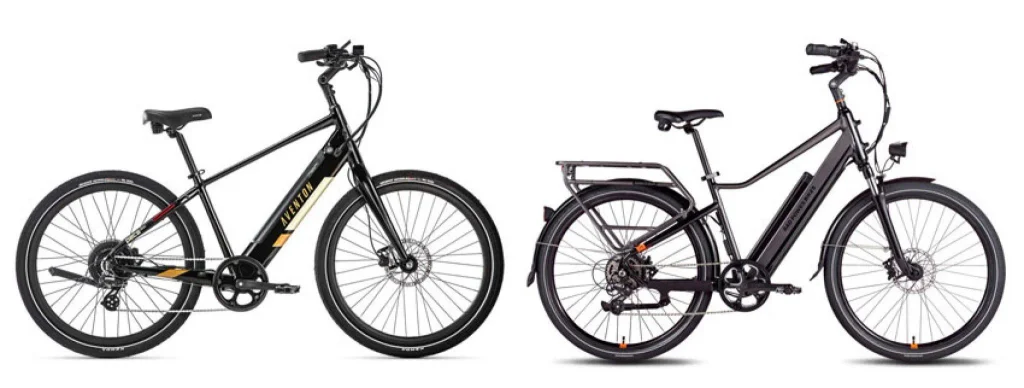
What’s the Difference Between Aventon and Rad Power?
The easiest way to understand Aventon vs Rad Power is to look at the types of riders each brand is trying to attract.
Aventon’s current lineup ranges from lightweight city bikes such as the Soltera 2.5 and Soltera 3 ADV to commuter models such as the Level 4 REC and Level 4 ADV, fat-tire models such as the Aventure 3 and Aventure M, cargo bikes such as the Abound LR and Abound SR, and mid-drive performance bikes such as the Ramblas ADV and Current series.
If you’re deciding between Aventon’s different models first, our guide to Which Aventon Electric Bike Is Best for You? can help narrow things down.
Rad Power takes a more utility-focused approach. Its current catalog includes models such as the RadRunner, RadRunner Max, RadWagon 5, Radster Road, Radster Trail, and RadExpand 5 Plus.
That gives Rad Power a particularly strong selection for riders who want cargo, utility, folding, or fat-tire capability.
The important point is that neither brand is simply “better.”
They are increasingly designed for different buyers.
Motor Power: Aventon Vs Rad Power
Both brands use plenty of 750W-class hub motors, so comparing the wattage alone doesn’t tell you much.
Aventon’s current lineup includes 750W hub-drive models such as the Level 4 REC and Aventure 3. Aventon also goes significantly further up the performance ladder with mid-drive models such as the Level 4 ADV, Aventure M, Ramblas ADV, and Current series.
Rad Power also has a strong 750W-class lineup. The Radster Road, Radster Trail, RadWagon 5, and RadRunner Max all put serious motor power into their respective categories.
But there is an important difference.
Aventon gives you more choices if you want to move beyond a conventional rear-hub motor.
The Level 4 ADV uses a 100Nm mid-drive motor, while the Ramblas ADV uses a 100Nm mid-drive system for mountain biking. The Current ADV and Current EXP move even further into full-suspension trail territory.
Rad Power doesn’t currently offer a comparable mid-drive lineup.
Also, don’t assume that a higher wattage automatically means a faster e-bike. Controller programming, torque, gearing, rider weight, terrain, and the bike’s speed settings all matter.
Our guide to How Fast Does a 750W Electric Bike Go? explains why motor wattage doesn’t tell the entire story.
Winner: Aventon for performance variety
Rad Power remains very competitive if you simply want a powerful hub-motor e-bike for commuting or utility riding.
But Aventon gives you more room to move into higher-performance territory.
Torque Sensors and Ride Feel
This is one of the biggest differences between the brands.
A cadence sensor basically detects whether you’re pedaling. Once you start pedaling, the motor provides assistance according to the selected level.
A torque sensor works differently. It measures how hard you’re pushing the pedals and adjusts motor assistance accordingly.
Pedal harder and you get more assistance. Ease off and the motor responds accordingly.
If you’re unfamiliar with the technology, our guide to What Is Pedal Assist on an Electric Bike? explains the difference in more detail.
Aventon has made torque sensing a major part of its current lineup. That gives many of its bikes a more natural, bicycle-like feeling when accelerating and climbing.
Rad Power has also moved further toward torque sensing in its newer models. The Radster Road, Radster Trail, and RadRunner Max, for example, offer more sophisticated power delivery than some of the older Rad models.
The difference is that Rad Power’s transition toward torque sensing is more selective across the lineup.
Winner: Aventon
If natural pedal response is one of your biggest priorities, Aventon still has the stronger overall position.
Range and Battery Size
Range is one area where it’s easy to get fooled by manufacturer claims.
Aventon currently has some impressive range figures. The Level 4 ADV is rated for up to 110 miles, while models such as the Aventure 3 and Level 4 REC are rated for up to 65 and 75 miles respectively.
Rad Power also offers several bikes with claimed ranges of 60+ miles, including the RadExpand 5 Plus, RadWagon 5, RadRunner Max, Radster Road, and Radster Trail.
But advertised range isn’t necessarily real-world range.
Your actual range depends on:
- Rider weight
- Terrain
- Wind
- Temperature
- Tire pressure
- Assist level
- Average speed
- Throttle use
- Cargo weight
A rider carrying heavy cargo uphill at high assist levels will get very different results from a lighter rider cruising on flat pavement.
If you’re a heavier rider, our guide to The Best Electric Bikes for Heavy Riders is worth reading because payload capacity and battery size can make a major difference.
Winner: Tie
Both brands offer long-range options. The better choice depends more on the specific model than the badge on the frame.
Comfort and Ride Quality
This is where the personalities of Aventon and Rad Power become obvious.
Aventon generally leans toward a more traditional bicycle feel. Steering tends to feel more responsive, and many of its frames have a sportier riding position.
Rad Power generally leans toward comfort and utility.
Its bikes often have more upright riding positions, wider tires, and designs that prioritize stability and approachability.
That makes Rad Power particularly appealing to newer riders who don’t want an aggressive riding position.
The difference can be summed up pretty simply:
- If you want an e-bike that feels more like a conventional bicycle with a motor, Aventon usually has the advantage.
- If you want a relaxed, upright, stable ride, Rad Power is often the better fit.
Winner: Aventon for ride refinement, Rad Power for relaxed comfort
Neither approach is wrong. It comes down to how you want your electric bike to feel.
Build Quality and Durability
Both companies have built increasingly sophisticated e-bikes, but their priorities are somewhat different.
Aventon tends to emphasize frame integration, clean cable routing, modern styling, and a more polished overall appearance.
Rad Power’s designs are generally more utilitarian. The focus is less on making every component disappear into the frame and more on making the bike practical and easy to use.
That doesn’t automatically mean one brand is more reliable.
Long-term reliability depends on the individual model, maintenance, riding conditions, component quality, and how heavily the e-bike is used.
One thing worth considering is weight.
Many Rad Power bikes are fairly substantial, particularly the cargo and utility models. If you’ll regularly need to lift your e-bike into a vehicle or carry it up stairs, weight deserves more attention than it gets in many buying guides.
Winner: Aventon for refinement
Rad Power remains a strong choice when practicality matters more than a sleek, integrated appearance.
Security and Smart Features
Aventon has a clear advantage here.
Several of its newer models include connected features such as GPS tracking, app connectivity, and integrated anti-theft technology.
This is particularly useful if you’re commuting in an area where leaving an expensive e-bike unattended is a concern.
Rad Power has also improved its smart features, especially on newer premium models such as the RadRunner Max.
Still, Aventon’s current lineup puts more emphasis on connected security and technology.
That doesn’t mean a Rad Power bike is unsafe. It simply means you’ll generally rely more heavily on conventional physical security measures.
Winner: Aventon
If GPS, app connectivity, and integrated anti-theft features are high on your list, Aventon is the stronger choice.
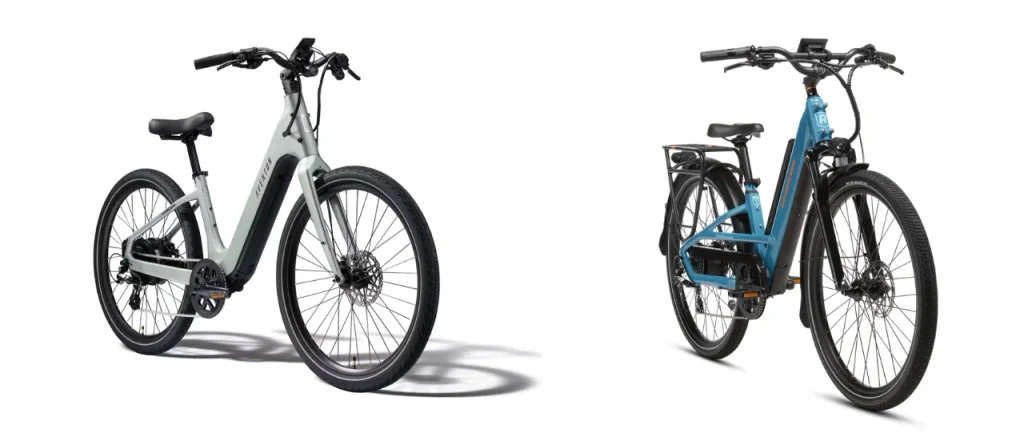
Aventon Vs Rad Power: Commuter E-Bikes
Commuting is one of the strongest categories for both brands.
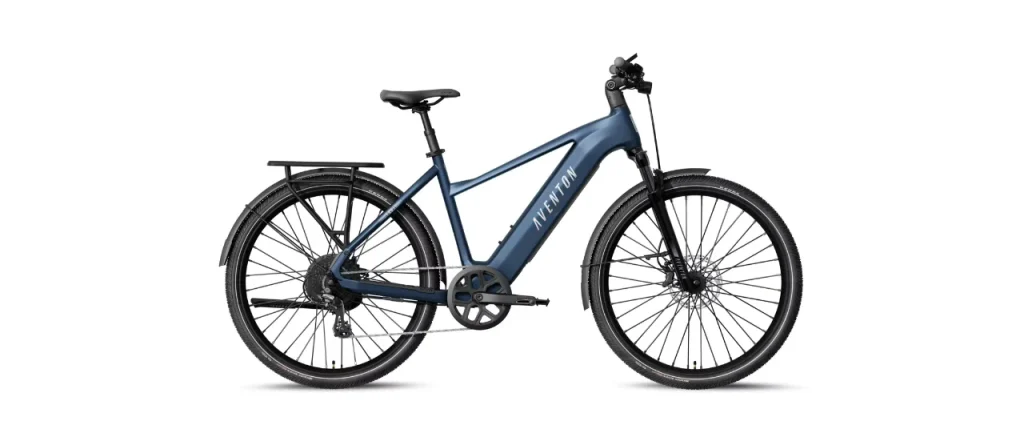
Aventon’s current Level 4 lineup gives riders two very different choices.
The Level 4 REC uses a 750W hub-drive motor and combines it with comfort-focused equipment, a torque sensor, connected security, and a suspension fork.
The Level 4 ADV moves into mid-drive territory with a 100Nm motor and Autoshift technology.
Aventon also offers the Pace 5 REC for riders who want a more comfort-oriented road and city bike.
Rad Power’s Radster Road is one of its strongest current commuter options. It combines a 750W motor, 28 mph top speed, long claimed range, and torque sensing in a relatively straightforward package.
That makes this a very close category.
Winner: Aventon for refinement, Rad Power for utility and value
If you’re interested in a lightweight commuter, the Aventon Soltera 2.5 Review takes a closer look at one of Aventon’s simpler current city e-bikes.
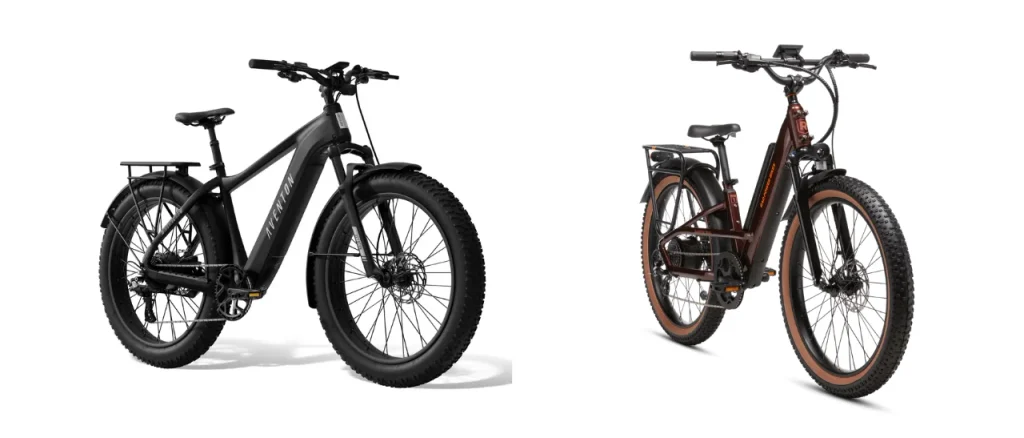
Fat-Tire E-Bikes: Aventure 3 vs Radster Trail
Fat-tire e-bikes are another area where both brands are competitive.
Aventon’s Aventure 3 uses 4-inch all-terrain tires and a powerful 750W-class motor with up to 1440W of peak power. It is designed to handle pavement, gravel, dirt, and other less-than-perfect surfaces.
Aventon also offers the Aventure M, which takes the concept further with a 100Nm mid-drive motor.
Rad Power’s Radster Trail is its current off-road-focused option. It combines a 750W motor, 28 mph top speed, 65+ mile claimed range, and a 370-pound payload capacity.
The Radster Trail is especially interesting if you want a more aggressive fat-tire bike without moving into the price territory of a full mid-drive eMTB.
For a wider look at the category, see The Best Fat-Tire Electric Bikes.
Winner: Tie
Aventon has the stronger premium and mid-drive options, while Rad Power has a very compelling utility-oriented alternative.
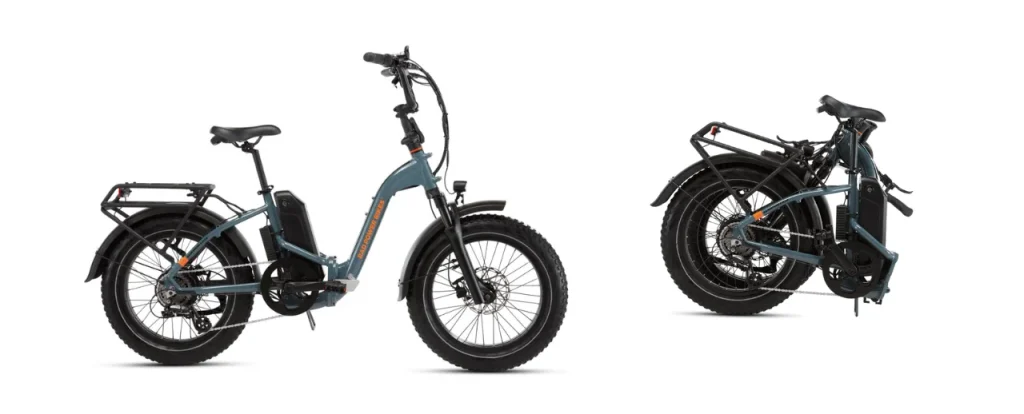
Folding E-Bikes: Aventon’s Lineup vs RadExpand 5 Plus
This is one category where Rad Power has a clear advantage.
Aventon does not currently have a comparable actively marketed folding e-bike in its current lineup.
Rad Power does.
The RadExpand 5 Plus is a dedicated folding e-bike with 20 x 4-inch fat tires, a suspension fork, torque sensing, and a 750W motor.
It also offers a 60+ mile claimed range and folds for easier storage and transportation.
Our RadExpand 5 Plus Electric Folding Bike Review looks at its motor, suspension, folding mechanism, range, and real-world trade-offs in more detail.
Winner: Rad Power
If folding is a requirement, this isn’t a particularly difficult decision.
Rad Power has the stronger current option.
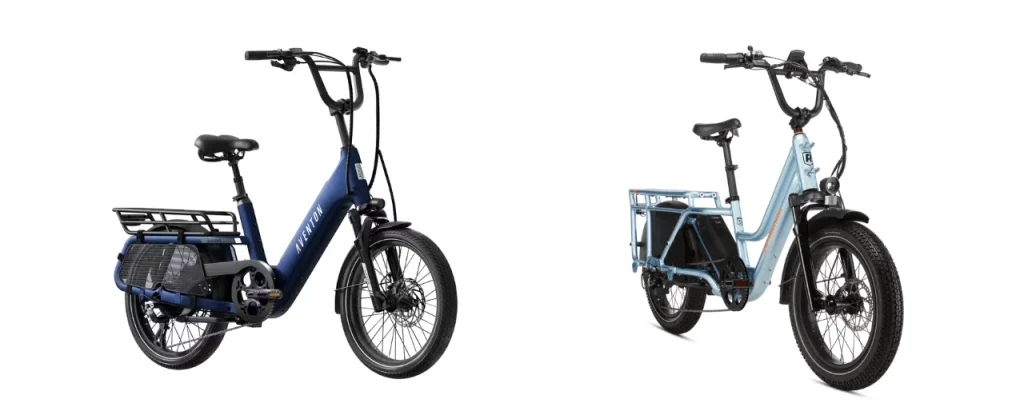
Cargo E-Bikes: Abound vs RadWagon and RadRunner
Cargo is another category where Rad Power’s broader utility focus becomes obvious.
Aventon’s Abound LR and Abound SR give the brand strong cargo options.
The Abound LR is designed to carry up to two passengers, while the Abound SR takes a more compact approach and is designed around carrying a single passenger.
Rad Power approaches cargo differently.
The RadWagon 5 is a traditional longtail cargo e-bike designed for serious hauling and passenger use.
The RadRunner is more compact and blends cargo and utility-bike characteristics.
The RadRunner Max takes that basic formula and adds substantially more performance and technology.
That gives Rad Power more ways to approach the cargo category.
If you’re using an e-bike for deliveries, our guide to The Best Electric Bike Accessories for Delivery Drivers covers some of the equipment that can make a big difference.
You can also read our Aventon Abound SR Review for a closer look at Aventon’s compact cargo platform.
Winner: Rad Power for variety, Aventon for refinement
Where the Two Brands Stop Overlapping
This is probably the most interesting part of the Aventon vs Rad Power comparison.
At a certain point, the two brands simply stop competing for the same buyer.
Aventon offers genuine mid-drive electric bikes.
The Ramblas ADV is a hardtail electric mountain bike with a 100Nm mid-drive motor and trail-oriented components.
Our Aventon Ramblas ADV Review takes a deeper look at the bike and its mid-drive system.
Aventon also goes significantly further with the Current ADV and Current EXP, which are full-suspension eMTBs using the company’s Ultro X mid-drive platform.
Rad Power does not currently have a direct equivalent.
That gives Aventon a major advantage for serious trail riding and riders who specifically want a mid-drive motor.
On the other hand, Rad Power has a much stronger focus on folding and utility formats.
So this part of the comparison is less about which company is better and more about what type of e-bike you need.
Winner: Split
Aventon wins for mid-drive performance.
Rad Power wins for practical utility formats.
Value for Money
This is arguably Rad Power’s strongest category.
Rad Power has built its reputation around making e-bikes accessible without requiring buyers to spend several thousand dollars.
Its current lineup includes relatively affordable options such as the RadRunner while also extending into more expensive models such as the RadRunner Max and RadWagon 5.
Aventon has moved further upmarket with models such as the Level 4 ADV, Aventure M, Ramblas ADV, and Current series.
You’re paying for things such as torque sensing, integrated technology, more advanced motors, connected security, and, in some cases, mid-drive performance.
That doesn’t necessarily make Aventon overpriced.
It simply means the two brands don’t always compete at the same price points.
If you’re wondering where the money goes when e-bikes get more expensive, our guide Why Are Electric Bikes So Expensive? breaks down the major cost factors.
Winner: Rad Power
For buyers focused primarily on getting the most useful e-bike for the least money, Rad Power remains very difficult to ignore.
Customer Support and Dealer Network
Both brands have moved beyond the idea of being purely online e-bike companies.
Aventon says it has more than 2,000 bike shops where customers can get test rides and service.
That is a meaningful advantage if you want to see an e-bike in person before spending your money.
Rad Power also has physical stores and service options, although the exact availability depends on where you live.
This is one category where local availability matters more than a nationwide number.
A brand may have hundreds or thousands of service locations, but what matters to you is whether there’s a qualified service option within reasonable driving distance.
Winner: Tie
I’d give Aventon a slight edge for its broad dealer presence, but your local area should ultimately determine the winner.
Aventon Vs Rad Power: Category Winners
| Category | Winner | Why |
| Motor performance | Aventon | More powerful mid-drive options |
| Motor utility | Rad Power | Strong 750W-class utility lineup |
| Torque sensing | Aventon | More consistently integrated across the current lineup |
| Range | Tie | Strong claimed ranges from both brands |
| Ride refinement | Aventon | More traditional bicycle-like feel |
| Comfort and accessibility | Rad Power | Relaxed and approachable designs |
| Build refinement | Aventon | More integrated and polished designs |
| Commuters | Aventon | Strong technology and ride quality |
| Fat-tire | Tie | Excellent choices on both sides |
| Folding | Rad Power | RadExpand 5 Plus |
| Cargo | Rad Power | More utility-oriented formats |
| Mid-drive | Aventon | Multiple current mid-drive models |
| Format variety | Rad Power | Strong utility and folding selection |
| Smart security | Aventon | Strong GPS and connected features |
| Value | Rad Power | More accessible pricing |
| Premium performance | Aventon | Stronger high-end performance lineup |
Who Should Choose Rad Power?
Rad Power is probably the better choice if you want:
- A practical first e-bike
- Strong value for your money
- A relaxed, upright riding position
- A dedicated folding e-bike
- A cargo-focused electric bike
- A utility-oriented e-bike
- A 750W-class hub motor
- A simpler ownership experience
- Multiple cargo and utility formats
Rad Power is particularly attractive if you’re buying your first electric bike or if you need a very specific format that Aventon doesn’t currently offer.
If your priority is practicality rather than having the most refined bike possible, Rad Power makes a lot of sense.
Who Should Choose Aventon?
Aventon may be the better choice if you want:
- A more traditional bicycle feel
- Torque-sensing pedal assist
- Integrated design
- Connected security features
- GPS tracking on supported models
- A premium commuter
- A lightweight city e-bike
- A fat-tire e-bike with more performance
- A mid-drive electric bike
- A genuine electric mountain bike
Aventon is also the better fit if you’ve already ridden a torque-sensing e-bike and don’t want to go back to a basic cadence-sensor experience.
Aventon Vs Rad Power: Which Should You Buy?
So, Aventon vs Rad Power: which is better?
The answer depends on what you value most.
If you’re a first-time buyer on a tight budget, I’d give Rad Power the edge for accessibility and utility.
The current lineup gives you several practical choices, from the RadRunner to the RadWagon 5, Radster models, and RadExpand 5 Plus.
Aventon becomes more attractive when you care about ride refinement, torque sensing, connected technology, or mid-drive performance.
The Level 4 ADV is particularly interesting for commuters who want a more advanced motor and automatic shifting, while the Ramblas ADV and Current models give Aventon a performance advantage that Rad Power simply doesn’t currently match.
Your preferred speed class can also help narrow the decision. Our guides to The Best Class 2 Electric Bikes and The Best Class 3 Electric Bikes are useful starting points.
And if your budget is the main factor, check out Best Electric Bike Under $1,500 and Best Electric Bikes Under $2,000 before making your decision.
The Bottom Line
Rad Power wins for value, utility, folding options, and cargo variety.
Aventon wins for ride refinement, torque-sensing performance, smart technology, and mid-drive capability.
But here’s the most important takeaway:
Don’t choose the brand first. Choose the bike first.
Compare the specific Aventon and Rad Power models that fit your budget, riding style, body size, and intended use.
If you’re brand new to e-biking and want a practical, affordable starting point, Rad Power deserves serious consideration.
If you want a folding e-bike, Rad Power currently has the stronger option.
If you need a cargo-focused bike, Rad Power gives you more utility-oriented choices.
If you want a premium commuter, stronger integration, or a mid-drive electric mountain bike, Aventon is the stronger choice.
And if you’re shopping specifically for cargo or delivery work, compare the Abound, RadRunner, and RadWagon based on how much cargo capacity, passenger space, and ride comfort you actually need.
There isn’t one universal winner.
But once you match the right electric bike to the way you actually plan to ride, the better choice becomes much easier to see.