
Aventon and Himiway are both well-known names in the electric bike market, but they take very different approaches to building e-bikes.
Aventon leans toward polished, commuter-friendly bikes with strong smart features, refined ride quality, and a large dealer network. Himiway, on the other hand, has built much of its reputation around powerful motors, fat tires, long-range batteries, and bikes designed for riders who want more capability for their money.
That makes an Aventon vs Himiway comparison more interesting than simply looking at motor wattage or battery capacity.
The Aventon Aventure 3 and Himiway D5 2.0 are both currently listed at $1,999, but they are aimed at somewhat different riders.
So which brand should you choose?
The answer depends on what you value most. If you want a refined everyday commuter with strong technology and dealer support, Aventon has the edge. If you want maximum power, suspension, payload capacity, and off-road capability, Himiway deserves a serious look.
Aventon vs Himiway: How We Evaluated
We compared the two brands based on the things that actually matter when choosing an electric bike, rather than simply counting watts.
The comparison considers motor performance, torque sensors, battery capacity, real-world range potential, ride comfort, build quality, security features, model variety, cargo capability, dealer support, and overall value.
We also looked at the current 2026 lineups instead of relying on older models that may no longer represent what either company sells today.
For individual bikes, we paid particular attention to similarly priced models. The Aventon Aventure 3 and Himiway D5 2.0 are especially useful examples because both are currently listed at $1,999 while taking noticeably different approaches to performance and ride feel.
For riders considering other brands, our comparisons of Aventon vs Specialized, Aventon vs Mokwheel, Aventon vs Trek, Aventon vs Ride1Up, Aventon vs Lectric, Aventon vs Rad Power, and Aventon vs Velotric can also help put the differences into perspective.
Aventon vs Himiway: Quick Comparison
| Category | Aventon | Himiway |
| Overall approach | Refined, commuter-focused, technology-driven | Powerful, rugged, adventure-focused |
| Featured mainstream pricing | From around $1,199 | Around $1,999 |
| Motor options | Hub and mid-drive | Hub and mid-drive |
| Torque sensors | Available on current models | Available on several current models |
| Fat-tire selection | Strong | Excellent |
| Lightweight bikes | Strong | More limited |
| Cargo bikes | Excellent | More limited |
| Folding bikes | Limited current overlap | Limited current overlap |
| Long-range options | Excellent | Excellent |
| Smart security | Excellent | Available on select models |
| Dealer network | 1,800+ bike shops | 1,000+ local shops advertised |
| Best for | Commuters, city riders, tech-focused buyers | Heavy riders, off-road riders, power-focused buyers |
| Value | Strong | Strong, especially for power and capacity |
There is no universal winner here.
Aventon generally feels like the more polished brand. Himiway often gives you more hardware for the money.
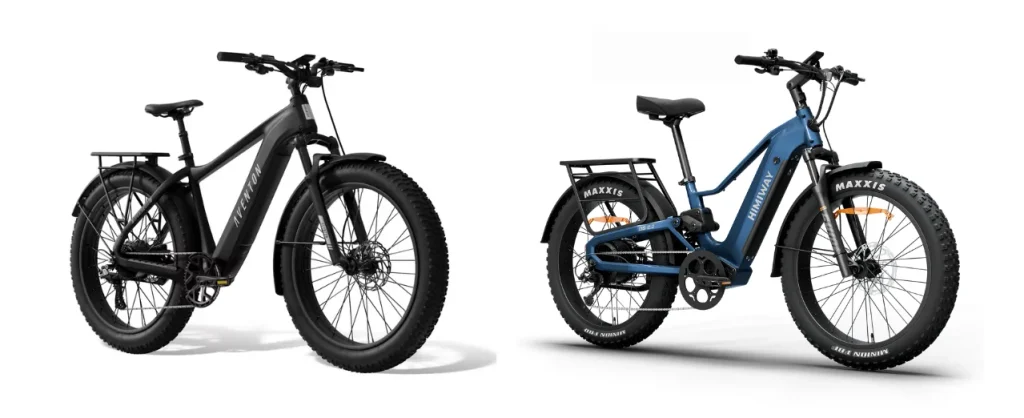
What’s the Difference Between Aventon and Himiway?
The biggest difference is philosophy.
Aventon has increasingly moved toward a complete ownership experience. Its newer bikes combine torque-sensing systems, integrated displays, app connectivity, GPS and theft protection on select models, refined frames, and a large network of bike shops.
That is particularly noticeable with bikes such as the Level 4 REC and Level 4 ADV.
Himiway takes a more performance-oriented approach. Its lineup includes powerful fat-tire bikes with large batteries, full suspension, high payload capacities, and motors designed for hills, trails, rough surfaces, and heavier riders.
The Himiway D7 Pro is a good example. It uses a 1,000W Bafang mid-drive motor rated at 160Nm of torque, a 960Wh battery, full suspension, 26 x 4.8-inch tires, and a 400-pound payload rating.
So the difference is not simply Aventon versus Himiway.
It is refinement versus brute capability in many parts of the lineup.
That distinction becomes important once you start comparing individual models.
Motor Power: Aventon vs Himiway
If motor power is your first priority, Himiway usually has the advantage.
The current Aventon lineup includes both hub-drive and mid-drive options. The Level 4 REC, for example, uses a rear hub motor with 80Nm of torque and up to 1,440W of peak power.
That is plenty for normal commuting, hills, paved bike paths, and everyday riding.
The Level 4 ADV moves into another category with a 100Nm Ultro S mid-drive motor. It also adds Shimano CUES 10-speed gearing and automatic shifting technology.
Himiway, meanwhile, has built its identity around high-output bikes.
The D5 2.0 uses a 750W motor producing 90Nm of torque. The D7 Pro goes much further with its 1,000W Bafang mid-drive and 160Nm of torque.
That extra torque matters when climbing steep hills, riding over loose surfaces, carrying additional weight, or riding off-road.
But more motor does not automatically mean a better bike.
For a daily city commute, the Aventon Level 4 REC can be more than powerful enough. For aggressive trail riding or riders who regularly carry a lot of weight, Himiway’s higher-output options become more attractive.
Torque Sensors and Ride Feel
This is one area where both brands have improved considerably.
A torque sensor measures how hard you are pedaling and adjusts motor assistance accordingly. The result is generally a more natural feeling ride than a basic cadence sensor provides.
Aventon’s newer bikes make good use of torque-sensing technology.
The bike responds to your pedaling effort instead of simply turning the motor on at a preset level. That makes acceleration feel smoother and makes it easier to control the bike around pedestrians, corners, and busy streets.
Himiway also offers torque-sensing systems on several current models, including bikes where riders can switch between torque and cadence-based assistance.
That gives Himiway an important advantage for riders who want to choose how the bike responds.
Overall, Aventon gets a slight edge for polished everyday ride feel, while Himiway offers more flexibility on some performance-oriented models.
If you are coming from a traditional bicycle, both brands have bikes that can feel surprisingly natural.
Range and Battery Size
Himiway has traditionally been very strong in battery capacity.
Large batteries are common throughout its lineup, particularly on its fat-tire and adventure-oriented models.
The D5 2.0, for example, uses a 48V 15Ah battery. Himiway rates it for up to 70 miles under ideal conditions.
The D7 Pro takes capacity considerably higher with a 960Wh battery and a claimed range of up to 80 miles.
Aventon is also competitive.
The Aventure 3 uses a 733Wh battery and is rated for up to 65 miles. The Level 4 REC uses the same 733Wh capacity and is rated for up to 75 miles.
Aventon also has models that push range considerably further. The Level 4 ADV is rated for up to 110 miles, while the Aventure M can reach up to 85 miles under the company’s testing conditions.
As always, advertised range should be treated as a maximum rather than a guarantee.
Rider weight, terrain, speed, temperature, tire pressure, assist level, wind, and stop-and-go riding can make a substantial difference.
For long-distance riding, both brands have excellent choices. Himiway simply tends to emphasize big batteries more heavily across its lineup.
Comfort and Ride Quality
Himiway has a clear advantage if your idea of comfort involves suspension and fat tires.
Many Himiway models use full suspension and wide tires. That combination can absorb rough pavement, gravel, dirt trails, potholes, and uneven surfaces better than a lightweight city e-bike.
The D5 2.0 is a good example.
Its full-suspension design and fat tires make it much more suited to rough terrain than a rigid city bike.
Aventon takes a different approach.
The company’s newer commuter bikes focus on controlled handling, upright riding positions, suspension forks, suspension seatposts on select models, and integrated accessories.
The Level 4 REC is particularly commuter-oriented.
For smooth pavement and city streets, Aventon can feel more nimble and easier to live with every day. For rough trails and broken surfaces, Himiway’s larger tires and suspension-heavy designs become increasingly attractive.
If comfort is your top priority, think about where you actually ride.
More suspension is not automatically better if most of your riding happens on smooth roads.
Build Quality and Durability
Both brands offer aluminum-frame electric bikes designed for everyday use, but the typical construction philosophy is different.
Aventon’s bikes often feel more integrated. Cables, displays, batteries, racks, lights, and other components are designed to work together as part of a complete package.
That gives the bikes a cleaner appearance and a more conventional bicycle feel.
Himiway tends to emphasize ruggedness and high-capacity hardware.
Fat tires, suspension systems, large batteries, powerful motors, and high payload ratings are common themes.
This makes Himiway particularly interesting for heavier riders.
If rider weight is one of your biggest concerns, our guide to the best electric bikes for heavy riders is worth reading alongside this comparison.
One thing to remember is that larger hardware usually means a heavier bicycle.
A Himiway may be more capable on rough terrain, but an Aventon can be easier to move, store, transport, and maneuver.
Security and Smart Features
This is one of Aventon’s strongest advantages.
Several newer Aventon models offer integrated smart security features, including GPS and 4G connectivity, unusual-activity alerts, electronic locking features, and other theft-prevention functions.
That is especially useful if you regularly leave an e-bike outside a coffee shop, workplace, apartment, or transit station.
Aventon has clearly invested in turning the e-bike into a connected device.
Himiway offers security features on select models, but smart connectivity is not as central to the brand’s identity.
The A7 Pro, for example, includes an ABUS rear-wheel lock, while Aventon’s newer connected bikes go further with app-based security technology.
If security technology is high on your list, Aventon gets the advantage.
If you care more about motor output and mechanical capability, Himiway becomes more competitive.
Commuter E-Bikes: Aventon Level 4 REC vs Himiway A7 Pro
Aventon is the better fit for most commuters.
The company has built a strong selection of bikes designed around daily transportation rather than simply recreational riding.
The Level 4 REC is a particularly good example.
It combines a 750W hub motor, 733Wh battery, suspension components, integrated accessories, and connected security features into a package designed for everyday use.
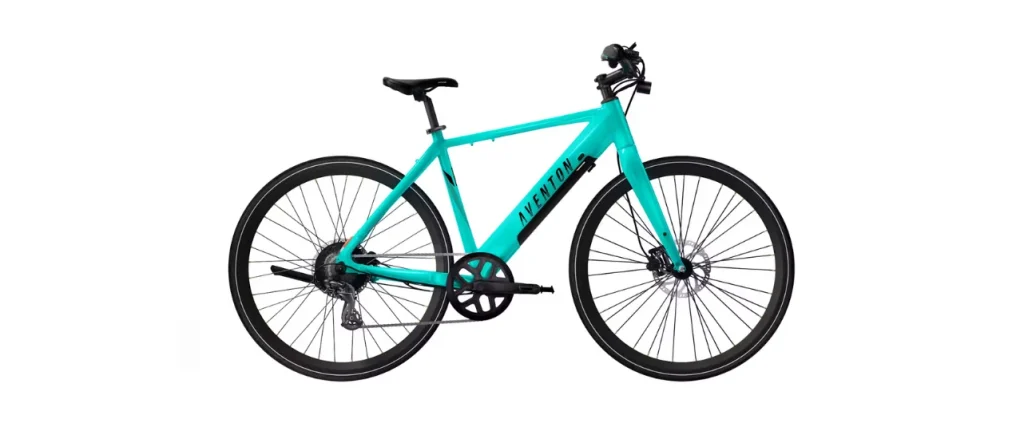
The Soltera 2.5 takes the lightweight approach.
At around 46 pounds, it is dramatically easier to handle than a typical fat-tire e-bike. Its 7-speed drivetrain and up-to-46-mile claimed range make it a better choice for riders who want something simple and relatively easy to carry.
If weight matters even more, the Soltera 3 ADV goes further with a belt drive and a much lighter frame.
Our Aventon Soltera 2.5 review goes into more detail about how this lightweight model performs.
Himiway does offer commuter-friendly models, particularly the A7 and A7 Pro.
The A7 Pro is particularly interesting because it combines a 500W mid-drive motor with 130Nm of torque, a 720Wh battery, full suspension, and a 300-pound payload. It is a premium commuter rather than a direct price match for the $1,999 Level 4 REC, with Himiway currently listing the A7 Pro at $2,899 and up to 50 miles of range.
That makes it much more powerful than the typical lightweight city e-bike.
Still, Aventon has the broader commuter-oriented lineup.
Winner: Aventon
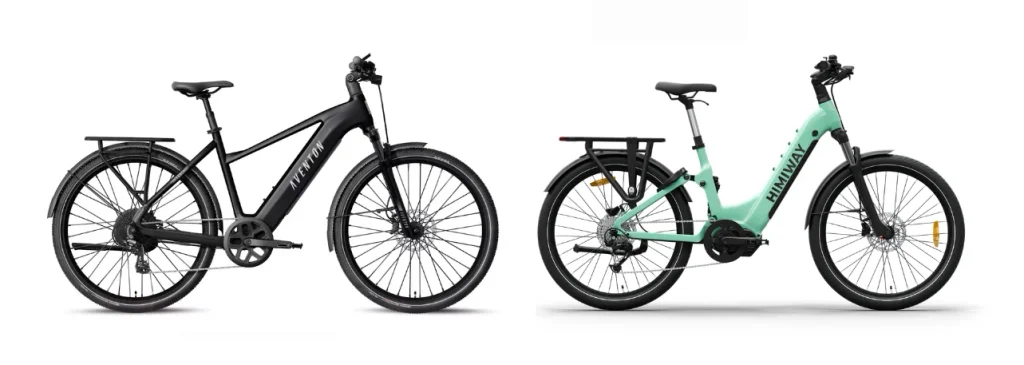
Lightweight City E-Bikes
This is another clear Aventon category win.
The Soltera family gives Aventon an option for riders who do not want a 70- to 80-pound electric bike.
The Soltera 2.5 weighs around 46 pounds. The Soltera 3 ADV goes even lower with a significantly lighter design.
That difference matters.
A lighter bike is easier to carry up stairs, load into a vehicle, maneuver around a garage, and store inside an apartment.
Himiway’s lineup is much more focused on power and capability.
Even its commuter-oriented bikes are generally heavier than Aventon’s lightweight models.
If your priorities are low weight, simple handling, and urban riding, Aventon is the obvious choice.
Winner: Aventon
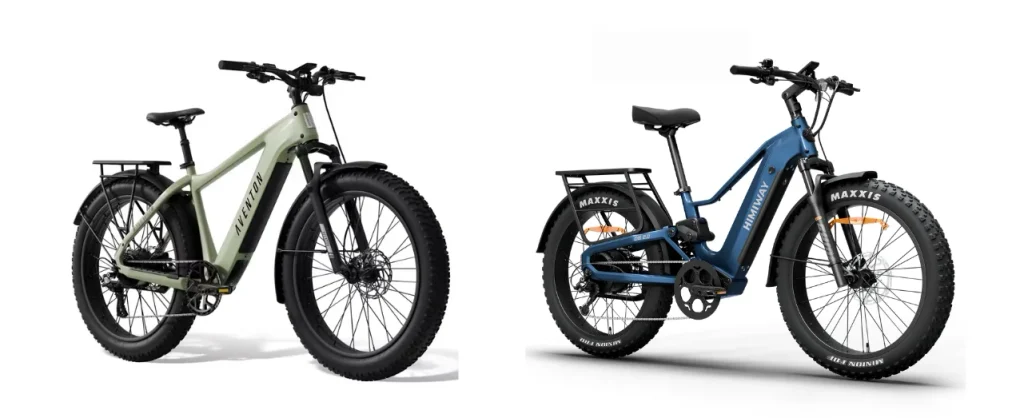
Fat-Tire E-Bikes: Aventon Aventure 3 vs Himiway D5 2.0
This is probably the most interesting head-to-head comparison.
The Aventon Aventure 3 and Himiway D5 2.0 are both currently listed at $1,999, but they emphasize different strengths.
| Specification | Aventon Aventure 3 | Himiway D5 2.0 |
| Motor | 750W hub | 750W hub |
| Peak power | Up to 1,440W | Not directly comparable by advertised peak figure |
| Torque | 80Nm | 90Nm |
| Battery | 733Wh | 720Wh |
| Claimed range | Up to 65 miles | Up to 70 miles |
| Tires | 26 x 4 inches | 26 x 4 inches |
| Suspension | Front suspension | Full suspension |
| Payload | 400 lbs total weight limit | 400 lbs payload |
| Smart security | GPS/4G features | More limited |
| Riding focus | Commuting and adventure | Adventure and rough terrain |
On paper, these bikes look surprisingly close.
In actual use, they feel different.
The Aventure 3 is more polished as an all-around electric bike. It has integrated smart security, a refined frame, a strong dealer network, and a more commuter-friendly overall package.
The D5 2.0 puts more emphasis on suspension and rugged riding.
Its 90Nm of torque, full-suspension setup, and 400-pound payload capacity make it appealing to riders who frequently leave paved roads or need more carrying capacity.
Our detailed Himiway D5 2.0 20-inch review covers the smaller-wheel version, which is especially interesting for shorter riders. The standard D5 2.0 is the better direct comparison with the Aventure 3 because both use 26-inch fat tires.
For more options, our guide to the best fat-tire electric bikes is also worth checking out.
Winner for commuting and smart features: Aventure 3
Winner for rough terrain and suspension: D5 2.0
Folding E-Bikes: Aventon vs Himiway
This is one category where you should not force a comparison that does not really exist.
Neither brand currently has a folding lineup that directly matches the established folding e-bike specialists.
Aventon has historically offered bikes that can work in compact urban environments, but its current lineup is increasingly centered around full-size commuter, city, fat-tire, cargo, and performance models.
Himiway is even more focused on larger full-size electric bikes.
If folding capability is your main requirement, you should look beyond these two brands.
Our guide to the best folding electric bikes is a better starting point because folding bikes are a specialized category where frame design, folded dimensions, hinge quality, and actual carrying weight matter more than motor wattage alone.
Winner: Neither
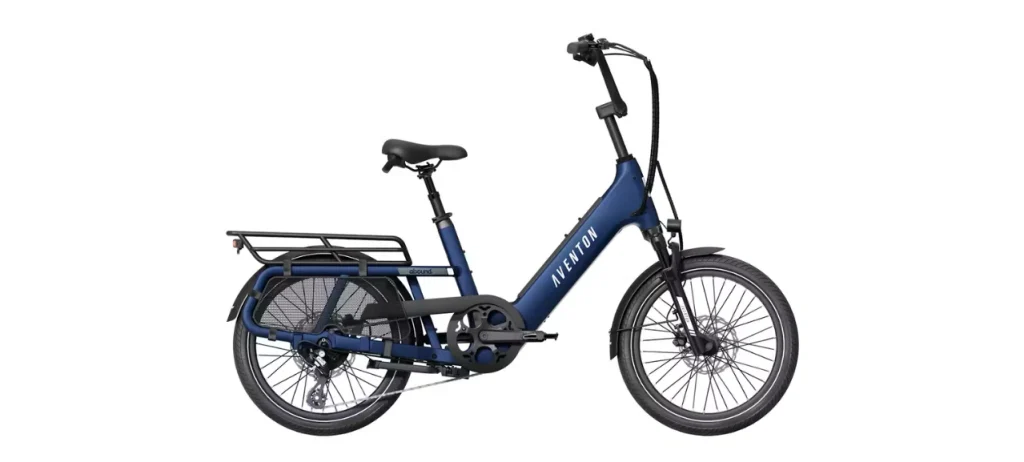
Cargo E-Bikes: Aventon Abound vs Himiway
Aventon has a major advantage here.
The Abound family is specifically designed for cargo use, with models such as the Abound SR and Abound LR built around carrying passengers, groceries, equipment, or other loads.
The Abound range also benefits from Aventon’s connected security technology and broader dealer support.
If you are considering an Abound, our Aventon Abound SR review provides a closer look at the bike.
Himiway has bikes with high payload capacities, but that is not the same thing as offering a dedicated cargo-bike platform.
A D7 Pro can carry a substantial load, for example, but its design is still fundamentally an adventure/mountain e-bike rather than a purpose-built long-tail cargo bike.
That distinction matters.
Cargo bikes need the right frame geometry, wheelbase, accessories, passenger equipment, and load distribution.
For families, grocery runs, and regular cargo hauling, Aventon is the better choice.
Winner: Aventon
Where the Two Brands Stop Overlapping
This is where the Aventon vs Himiway comparison becomes much more interesting.
At around $2,000, there are genuine alternatives between the two brands. But once you move higher into their respective lineups, the bikes begin serving very different riders.
Aventon’s Level 4 ADV is a good example.
It uses a 100Nm mid-drive motor, Shimano CUES 10-speed gearing, automatic shifting, an 800Wh battery, and a claimed range of up to 110 miles.
If you want to see how Aventon’s dedicated e-mountain-bike approach compares, our Aventon Ramblas ADV review takes a closer look at one of its more trail-focused models.
That is a technology-focused commuter and long-distance machine.
Himiway’s D7 Pro goes in another direction.
It uses a 1,000W Bafang mid-drive motor producing 160Nm of torque, a 960Wh battery, 26 x 4.8-inch tires, long-travel suspension, and a 400-pound payload rating.
It is not really competing with the Level 4 ADV for the same buyer.
The same is true with the Aventure M.
Aventon’s Aventure M uses a 100Nm mid-drive system and is rated for up to 85 miles. It is a more refined, premium fat-tire platform.
Himiway’s A7 Pro uses a 500W mid-drive motor with a much higher 130Nm torque figure, full suspension, and a 300-pound payload.
Again, the numbers tell only part of the story.
Aventon is increasingly building bikes around integration, connected technology, refined handling, and everyday usability.
Himiway continues to have a strong argument for riders who want big tires, high torque, suspension, high payload capacity, and off-road capability.
This is why simply asking which brand makes the “better” e-bike does not really work.
They are moving toward different definitions of what a better e-bike should be.
Value for Money
Himiway has traditionally had a strong value proposition.
You can get a lot of hardware for your money, particularly if you prioritize motor power, battery size, suspension, fat tires, and payload capacity.
The D5 2.0 is a good example. Around the $2,000 price point, it offers a 750W motor, 90Nm of torque, full suspension, fat tires, and a large battery.
Aventon takes a different approach to value.
You may not always get the biggest motor or the most aggressive suspension for the money, but you are paying for a more complete package.
That can include better integration, smart security, app connectivity, dealer support, refined components, and a more conventional bicycle feel.
This is particularly important because electric bikes are not simply motors and batteries.
If you want to understand why prices vary so much between e-bikes, our guide to why electric bikes are so expensive explains the major cost factors.
So who offers better value?
Himiway wins on hardware-per-dollar.
Aventon wins on the overall ownership package.
Customer Support and Dealer Network
This is an important advantage for Aventon.
Aventon currently advertises a network of more than 1,800 bike shops.
That gives customers more opportunities to see bikes in person, get professional service, and have problems diagnosed locally.
Himiway has also been expanding its physical presence and currently advertises more than 1,000 local shops.
That is a significant improvement over the traditional direct-to-consumer model.
Still, Aventon has the larger advertised network.
For a first-time e-bike buyer, local support can be worth paying for.
Electric bikes eventually need brake adjustments, tire changes, drivetrain maintenance, firmware updates, electrical troubleshooting, and other service.
If you live near an Aventon dealer, that can make the ownership experience considerably easier.
Winner: Aventon
Aventon vs Himiway: Category Winners
| Category | Winner | Why |
| Overall commuter | Aventon | Better integration and commuter-focused lineup |
| Motor power | Himiway | More high-output options |
| Torque | Himiway | Stronger maximum torque on performance models |
| Ride feel | Aventon | More refined and natural overall experience |
| Fat-tire/off-road | Himiway | Strong suspension and rugged hardware |
| Lightweight e-bikes | Aventon | Much lighter city options |
| Long range | Tie | Both offer high-capacity, long-range models |
| Smart security | Aventon | Stronger connected security system |
| Cargo | Aventon | Dedicated Abound cargo lineup |
| Heavy riders | Himiway | Excellent payload and high-torque options |
| Dealer network | Aventon | Larger advertised network |
| Hardware value | Himiway | More power and hardware for the money |
| Overall ownership experience | Aventon | Stronger integration and service ecosystem |
Who Should Choose Himiway?
Choose Himiway if you want an e-bike that emphasizes capability over minimal weight.
It makes particular sense for riders who:
- Want a powerful motor
- Ride steep hills regularly
- Spend significant time on dirt or gravel
- Want fat tires and full suspension
- Need a high payload capacity
- Are shopping for an e-bike for heavier riders
- Want a large battery
- Prefer maximum hardware for the money
- Do not mind riding a heavier electric bike
The D5 2.0 is an excellent example of this philosophy.
Move higher in the lineup and the D7 Pro becomes even more performance-oriented.
Himiway is also worth considering if you want a bike that feels more like an adventure machine than a traditional commuter bicycle.
Who Should Choose Aventon?
Choose Aventon if you want a more polished everyday ownership experience.
It makes particular sense for riders who:
- Mainly ride on paved roads
- Want a commuter or city e-bike
- Care about ride quality
- Want smart security features
- Prefer a lighter bike
- Want access to a large dealer network
- Need a dedicated cargo bike
- Want a more traditional bicycle feel
- Prefer integrated technology
- Want both hub-drive and refined mid-drive options
The Level 4 REC is a strong choice for everyday commuting.
The Level 4 ADV makes more sense if you want a premium mid-drive commuter with long range and automatic shifting.
And the Aventure 3 is a strong option if you want fat tires without moving completely into the rugged, adventure-oriented side of the market.
Our other Aventon comparisons, including Aventon vs Lectric, Aventon vs Rad Power, and Aventon vs Velotric, can help if you are still comparing brands.
Aventon vs Himiway: Which Should You Buy?
For most riders buying an electric bike primarily for commuting, errands, paved trails, and everyday transportation, I would choose Aventon.
The combination of refined ride quality, smart features, model variety, and dealer support makes it the safer all-around choice.
But if your priorities are different, Himiway can be the better buy.
If you want a powerful fat-tire e-bike with full suspension, high torque, a large battery, and a high payload capacity, Himiway offers some very compelling options.
The decision becomes especially easy when you match the bike to the job.
Choose Aventon if:
You want commuting, city riding, smart security, lighter models, cargo capability, and a large dealer network.
Choose Himiway if:
You want power, suspension, fat tires, high torque, off-road capability, and maximum hardware for your budget.
And if you are still undecided, do not limit yourself to these two brands. Our comparisons of Aventon vs Specialized, Aventon vs Trek, Aventon vs Ride1Up, and Aventon vs Mokwheel provide additional context.
The Bottom Line
Aventon and Himiway are both strong electric bike brands, but they are not trying to build exactly the same bikes.
Aventon is the better all-around choice for most commuters and city riders. Its current lineup feels more refined, its smart security technology is a major advantage, and its large dealer network makes ownership easier.
Himiway is the stronger choice for riders who care more about power and rugged capability.
Its high-torque motors, fat tires, suspension systems, large batteries, and high payload capacities make it especially appealing for heavier riders and people who regularly ride beyond smooth pavement.
If I had to pick one brand for the average electric bike buyer, Aventon gets the overall win.
If I were buying specifically for off-road riding, high payload capacity, or maximum motor performance, I would take a much closer look at Himiway.
In other words, Aventon wins the broader comparison, but Himiway can absolutely win the individual rider.