
If you’re comparing Aventon vs Mokwheel in 2026, you’ve stumbled onto one of the more interesting matchups in the direct-to-consumer e-bike space. Both brands sell online, both compete hard on power and price, and both have built loyal followings without the backing of a traditional bike-shop name.
But they’re chasing different riders.
- Aventon builds a polished, tech-integrated ecosystem: torque-sensing options across much of its current lineup, 4G-connected security on select models, and a large dealer network for test rides and service.
- Mokwheel puts more emphasis on raw power, large batteries, fat tires, and utility features such as solar charging and power-station functionality.
So which brand should you actually buy?
I compared the current 2026 lineups across motor performance, torque sensing, range, comfort, build quality, smart features, pricing, and the major categories where both brands actually compete.
How we evaluated: We looked at current specs, pricing, warranty terms, dealer and support networks, and real-world impressions from independent reviewers and long-term owners. The focus is on commuting, off-road capability, and everyday utility, not just numbers on a spec sheet.
Here’s where each brand wins.
Aventon vs Mokwheel: Quick Comparison
| Category | Aventon | Mokwheel |
| Best for | Tech, security, refinement, and dealer support | Raw power, fat tires, large batteries, and utility |
| Representative commuter | Level 4 REC | Tarmac |
| Representative fat-tire model | Aventure 3 | Basalt 2.0 |
| Representative mid-drive | Ramblas ADV | Onyx is hub-drive, not mid-drive |
| Motor output | Up to 750W hub-drive on major commuter/fat-tire models; 100Nm+ on current mid-drives | 750W-class hub motors with substantially higher peak output and torque on some models |
| Battery options | Up to 800Wh on Level 4 ADV; larger batteries on premium models | Up to 48V 19.6Ah, about 941Wh, on models such as Basalt 2.0 and Onyx |
| Claimed range | Up to 110 miles on Level 4 ADV | Up to 80 miles on some current models |
| Torque sensing | Common across much of the current lineup | Torque + cadence sensing on many current models |
| Smart security | 4G/GPS and app-based features on select models | Basic anti-theft features on some models |
| Cargo | Dedicated Abound LR and Abound SR | No direct longtail cargo equivalent |
| Fat-tire | Aventure 3 | Major part of the lineup |
| Unique formats | Mid-drive eMTBs, cargo bikes, lightweight city bikes | Solar charging, power-station bikes, electric trike, folding models |
| Dealer support | 2,000+ bike shops | Growing dealer network, but primarily DTC |
| Current price examples | Soltera 2.5 $1,199; Aventure 3 $1,999; Level 4 REC $1,999; Ramblas ADV $2,899 | FLINT ST $1,399; Tarmac $1,699; Basalt 2.0 $1,699; Onyx $3,299 |
| Overall value | Strong ownership experience and technology | Strong specs-per-dollar, especially for power and utility |
Aventon’s current lineup includes the Soltera 2.5, Aventure 3, Level 4 REC, Ramblas ADV and other models, while its website currently promotes 2,000+ bike shops for test rides and service. Mokwheel’s current product and comparison pages list models including Basalt 2.0, Obsidian 2.0, Onyx, Tarmac and FLINT.
What’s the Difference Between Aventon and Mokwheel?
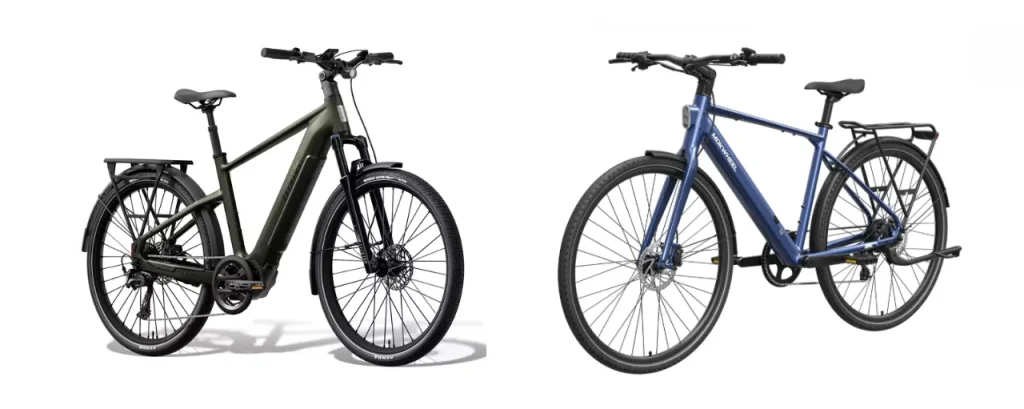
The easiest way to understand these two brands is to look at what each one is actually trying to sell you.
Aventon builds a cohesive, tech-forward ecosystem. Select current models use the Aventon Control Unit, which brings features such as 4G-connected GPS tracking, app-based ride data, and security functions. Aventon also sells through more than 2,000 bike shops, giving buyers the option to test ride and access service locally.
If you’re deciding between Aventon’s own models first, our guide to which Aventon electric bike is best for you is a good starting point.
Mokwheel takes a different approach. Its current lineup leans heavily toward high-output fat-tire bikes, large batteries, and utility-focused features. The Basalt 2.0, for example, combines a 750W motor with a roughly 941Wh battery and solar-charging compatibility. Other models push even further into high-output riding, while the brand also offers lightweight urban bikes such as the FLINT.
Mokwheel also sells unusual formats that you don’t find throughout Aventon’s lineup, including the Granite electric trike and folding models.
Neither brand is wrong here. They’re just optimizing for very different riders.
Motor Power: Aventon vs Mokwheel
Both brands offer powerful hub-motor e-bikes, but Mokwheel generally pushes harder on peak output and torque.
Aventon’s hub-motor bikes generally run from smaller city-bike motors up through 750W-class systems. The Aventure 3, for example, uses a 750W hub motor with up to 1,440W of peak power, while the Ramblas ADV uses Aventon’s A100 mid-drive motor with 100Nm of torque. Current Aventon mid-drive models go even higher in torque.
Mokwheel puts more emphasis on big output numbers. The Basalt 2.0 uses a 750W motor with a claimed 1,100W peak and 90Nm of torque. The Obsidian 2.0 goes to a claimed 1,300W peak with more than 105Nm, while the Onyx is listed at 750W with a claimed peak of 1,300W and more than 210Nm of torque.
Those numbers are impressive, but wattage and torque alone don’t tell the whole story. Motor tuning, gearing, weight, tire size, controller behavior, and whether the motor is a hub or mid-drive all affect how an e-bike actually feels.
If you’re comparing 750W-class bikes specifically, our guide to how fast a 750W electric bike can actually go explains why tuning and gearing matter just as much as the number on the spec sheet.
Winner: Mokwheel
If raw motor output and torque are the priority, Mokwheel has the stronger numbers across several of its current high-output models.
Torque Sensors and Ride Feel
Both brands have moved toward torque sensing, though the tuning and overall bike design remain different.
Our guide to what pedal assist is on an electric bike breaks down the difference between torque and cadence sensing if you want the full explanation.
Aventon uses torque sensing extensively across its current lineup. The result is generally a more bicycle-like response, where motor assistance changes naturally with how hard you’re pedaling. Select models also offer Sensor Switch functionality that gives riders more control over the assistance behavior.
Mokwheel uses torque-and-cadence sensing on many current models. The company’s newer 2.0-generation bikes have put more emphasis on smoother sensor response, which helps close the gap with more established torque-sensing systems.
The bigger difference is not simply whether both bikes have torque sensors. It’s how the motor, sensor, gearing, tires, frame, and weight work together.
Winner: Aventon
Aventon gets the edge for overall pedal-assist refinement and bicycle-like response. Mokwheel’s newer bikes are much more competitive here than some of its earlier models.
Range and Battery Size
This category tilts toward Mokwheel, especially if battery capacity is your main concern.
Aventon’s current lineup ranges from lightweight city bikes with smaller batteries to premium models with substantially larger packs. The Level 4 REC, for example, uses a 733Wh battery and is rated for up to 75 miles, while the Level 4 ADV uses an 800Wh battery and claims up to 110 miles.
Mokwheel puts particularly large batteries into several of its fat-tire bikes. The Basalt 2.0 uses a 48V 19.6Ah battery, which works out to roughly 941Wh. The Onyx uses the same nominal battery capacity and claims up to 60 to 80 miles of range.
That doesn’t mean a Mokwheel will automatically travel farther in real-world riding.
Actual range depends on:
- Rider weight
- Terrain and hills
- Wind and temperature
- Tire pressure
- Assist level and average speed
- Throttle use
- Cargo weight
A heavy fat-tire bike with an almost 1,000Wh battery can still consume energy quickly if you’re riding at high speed, climbing hills, or using the throttle heavily.
Independent testing is therefore more useful than simply comparing the biggest claimed range number.
Winner: Mokwheel
Mokwheel has the edge in battery capacity on several of its current models, particularly if you’re looking at large fat-tire bikes.
Comfort and Ride Quality
This is where the two brands’ personalities really diverge.
Aventon generally aims for a more bicycle-like riding experience. Its lineup includes commuter bikes, city bikes, fat-tire models, cargo bikes, and eMTBs, so comfort varies by model, but the overall riding position and handling tend to feel more familiar to traditional bicycle riders.
Mokwheel often builds bigger, heavier machines designed to remain stable over rough terrain. The Basalt 2.0 uses a 110mm adjustable front suspension fork and 4-inch tires, while the Obsidian 2.0 adds full suspension and an adjustable air shock.
That extra suspension and tire volume can be a major advantage on rough ground.
The trade-off is weight. Large Mokwheel fat-tire bikes can weigh around 80 pounds or more, which matters when lifting the bike onto a rack, moving it through a garage, or carrying it up steps.
Winner: Split
Aventon feels more agile and bicycle-like for everyday riding. Mokwheel feels more planted and capable when the terrain gets rough.
Build Quality and Durability
Both brands have improved their current-generation bikes, but they take somewhat different approaches.
Aventon generally has an edge in overall integration, frame design, cable management, and fit-and-finish. Its newer bikes also have a more unified design language across the lineup.
Mokwheel has made noticeable improvements in its newer models as well. The 2.0-generation bikes feature updated components and designs, while Mokwheel also emphasizes safety certifications and its two-year warranty.
The important point is that neither brand should be judged solely by one model. A lightweight FLINT is a very different machine from an 80-pound Basalt or Onyx.
Given how much heavier some Mokwheel bikes are, it’s worth checking how much the average electric bike weighs if portability is important to you.
Winner: Aventon
Aventon gets a slight edge for overall refinement and consistency of design, although Mokwheel has narrowed the gap with newer generations.
Security and Smart Features
Aventon has a clear advantage here.
The Aventon Control Unit brings features such as 4G-connected GPS tracking, unexpected-movement alerts, and other anti-theft functions to compatible current models. These features are managed through Aventon’s app ecosystem.
Mokwheel takes a simpler approach. Some current models offer anti-theft functions and detachable displays, but the brand’s technology focus is more heavily centered on power, utility, solar charging, and power-station functionality rather than integrated cellular tracking.
That’s a meaningful distinction if you regularly leave your e-bike outside a workplace, store it in a shared area, or use it for commuting.
Winner: Aventon
If integrated GPS tracking and app-based security matter to you, Aventon is the stronger choice.
Commuter E-Bikes: Aventon Level 4 REC vs Mokwheel Tarmac
Both brands offer genuine commuter options, but they arrive at the category from different directions.
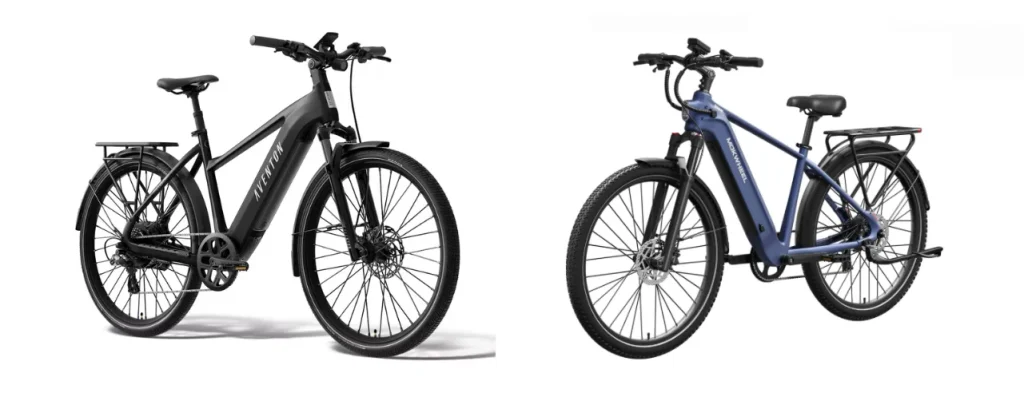
Aventon’s Level 4 REC uses a 750W hub-drive motor with up to 1,440W of peak power, a 733Wh battery, a torque sensor, suspension fork and seat post, regenerative braking, integrated lighting, and 4G/GPS security features.
For a detailed look at the current model, use our Aventon Level 4 REC review.
Mokwheel’s Tarmac uses a 750W motor with a claimed 920W peak output and 75Nm of torque. It also uses Mokwheel’s torque-and-cadence sensing system, an 80mm front suspension fork, integrated lighting, and turn signals.
The Tarmac is the more aggressive value play. The Level 4 REC feels more like a premium connected commuter.
Winner: Split
The Level 4 REC wins on smart security, connectivity, and overall refinement. The Tarmac offers strong motor output and comfort-focused equipment for less money.
Fat-Tire E-Bikes: Aventon Aventure 3 vs Mokwheel Basalt 2.0
This is arguably Mokwheel’s home turf, and it shows.
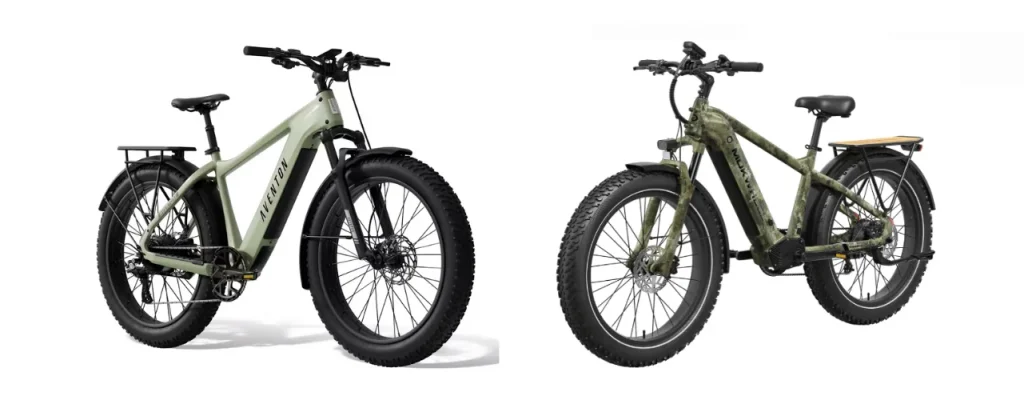
Aventon’s Aventure 3 uses a 750W hub motor with up to 1,440W of peak power, 80Nm of torque, 4-inch all-terrain tires, suspension, and integrated smart-security features.
If fat-tire capability matters to you beyond this matchup, our guide to the best fat-tire electric bikes covers the wider category.
Mokwheel’s Basalt 2.0 counters with a 750W motor, claimed 1,100W peak power and 90Nm of torque, a roughly 941Wh battery, 4-inch tires, a 110mm adjustable front suspension fork, and solar-charging compatibility.
It also supports the brand’s power-station concept, making it particularly interesting for camping, hunting, and off-grid use.
Winner: Mokwheel
The Basalt 2.0 combines a larger battery, higher claimed torque, and more unusual utility features. The Aventure 3 remains the more polished alternative for riders who want a fat-tire bike with Aventon’s connected ecosystem.
Off-Road and Full-Suspension: Aventon Ramblas ADV vs Mokwheel Obsidian 2.0
This matchup highlights a major structural difference between the brands.
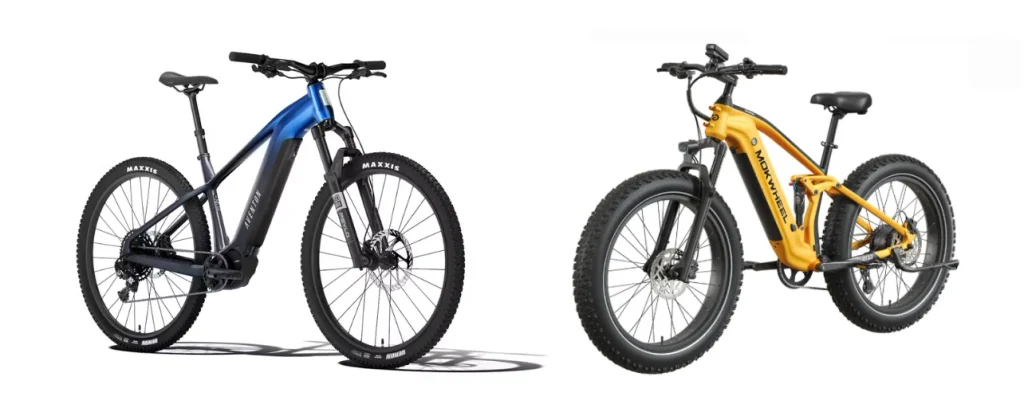
Aventon’s Ramblas ADV is a genuine hardtail electric mountain bike. It uses Aventon’s A100 mid-drive motor with 100Nm of torque, a suspension fork, a 12-speed SRAM drivetrain, and mountain-bike-oriented components.
Our Aventon Ramblas ADV review covers its suspension and drivetrain setup in more detail.
Mokwheel’s Obsidian 2.0 takes a completely different approach. It is a full-suspension fat-tire e-bike with a rear hub motor, claimed 1,300W peak output, more than 105Nm of torque, an adjustable air shock, and a 10-speed drivetrain.
The Obsidian 2.0 offers a lot of hardware for the money. But a high-powered hub-motor fat bike is not the same thing as a purpose-built mid-drive eMTB.
Winner: Split
The Ramblas ADV is the better choice for genuine mountain-bike riding and technical trails. The Obsidian 2.0 is more compelling if you want massive tires, full suspension, and high motor output at a relatively accessible price.
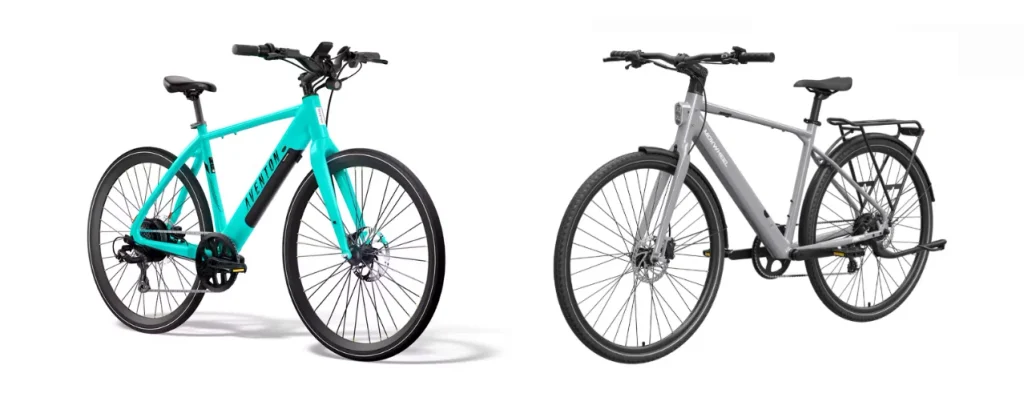
Budget E-Bikes: Aventon Soltera 2.5 vs Mokwheel FLINT
If price and weight are the deciding factors, this matchup is worth a close look.
Aventon’s Soltera 2.5 uses a 350W motor, torque sensing, a 7-speed drivetrain, and a lightweight design around 46 pounds. Aventon currently lists it at $1,199.
Our Aventon Soltera 2.5 review covers how that lighter design works in everyday riding.
Mokwheel’s FLINT is built around the lightweight urban category. The current FLINT lineup includes standard and ST versions as well as FLINT PRO models, with some configurations using Gates belt drives.
Mokwheel currently lists the FLINT ST at $1,399, while the broader FLINT family is positioned as a lightweight urban option with up to 50 miles of claimed range.
That makes this less of a simple price comparison and more of a choice between Aventon’s established lightweight city platform and Mokwheel’s newer urban-focused FLINT family.
Winner: Split
The Soltera 2.5 is the safer pick for a simple, lightweight city e-bike at a lower current list price. The FLINT becomes more interesting if you specifically want the newer platform or belt-drive configuration.
Where the Two Brands Stop Overlapping
This is where each brand offers something the other genuinely doesn’t.
Aventon builds dedicated cargo e-bikes. Mokwheel currently doesn’t have a direct longtail equivalent.
The Abound LR and Abound SR give Aventon a dedicated cargo platform built around carrying passengers and loads. Both also bring Aventon’s connected security features to the cargo category.
Our Aventon Abound SR review covers how the platform handles under load, and for riders using an e-bike for actual work, our guide to the best electric bike accessories for delivery drivers is also worth a look.
Mokwheel builds solar-charging, power-station e-bikes and an electric trike. Aventon doesn’t.
Mokwheel’s Basalt and Onyx families offer solar-charging compatibility and power-station functionality, while the brand also sells the Granite E-Trike.
That gives Mokwheel a very different identity from Aventon.
Winner: Split
Aventon wins for dedicated cargo capability. Mokwheel wins for off-grid power features and unusual formats.
Value for Money
This category leans toward Mokwheel, particularly for riders who prioritize motor output, battery capacity, and utility features over refinement.
Mokwheel’s current lineup spans everything from lightweight urban bikes to high-output fat-tire models. Current examples include the FLINT ST at $1,399, Tarmac at $1,699, Basalt 2.0 at $1,699, and Onyx at $3,299.
Aventon’s current lineup covers a broader spread as well, from the $1,199 Soltera 2.5 through the $1,999 Aventure 3 and Level 4 REC, up to premium models such as the Ramblas ADV and Level 4 ADV.
That makes the comparison more nuanced than simply saying one brand is cheap and the other is expensive.
For more context on where e-bike pricing generally goes, our guide to why electric bikes are so expensive is worth a read, and our roundup of the best electric bikes under $2,000 shows how both brands stack up against the wider market.
Winner: Mokwheel
Mokwheel generally gives power-focused buyers more motor and battery hardware for the money, particularly in the fat-tire category.
Customer Support and Dealer Network
Aventon has a major advantage here.
Aventon currently says it has 2,000+ bike shops, giving customers opportunities for test rides and in-person service. That’s a meaningful advantage over a brand that is primarily direct-to-consumer.
Mokwheel has been expanding its dealer presence and currently promotes dealers and test rides in the United States, but its sales model remains heavily online-focused.
For a buyer who is nervous about assembling an e-bike, wants to test ride before purchasing, or simply prefers having a local shop available, this difference matters.
Winner: Aventon
Aventon’s dealer network is one of the clearest reasons to pay attention to the brand beyond the raw specifications.
Aventon vs Mokwheel: Category Winners
| Category | Winner | Why |
| Motor power | Mokwheel | Higher claimed peak output and torque on several current models |
| Torque sensing | Aventon | More consistently bicycle-like pedal-assist response |
| Range and battery | Mokwheel | Larger battery capacities on several fat-tire models |
| Comfort | Split | Aventon lighter and more agile, Mokwheel more planted off-road |
| Build quality | Aventon | Slight edge in overall integration and refinement |
| Commuters | Split | Level 4 REC refinement vs Tarmac value and output |
| Fat-tire | Mokwheel | Larger battery, higher torque, solar/power features |
| Off-road/full suspension | Split | Ramblas mid-drive MTB design vs Obsidian power and suspension |
| Budget e-bikes | Split | Soltera is lighter and cheaper, FLINT offers a newer lightweight platform |
| Cargo | Aventon | Dedicated Abound platform |
| Unique formats | Mokwheel | Solar charging, power station, electric trike |
| Smart security | Aventon | Integrated 4G/GPS security on compatible models |
| Value for money | Mokwheel | Stronger raw specifications in several categories |
| Dealer support | Aventon | 2,000+ bike shops |
Who Should Choose Mokwheel?
Mokwheel is probably the better choice if you want:
- High motor output and torque for the price
- A genuinely large battery
- Solar charging or power-station functionality for camping, hunting, or off-grid use
- A fat-tire e-bike designed around rougher terrain
- An electric tricycle, since Aventon doesn’t currently offer one
- A full-suspension fat-tire bike without moving into traditional premium eMTB pricing
- A bike where raw specifications matter more than having the lightest or most bicycle-like ride
Mokwheel makes the most sense if you’re prioritizing power, battery capacity, utility, and unusual features over integrated security and dealer support.
Who Should Choose Aventon?
Aventon may be the better choice if you want:
- A lighter, more bicycle-like ride across much of the lineup
- Integrated 4G/GPS security on compatible models
- A dedicated cargo e-bike
- The option to test ride before buying
- Access to more than 2,000 bike shops
- A more polished and integrated ownership experience
- A genuine mid-drive electric mountain bike
- A broader mix of commuter, city, cargo, fat-tire, and performance models
Aventon makes the most sense if security, refinement, local support, and everyday ride quality matter more to you than chasing the biggest torque number.
Aventon vs Mokwheel: Which Should You Buy?
So, Aventon vs Mokwheel: which is better?
For riders chasing raw power, big batteries, and unusual features such as solar charging and power-station functionality, Mokwheel has the edge in several 2026 categories, especially fat-tire and utility-focused riding.
That doesn’t make Aventon the weaker brand.
Aventon’s smart security ecosystem, dealer network, cargo platform, and more bicycle-like riding experience solve real problems that Mokwheel’s lineup doesn’t address in the same way.
If you want to test ride before buying, need integrated theft protection, or specifically want a cargo bike, Aventon remains the stronger choice regardless of the spec sheet.
If you’re still narrowing things down by speed class, our guides to the best Class 2 electric bikes and the best Class 3 electric bikes can help, since both brands offer models across different configurations and categories.
The Bottom Line
- Mokwheel wins for raw power, large battery capacity, fat-tire utility, and unusual features such as solar charging and power-station functionality.
- Aventon wins for smart security, dealer support, build refinement, cargo capability, and a more bicycle-like riding experience.
- Both brands have strong options for commuters and off-road riders, but the best choice depends heavily on the specific model.
But the real takeaway is this:
Don’t pick the brand first. Pick the bike first.
Compare the specific Aventon and Mokwheel models that actually fit your budget, riding style, and use case.
- If you want the most motor and battery capability for your money, Mokwheel deserves serious consideration.
- If you’re hunting, camping, or riding off-grid regularly, Mokwheel’s solar and power-station features are genuinely unusual.
- If you need a dedicated cargo bike, Aventon’s Abound platform is currently the stronger option between these two brands.
- If integrated GPS security and in-person support matter more than chasing the highest torque number, Aventon’s ecosystem is worth the premium.
- If you want a genuine electric mountain bike rather than a powerful fat-tire e-bike, Aventon’s Ramblas ADV is the more purpose-built choice.
There isn’t one universal winner here either. But once you match the right bike to how you actually plan to ride, the better choice tends to become obvious fairly quickly.