
If you’re comparing Aventon vs Cyrusher in 2026, you’re looking at two e-bike brands that take noticeably different approaches.
Aventon has built a broad lineup around connected technology, commuter bikes, cargo e-bikes, fat-tire models, mid-drive bikes, and dedicated electric mountain bikes. Cyrusher puts more emphasis on fat tires, suspension, comfort, and all-terrain riding.
So which one deserves your money?
The answer depends heavily on the type of e-bike you want. Aventon offers more variety in motor systems, connected features, cargo bikes, and eMTBs, while Cyrusher focuses heavily on comfortable, suspension-equipped bikes for mixed surfaces and recreational riding.
I compared the two brands across motor power, torque sensors, range, comfort, build quality, security, commuting, lightweight riding, fat-tire performance, mountain biking, cargo, pricing, and ownership support.
If you’ve already read our comparisons of Aventon vs Fiido, Aventon vs Engwe, or Aventon vs Himiway, you’ll recognize the approach. The goal is not to force every rider into the same choice. It is to find the bike that fits how you actually ride.
How We Evaluated
We focused on models currently listed on the official Aventon and Cyrusher websites rather than older bikes that still appear in search results and outdated reviews.
We looked at motor configuration, torque, battery capacity, claimed range, sensor type, tires, suspension, brakes, smart features, carrying capability, pricing, warranty coverage, and support.
One important note about range: maximum range is a manufacturer claim, not a guarantee of real-world mileage. Rider weight, terrain, wind, temperature, tire pressure, cargo, assist level, and throttle use can all have a major effect on how far an e-bike actually travels.
Aventon Vs Cyrusher: Quick Comparison
| Category | Aventon | Cyrusher |
| Best known for | Connected technology, commuter bikes, cargo, eMTBs | Fat tires, suspension, comfort, all-terrain riding |
| Commuter example | Level 4 REC | Kommoda 3.0 |
| Lightweight example | Soltera 3 ADV | No direct equivalent |
| Fat-tire example | Aventure 3 | Ranger 2.0 |
| Mid-drive fat-tire example | Aventure M | No direct equivalent |
| Mountain-bike example | Ramblas ADV | Trax 2.0 |
| Cargo example | Abound SR / Abound LR | Glider |
| Motor choices | Hub-drive and mid-drive | Primarily hub-drive |
| Torque sensing | Used extensively across current models | Available on selected current models |
| Suspension focus | Model dependent | Major focus of the lineup |
| Smart security | 4G/GPS and anti-theft on supported models | More traditional approach |
| Dealer/service model | Large bike-shop network | Direct sales plus stores and service support |
| Warranty | Coverage varies by model and component | Two-year frame coverage, with shorter coverage on some components |
| Best suited to | Commuting, cargo, connected features, eMTB riding | Comfort, fat tires, suspension, mixed terrain |
Aventon’s current lineup is considerably broader, covering city bikes, commuters, cargo bikes, fat-tire models, mid-drive bikes, hardtail eMTBs, and full-suspension eMTBs. Cyrusher’s current lineup is more concentrated around comfortable, fat-tire, full-suspension, step-through, commuter, and cargo-oriented designs.
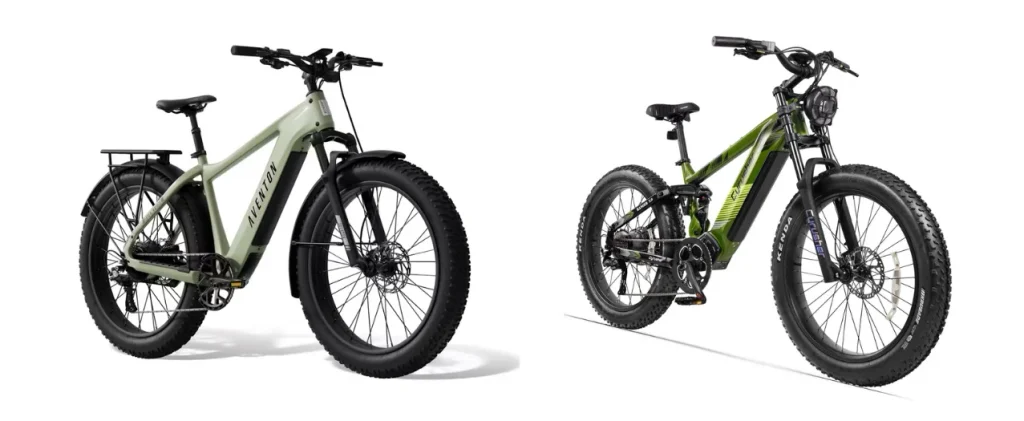
What’s the Difference Between Aventon and Cyrusher?
The biggest difference is philosophy.
Aventon is increasingly building an ecosystem around its e-bikes. Supported models can include ACU connectivity, 4G/GPS tracking, anti-theft functions, app integration, over-the-air updates, and ride customization.
Cyrusher puts more of the emphasis on the physical riding experience. Its current lineup includes wide tires, suspension systems, upright geometry, high-capacity batteries, and step-through frames designed around comfort and confidence on uneven surfaces.
That does not mean Aventon bikes are uncomfortable or Cyrusher bikes lack technology.
It simply means the brands prioritize different things.
Aventon gives you more ways to move between lightweight city riding, commuting, cargo hauling, fat-tire riding, and serious eMTB use. Cyrusher concentrates more heavily on making the ride feel substantial, stable, and cushioned.
For readers comparing Aventon with more traditional bicycle brands, our guides to Aventon vs Specialized, Aventon vs Trek, Aventon vs Giant, and Aventon vs Cannondale provide useful context.
Motor Power
Aventon has one of the more diverse motor selections in its current lineup.
The Level 4 REC uses a 750W hub-drive motor with up to 1,440W of peak power. The Aventure 3 also uses a 750W hub motor with 1,440W peak output and 80Nm of torque.
Then Aventon moves into mid-drive territory. The Aventure M uses a 100Nm mid-drive motor, while the Ramblas ADV also uses a 100Nm mid-drive system. The Level 4 ADV uses Aventon’s Ultro S mid-drive motor with up to 100Nm.
At the higher end, the Current ADV and Current EXP use the Ultro X mid-drive motor with up to 120Nm of torque. The Current ADV is a full-suspension trail eMTB, while the Current EXP adds a carbon full-suspension platform.
Cyrusher takes a different approach. Its current lineup is centered mainly around 750W hub-drive systems, including the Kommoda 3.0, Ranger 2.0, Trax 2.0, Path, Aura, Zenith, Roam, Sprint, and Glider.
The Ranger 2.0 and Trax 2.0 use 750W Bafang motors and are rated for up to 75 miles of claimed range. The Sprint is listed with a 750W motor producing 87Nm, while the Path uses a 750W motor with 85Nm.
So the important difference is not simply the wattage printed on the frame.
Aventon gives you a much wider choice between hub-drive and mid-drive systems. Cyrusher generally combines a powerful hub motor with fat tires, suspension, and a heavier all-terrain platform.
Torque Sensors and Ride Feel
Torque sensors measure how hard you are pressing the pedals and adjust motor assistance according to your input.
That usually creates a more natural feeling because the motor responds to how strongly you pedal rather than simply detecting that the pedals are turning.
Aventon has made torque sensing an important part of its newer lineup. The Aventure 3, for example, uses a torque sensor, while current Aventon platforms increasingly combine torque sensing with software-based ride customization.
The Abound SR is another interesting example because it gives riders different ways to tune the pedal-assist experience.
Cyrusher has also moved toward more natural pedal assistance on newer models. The Kommoda 3.0 uses a torque sensor alongside its 750W rear hub motor.
The difference here is less dramatic than it used to be. Both companies now offer models capable of producing a more natural pedal-assist experience.
For a more detailed explanation of how these systems work, our guide to what pedal assist is on an electric bike breaks down cadence and torque sensors in simple terms.
Range and Battery Size
Aventon offers strong claimed range across several categories.
The Level 4 REC is rated for up to 75 miles, while the Aventure 3 reaches up to 65 miles. The Aventure M is rated for up to 85 miles, and the Ramblas ADV reaches up to 90 miles.
The Level 4 ADV pushes the claimed figure to 110 miles, while the Current ADV and Current EXP are listed at up to 105 miles.
Cyrusher is competitive with several of its larger models.
The Kommoda 3.0 is rated for up to 68 miles. The Ranger 2.0 and Trax 2.0 reach up to 75 miles. The Roam is listed at 62 miles, while the Glider is also rated for up to 62 miles.
The Path, Aura, Zenith, and Sprint are listed around the 60-mile mark.
Battery size matters here because two bikes with similar claimed range can achieve that number in very different ways.
The Kommoda 3.0 uses a 48V 20Ah battery, while the Ranger 2.0 and Trax 2.0 use 52V 20Ah batteries.
Aventon also has some large-capacity options, but it spreads those batteries across a wider variety of bike types.
For riders who care about maximum claimed range, Aventon has several models that push beyond 90 or 100 miles. For riders who want a large battery combined with fat tires and full suspension, Cyrusher has some competitive options.
Comfort and Ride Quality
This is where Cyrusher’s design philosophy becomes especially obvious.
Many Cyrusher models use wide tires and suspension systems designed to absorb bumps, potholes, gravel, and uneven pavement. The Kommoda 3.0, Ranger 2.0, Trax 2.0, and Roam all use full-suspension layouts.
That gives Cyrusher bikes a substantial, planted feel.
The Kommoda 3.0 is particularly focused on easy access and comfort with its step-through frame. The Trax 2.0 also combines step-through access with full suspension.
Aventon has comfortable bikes too, but the company offers a much wider range of ride characteristics.
The Level 4 REC combines commuter geometry with a suspension fork and suspension seatpost. The Aventure 3 adds 4-inch fat tires, a suspension fork, and a suspension seatpost.
The Aventure M goes further with a mid-drive motor and 4-inch all-terrain tires.
Then there are Aventon’s eMTBs. The Ramblas ADV is a hardtail eMTB, while the Current ADV and Current EXP use full-suspension trail platforms.
So if comfort means plush suspension and wide tires, Cyrusher has more models built around that idea.
If comfort means choosing between lightweight city riding, commuter suspension, fat tires, and serious trail suspension, Aventon gives you more options.
Build Quality and Durability
Both brands use aluminum frames across much of their current lineup, but their priorities are different.
Aventon tends to integrate its electrical system and frame design around commuting, utility, and technology. The result is a lineup that ranges from the 37-pound Soltera 3 ADV to substantial cargo bikes and full-suspension eMTBs.
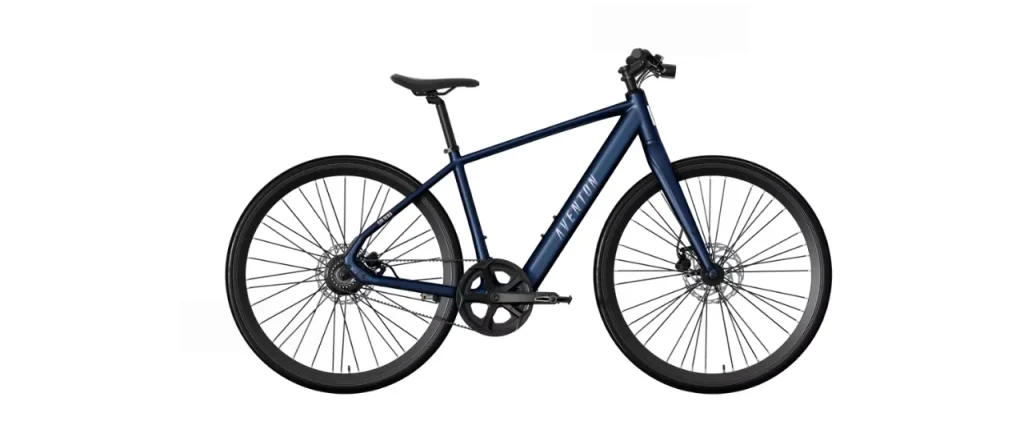
The Soltera 3 ADV is particularly different from the rest of the Aventon lineup. It weighs about 37 pounds and uses a belt drive, making it much easier to move and store than the larger fat-tire models.
Cyrusher generally builds heavier bikes.
That weight comes from the combination of wide tires, larger batteries, suspension components, and more substantial frames. The tradeoff is that these bikes can feel planted on rough surfaces, but they are less convenient to carry upstairs or load into smaller vehicles.
This is an important distinction that often gets lost when comparing motor wattage.
A 70- to 80-pound e-bike may be perfectly practical if it stays in a garage. It becomes a different proposition if you need to lift it into an apartment, onto a vehicle rack, or over a flight of stairs.
Security and Smart Features
This is one of Aventon’s clearest areas of differentiation.
Supported Aventon models use ACU technology to provide features such as 4G/GPS connectivity, anti-theft functions, tracking, and app-based controls.
The Aventure 3, for example, includes connected security features. The Level 4 REC and Level 4 ADV also include 4G/GPS and anti-theft functionality.
The Aventure M adds anti-theft functionality and Autoshift technology.
Cyrusher takes a simpler approach.
Its current lineup is primarily focused on the riding hardware rather than building every bike around a connected security ecosystem.
That does not make Cyrusher bikes less capable as bicycles. It simply means that Aventon has put more emphasis on what happens after the bike leaves the garage.
If GPS tracking and app-connected security are high on your list, this difference deserves serious consideration.
Commuter E-Bikes: Aventon Level 4 REC Vs Cyrusher Kommoda 3.0
The Aventon Level 4 REC and Cyrusher Kommoda 3.0 represent two very different definitions of a commuter e-bike.
The Aventon Level 4 REC is built around road and city use. It has a 750W hub motor, up to 1,440W peak output, a torque sensor, suspension fork, suspension seatpost, 4G/GPS connectivity, and a claimed range of up to 75 miles.
It is also available in both standard and step-through configurations.
The Kommoda 3.0 takes a more comfort-oriented route. It uses a step-through frame, 750W motor, full suspension, fat tires, and a 48V 20Ah battery with a claimed range of up to 68 miles.
That makes the two bikes feel very different even though both can handle everyday commuting.
The Level 4 REC is easier to position as a technology-focused daily commuter. The Kommoda 3.0 makes more sense when your commute includes rough pavement, gravel, potholes, or other surfaces where fat tires and full suspension become useful.
For another perspective on Aventon commuter bikes, our Aventon vs Velotric comparison looks at another brand with a strong focus on practical everyday riding.
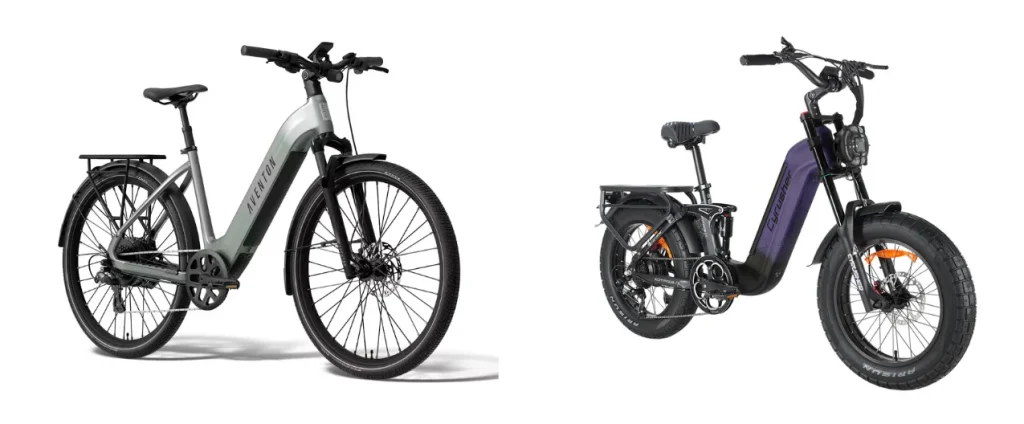
Lightweight E-Bikes: Aventon Soltera 3 ADV Vs Cyrusher
This is one category where the two brands do not have a direct matchup.
The Soltera 3 ADV is one of Aventon’s lightest current models at about 37 pounds. It uses a belt drive and is designed around efficient city riding, with a claimed range of up to 70 miles.
Cyrusher does not currently have a comparable lightweight city bike in this weight class.
Its current lineup generally prioritizes larger frames, wider tires, suspension, and substantial batteries.
That means the Soltera 3 ADV is the more relevant option if lifting, carrying, apartment storage, or vehicle transport is a major concern.
If you are specifically looking for a lightweight e-bike, our guide to best lightweight electric bikes is also worth reading before making a decision.
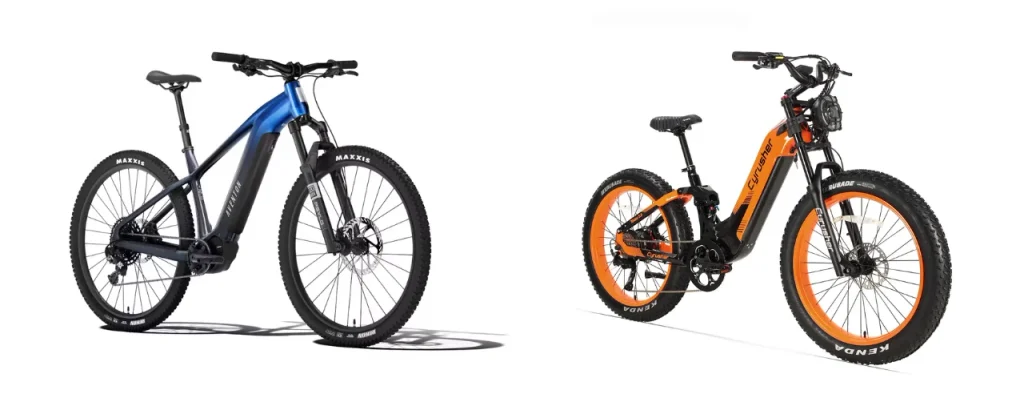
Mountain E-Bikes: Aventon Ramblas ADV Vs Cyrusher Trax 2.0
This comparison requires some care because the bikes are designed for different levels of off-road riding.
The Aventon Ramblas ADV is a dedicated hardtail eMTB. It uses a 100Nm mid-drive motor, has tubeless-ready wheels and tires, and is built around mountain-bike geometry rather than simply adding suspension and fat tires to a commuter frame.
The Cyrusher Trax 2.0 is a full-suspension all-terrain e-bike with a 750W Bafang motor, step-through frame, and a claimed range of up to 75 miles.
That gives the Trax a comfort-focused setup for riders who want suspension at both ends and easy frame access.
The Ramblas is the more conventional mountain-bike platform. It is designed around the way a dedicated hardtail eMTB handles climbing, descending, cornering, and trail terrain.
For casual trails and rough recreational riding, the Trax 2.0 can make sense. For riders specifically looking for a mountain-bike platform, the Ramblas ADV belongs in a different category.
Aventon’s Current ADV and Current EXP go even further with full-suspension eMTB platforms and up to 120Nm of motor torque.
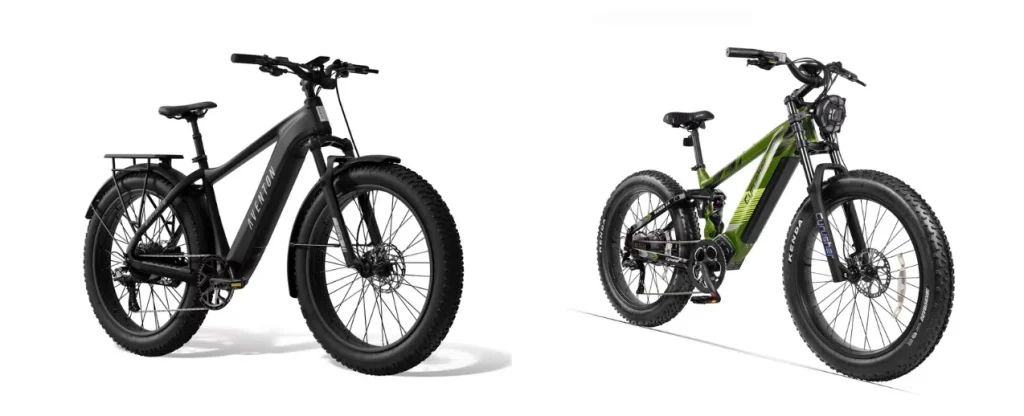
Fat-Tire E-Bikes: Aventon Aventure 3 Vs Cyrusher Ranger 2.0
The Aventon Aventure 3 and Cyrusher Ranger 2.0 are much closer competitors.
The Aventure 3 uses 4-inch all-terrain tires, a 750W hub motor with 1,440W peak power, a torque sensor, suspension fork, suspension seatpost, and a claimed range of up to 65 miles.
It also includes Aventon’s connected security features.
The Ranger 2.0 uses a 750W Bafang motor, 52V 20Ah battery, full suspension, and 4-inch fat tires. Cyrusher lists up to 75 miles of range and a 28 mph top speed.
The Ranger is therefore more focused on suspension and long-distance all-terrain comfort.
The Aventure 3 brings more emphasis to connected technology and a smart-bike ecosystem.
If you want a fat-tire e-bike for commuting, paved roads, gravel, and occasional trails, either platform can fit the job. The deciding factor is whether you value connected features or a more suspension-heavy setup.
For more fat-tire comparisons, our Aventon vs Himiway article looks at another major player in this category.
Cargo E-Bikes: Aventon Abound Vs Cyrusher Glider
Cargo is another category where the two brands are not direct copies of each other.
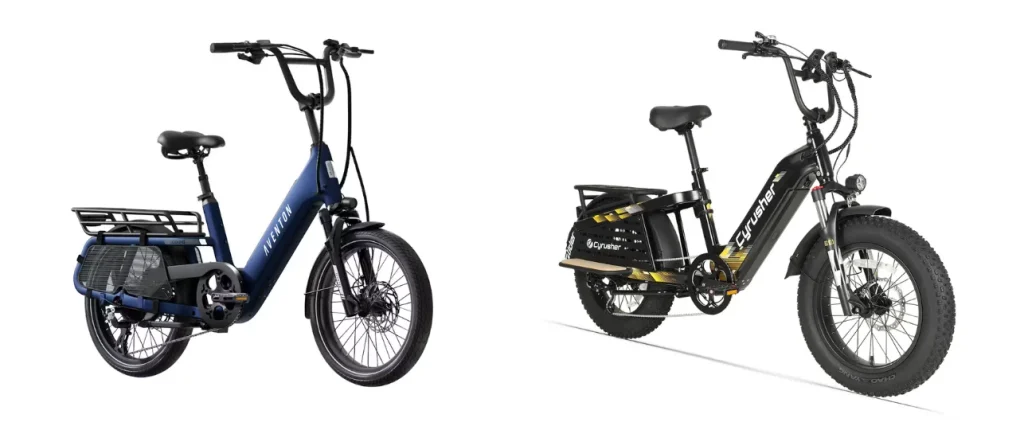
Aventon has built dedicated cargo platforms with the Abound SR and Abound LR.
The Abound SR is designed to carry one passenger, while the Abound LR can carry up to two passengers. Both use a 750W-class motor system with up to 1,440W peak power and include connected 4G/GPS security features.
Cyrusher’s Glider is also a cargo e-bike, but its design is more compact and less focused on long-tail passenger carrying.
It is listed with a 750W motor, a claimed range of up to 62 miles, and a step-through frame.
If your main purpose is carrying children, passengers, groceries, or substantial cargo, the Abound platform offers a more dedicated cargo-bike approach.
The Glider is more relevant if you want a cargo-capable bike without moving into the larger long-tail format.
For more cargo-bike context, our Aventon Abound SR review covers the smaller Abound platform in greater detail.
Where The Two Brands Stop Overlapping
This is where the comparison becomes much clearer.
Cyrusher has built much of its identity around fat tires and suspension. The Kommoda 3.0, Ranger 2.0, Trax 2.0, and Roam all demonstrate that approach.
The result is a lineup aimed heavily at riders who want stability and cushioning on mixed surfaces.
Aventon has a much wider spread of bike types.
You can move from the 37-pound Soltera 3 ADV to the Level 4 REC, Aventure 3, Aventure M, Abound cargo bikes, Ramblas ADV, Current ADV, and Current EXP.
That category depth matters because riders do not all have the same needs.
Someone riding five miles to work on pavement has very different requirements from someone carrying two children or riding technical mountain trails.
Cyrusher does not try to cover every one of those use cases with the same breadth.
Aventon does.
Value for Money
Price alone does not tell the whole story.
Cyrusher’s current lineup includes the Aura and Zenith at around $1,399, the Kommoda 3.0 at around $1,599, the Path at around $1,799, and the Ranger 2.0 and Trax 2.0 at around $2,499 at the time of writing.
That pricing gives riders access to large tires, suspension, and powerful motors without moving into premium eMTB territory.
Aventon covers a much wider price range.
The Soltera 3 ADV is listed at $1,499, the Abound SR at $1,899, and the Level 4 REC and Aventure 3 at $1,999. The Aventure M and Ramblas ADV are $2,899, while the Current ADV reaches $3,999 and the Current EXP reaches $5,999.
The difference is that Aventon’s higher prices often correspond to more specialized technology or bike platforms rather than simply larger tires and suspension.
For budget-oriented alternatives, our comparisons of Aventon vs Lectric, Aventon vs Engwe, and Aventon vs Ride1Up provide additional context.
Customer Support and Dealer Network
Aventon has built a significant bike-shop presence around its products.
That can matter if you want to see an e-bike before buying it, get help with assembly, or have access to local service.
Cyrusher follows a more direct-sales model but also has physical store and service support. Its current warranty information provides two years of frame coverage, with different coverage periods for other components.
The practical difference is that local availability varies.
Before buying either brand, it is worth checking what service options actually exist near you.
If you prefer a traditional bike-shop relationship, Aventon’s dealer model may be an important part of the decision. If you are comfortable buying directly and handling more of the ownership process yourself, Cyrusher remains an option.
Aventon Vs Cyrusher: Category Comparison
The category comparison is more useful than declaring one brand the universal winner.
| Category | Stronger fit | Alternative |
| Motor variety | Aventon | Primarily hub-drive |
| Commuting | Aventon | Strong comfort-oriented alternative |
| Lightweight riding | Aventon | No direct lightweight equivalent |
| Fat-tire riding | Strong option | Cyrusher |
| Suspension comfort | Strong on selected models | Cyrusher |
| Mid-drive options | Aventon | No direct equivalent |
| Mountain e-bikes | Aventon | More recreational all-terrain focus |
| Cargo | Aventon | Glider provides a smaller cargo option |
| Smart security | Aventon | More traditional approach |
| Dealer support | Aventon | Direct sales, stores, and service support |
| Large-battery all-terrain riding | Strong | Cyrusher |
| Model variety | Aventon | More focused lineup |
These category distinctions reflect the current model mix rather than a claim that one company makes better bikes across the board.
Who Should Choose Aventon?
Aventon makes more sense for riders who:
- Mainly ride on paved roads, bike paths, and city streets
- Want a commuter or city e-bike
- Care about refined ride quality
- Want integrated security and connected features
- Prefer a lighter electric bike
- Want access to a large dealer network
- Need a dedicated cargo e-bike
- Want a lightweight urban e-bike
- Prefer a traditional bicycle feel
- Want both hub-drive and mid-drive options
Aventon’s current lineup gives you several different directions. The Abound SR and Abound LR also give Aventon a more developed cargo-bike presence.
For readers considering other major brands, our comparisons of Aventon vs Specialized, Aventon vs Trek, Aventon vs Mokwheel, Aventon vs Rad Power, Aventon vs Heybike, and Aventon vs Giant cover more alternatives.
Who Should Choose Cyrusher?
Cyrusher makes sense for riders who:
- Want a powerful 750W motor
- Ride regularly on gravel, dirt, or rough roads
- Want fat tires and suspension
- Prefer a comfortable, stable riding position
- Need a higher payload capacity
- Want a step-through frame
- Prefer full-suspension comfort
- Want strong all-terrain capability
- Need a bike for recreational and adventure riding
- Want a lot of hardware without moving into premium e-bike pricing
Cyrusher is especially relevant if you regularly ride rough pavement, gravel, mixed surfaces, or recreational trails and want suspension and wide tires to be a major part of the riding experience.
Aventon Vs Cyrusher: Which Should You Buy?
Start with the bike rather than the brand.
If your main use is commuting and city riding, compare the Level 4 REC with the Kommoda 3.0 based on whether you want connected commuter technology or a more suspension-heavy setup.
If you want a fat-tire bike, the Aventure 3 and Ranger 2.0 offer two different interpretations of the category.
If you want a mid-drive fat-tire bike, the Aventure M has no direct current Cyrusher equivalent, so this becomes a question of whether that motor configuration matters to you.
For mountain biking, the Ramblas ADV, Current ADV, and Current EXP belong to a more dedicated eMTB category than most of Cyrusher’s current comfort-focused models.
For cargo, the Abound SR and Abound LR are the more purpose-built platforms, while the Cyrusher Glider gives you a more compact cargo alternative.
If you are still narrowing the field, our comparisons of Aventon vs Specialized, Aventon vs Trek, Aventon vs Mokwheel, Aventon vs Ride1Up, Aventon vs Lectric, Aventon vs Rad Power, Aventon vs Velotric, Aventon vs Himiway, Aventon vs Heybike, Aventon vs Giant, Aventon vs Cannondale, Aventon vs Engwe, and Aventon vs Fiido can help you compare Aventon with other major competitors.
The Bottom Line
Aventon and Cyrusher are not simply two versions of the same e-bike company.
Aventon has a broader lineup and puts more emphasis on connected technology, security, specialized bike categories, cargo platforms, and mid-drive systems.
Cyrusher has a more concentrated identity built around fat tires, suspension, comfort, and all-terrain riding.
That difference makes the buying decision easier once you know what matters most to you.
Choose the Aventon model that fits your riding if you need a connected commuter, lightweight city bike, cargo platform, mid-drive fat-tire bike, or dedicated eMTB.
Choose the Cyrusher model that fits your riding if wide tires, suspension, step-through access, and a cushioned all-terrain ride are higher priorities.
The brand name is only the starting point.
The better purchase is the e-bike whose motor, battery, weight, suspension, tires, technology, and carrying capacity actually match the way you plan to ride.