
If you’re comparing Aventon vs Giant in 2026, you’re looking at two very different approaches to electric bikes.
Aventon has built its lineup around practical electric bikes for commuting, recreation, cargo, fat-tire riding, lightweight urban use, and increasingly serious trail riding. Its newer models also put a lot of emphasis on connected technology, security, and integrated features.
Giant comes from a much broader traditional cycling background. Its current U.S. e-bike lineup includes hardtails, trail bikes, enduro bikes, trekking bikes, gravel bikes, and high-end electric road bikes. The current range includes models such as the Talon E+, Stance E+, Reign E+, Explore E+, Revolt E+, and Defy Advanced E+ Elite.
That makes this comparison more complicated than simply asking which company makes the more powerful e-bike.
Aventon may make more sense if you want a comfortable commuter, fat-tire e-bike, cargo bike, or technology-focused everyday electric bike. Giant becomes much more interesting if you want an electric mountain bike, gravel bike, or road bike that is designed around traditional cycling performance.
So which one should you choose?
I’ve compared the two brands across motor performance, torque sensors, range, comfort, build quality, smart features, commuting, lightweight riding, fat tires, folding, cargo, value, and dealer support.
Aventon vs Giant: How We Evaluated
For this Aventon vs Giant comparison, I looked at the current lineups available from both brands in 2026 rather than relying on older models that may no longer represent what either company sells today.
The comparison considers motor output, torque sensors, battery capacity, claimed range, ride comfort, suspension, tires, frame design, security features, smart technology, cargo capability, pricing, and dealer support.
I also looked at where the two brands actually overlap.
That’s important because Aventon has dedicated models such as the Aventure 3, Level 4, Abound, Soltera, and Ramblas, while Giant’s range extends much further into traditional cycling categories such as electric road and gravel bikes.
I didn’t force a winner where there isn’t a direct comparison.
For example, Giant currently doesn’t have a direct U.S. equivalent to the Aventon Aventure 3’s 4-inch fat-tire formula, and Aventon doesn’t currently have a direct equivalent to Giant’s high-end Defy Advanced E+ Elite electric road bikes.
For readers comparing Aventon with other brands, our guides to Aventon vs Specialized, Aventon vs Mokwheel, Aventon vs Trek, Aventon vs Ride1Up, and Aventon vs Lectric provide more brand-to-brand comparisons.
Aventon vs Giant: Quick Comparison
| Category | Aventon | Giant |
| Overall approach | E-bike-focused, practical, technology-rich | Broad bicycle and e-bike range |
| Commuter e-bikes | Strong | Strong |
| Lightweight city e-bikes | Strong | Available |
| Fat-tire e-bikes | Strong | No direct current U.S. equivalent |
| Cargo e-bikes | Strong | No direct current U.S. cargo equivalent |
| Electric mountain bikes | Yes | Extensive range |
| Electric road bikes | Limited direct overlap | Strong |
| Electric gravel bikes | Limited direct overlap | Strong |
| Folding e-bikes | No current flagship folding model | No current flagship folding focus |
| Torque-sensor models | Many current models | Common across current E+ systems |
| Smart/security technology | Extensive on selected current models | RideControl, E-Lock and Find My on selected models |
| Dealer/service network | 2,000+ bike shops advertised | Established Giant retailer network |
| Current U.S. price range | About $1,199 to $5,999 among current listed models | About $2,950 to $12,000 among current listed models |
| Best suited to | Commuters, utility, recreation and connected e-bike buyers | Cyclists wanting broad category choice and performance |
Aventon’s current comparison page lists the Aventure 3, Aventure M, Current ADV, Current EXP, Level 4 ADV, Level 4 REC, Pace 5 REC, Ramblas ADV, Soltera 2.5, Soltera 3 ADV, Abound LR, Abound SR and other models. It also lists older models such as the Sinch 2.5, but the latter is discontinued.
Giant’s current U.S. e-bike catalog lists the Defy Advanced E+ Elite range at $9,900 to $12,000, the Defy Advanced E+ Elite AR at $7,350, the Talon E+ at $2,950, Stance E+ at $4,500 to $5,500, and Reign E+ at $6,500.
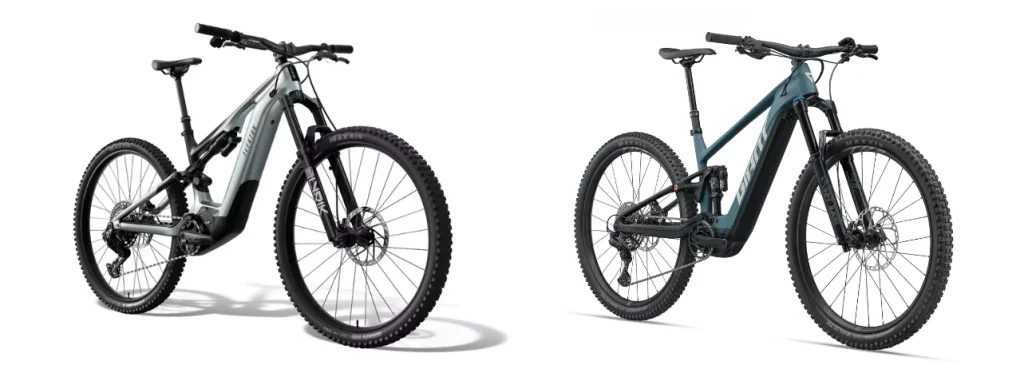
What’s the Difference Between Aventon and Giant?
The biggest difference is the role that electric bikes play in each company’s product range.
Aventon is primarily an e-bike brand.
Its current lineup is organized around categories that make sense to someone shopping specifically for an electric bike. You can choose a lightweight city bike such as the Soltera 2.5, a fat-tire Aventure 3, a cargo Abound, a commuter Level 4, or a dedicated eMTB such as the Ramblas ADV.
Giant treats e-bikes as part of a much larger bicycle ecosystem.
That means the company can take you from an aluminum hardtail like the Talon E+ to a trail-oriented Stance E+, a long-travel Reign E+, a trekking-oriented Explore E+, a gravel Revolt E+, or a high-end carbon Defy Advanced E+ Elite.
This difference becomes important when you start shopping by riding style.
If you simply want a good electric bike for commuting, errands, recreation, or utility riding, Aventon’s lineup is relatively easy to understand.
If you already know you want an electric road bike, gravel bike, or specific type of eMTB, Giant gives you far more options.
You can also compare Aventon with Rad Power, Velotric, Himiway, and Heybike.
Motor Power: Aventon vs Giant
Motor power is one area where the comparison gets complicated very quickly.
Aventon currently uses both hub-drive and mid-drive systems.
The Aventure 3 uses a 750W hub motor with up to 1,440W of peak power and 80Nm of torque. The Aventure M moves to a 100Nm mid-drive system. The Level 4 REC uses a hub-drive motor, while the Level 4 ADV uses Aventon’s Ultro S mid-drive motor with up to 100Nm of torque.
Giant also has several different motor configurations.
The current Talon E+ uses a SyncDrive Sport 2 motor rated at 75Nm. The new Stance E+ uses the SyncDrive Pro 3X system with up to 100Nm of torque and 800W peak power. The Revolt E+ uses a SyncDrive Pro system powered by a Shimano EP8 motor with 85Nm.
Giant’s Defy Advanced E+ Elite models use something different again. The SyncDrive Move Plus is a rear-hub motor rated at 30Nm but is designed by Giant to provide an equivalent riding effect to a higher-torque mid-drive system.
So it would be misleading to say that Giant simply uses one SyncDrive motor or that all of its motors are the same type.
The important thing is how the motor is matched to the bicycle.
Aventon’s high-output hub motors work well for practical commuting and fat-tire riding, while its newer mid-drive models add a more traditional pedal-driven feel.
Giant’s motor systems are matched more closely to individual bicycle categories.
Winner: It depends on the category. Aventon has very strong output in practical e-bike categories, while Giant offers a broader range of motor configurations for different types of cycling.
Torque Sensors and Ride Feel
Torque sensors measure how hard you are pushing the pedals and adjust motor assistance accordingly.
That usually creates a more natural feeling than a basic cadence sensor because the motor responds to your effort rather than simply detecting that the cranks are moving.
Aventon has moved heavily toward torque-sensing systems in its newer lineup.
The Aventure 3, for example, uses a torque sensor, while current Aventon models across commuter, cargo, city, and performance categories increasingly use more sophisticated sensing systems.
Giant has a long-established sensor-based approach.
The current Talon E+ uses PedalPlus six-sensor technology. Giant says its Smart Assist system considers rider input, cadence, speed, and terrain information to determine the amount of assistance. The new Stance E+ also uses six-sensor technology.
The difference can be felt most when climbing or accelerating.
A good torque-sensing system doesn’t simply throw maximum assistance at you. It can make the bike feel more like an extension of your own pedaling.
Both brands do this well on their current torque-sensor-equipped models.
Winner: Split. Both brands have strong torque-sensing systems, and the individual motor tuning matters more than the brand name.
Range and Battery Size
Range is another category where comparing the brands as a whole doesn’t tell the complete story.
Aventon currently has several long-range models.
The Aventure 3 is rated for up to 65 miles. The Aventure M reaches up to 85 miles, while the Level 4 REC reaches up to 75 miles. The Level 4 ADV is listed for up to 110 miles. Aventon’s Current ADV and Current EXP are also listed for up to 105 miles.
The battery sizes vary by model.
For example, Aventon lists the Aventure 3 with a 733Wh battery, while the Level 4 ADV uses an 800Wh battery.
Giant also offers a wide range of battery capacities.
The Talon E+ uses a 430Wh EnergyPak Smart battery and has a stated ideal-condition range of up to 71 miles. The current Stance E+ uses either a 625Wh or 800Wh battery depending on model, while the Explore E+ range uses 625Wh and can be upgraded to 800Wh on applicable models.
The Revolt E+ uses a 500Wh EnergyPak Compact battery and is compatible with a 250Wh range extender.
And then there are the road bikes.
The Defy Advanced E+ Elite uses a 400Wh EnergyPak battery, with the motor and lightweight road-bike design aimed at performance rather than simply maximizing battery capacity.
Advertised range should never be treated as a guaranteed distance.
Rider weight, cargo, wind, tire pressure, terrain, temperature, riding mode, speed, and battery condition can all change the actual result. Giant explicitly lists these factors in its e-bike guidance.
Winner: Split. Both brands offer long-range options, but the best choice depends on the specific bike and riding conditions.
Comfort and Ride Quality
Aventon puts a lot of emphasis on everyday comfort.
The Level 4 REC, for example, uses a comfort-oriented suspension fork and seatpost. The Aventure 3 adds 4-inch tires, which provide additional cushioning over rough pavement and loose surfaces.
The current Aventon lineup also includes several step-through and upright-oriented models, making the brand particularly relevant to riders who prioritize easy mounting and relaxed riding positions.
Giant approaches comfort differently.
The Explore E+ uses a 100mm suspension fork and wide tires designed for pavement, gravel, and dirt. The current Expression E+ uses a step-through frame, 63mm suspension fork, suspension seatpost, and 55mm tires.
Giant’s comfort can also come from frame and component design rather than simply adding suspension.
The Revolt E+, for example, uses a D-Fuse seatpost designed to absorb vibration, while the Defy Advanced E+ Elite uses Giant’s D-Fuse components and a carbon frame for road-oriented compliance.
Aventon tends to make comfort immediately obvious.
Giant often integrates comfort into the bicycle’s overall design.
Winner: Aventon for relaxed everyday riding; Giant for riders who want comfort while retaining more traditional cycling characteristics.
Build Quality and Durability
Build quality is difficult to reduce to a single specification.
Both companies use aluminum extensively, but Giant’s range extends much further into premium carbon frames and specialized bicycle construction.
The Defy Advanced E+ Elite, for example, uses a composite frame and premium road-bike components. Giant’s current Stance E+ uses ALUXX SL aluminum, while the Talon E+ uses an aluminum hardtail frame.
Aventon focuses more heavily on practical aluminum platforms.
The Aventure 3, Level 4, Abound, Soltera, and Ramblas each target different uses while sharing the brand’s focus on integrated e-bike functionality.
That doesn’t mean one brand automatically produces more durable bikes.
A road e-bike designed around lightweight performance has different durability requirements from a cargo bike designed to carry substantial loads.
Likewise, a trail bike needs a different frame and suspension design from a commuter.
The better question is whether the specific model is appropriately built for the job.
Winner: Giant has the broader range of purpose-built performance frames, while Aventon offers practical construction across a wide range of everyday e-bike categories.
Security and Smart Features
This is one of Aventon’s strongest areas.
Several current Aventon models offer connected features such as 4G/GPS connectivity, anti-theft functions, electronic locking, and other security-related technology. The Level 4 REC and Level 4 ADV are good examples. Aventon also advertises these technologies across several of its newer models.
Giant has also developed a serious smart ecosystem.
Current Giant models can use technologies such as RideControl, the RideControl App, E-Lock, Smart Assist, and Apple Find My integration where supported.
The current Talon E+, for example, includes Giant E-Lock and Find My Bike functionality. E-Lock can block motor assistance and trigger an alarm if the locked bike is moved. Find My Bike can help locate the bike through Apple’s Find My network.
So it would be wrong to describe Giant as having no smart security.
The difference is emphasis.
Aventon makes connected security a prominent selling point across a number of newer practical e-bikes.
Giant integrates smart technology into a broader cycling ecosystem.
Winner: Aventon for the breadth and prominence of connected security features across its practical lineup.
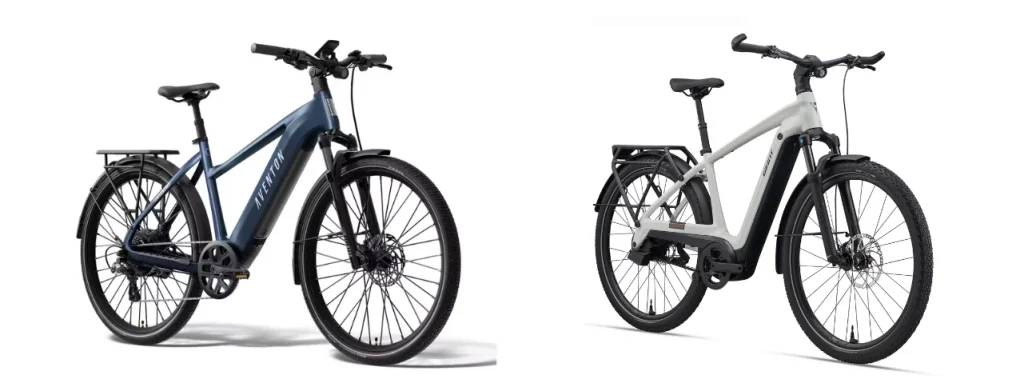
Commuter E-Bikes: Aventon Level 4 REC vs Giant Explore E+
This is one of the closest comparisons in the entire article.
Both are designed for riders who want more than a basic city bike.
| Specification | Aventon Level 4 REC | Giant Explore E+ |
| Motor | 750W hub drive | SyncDrive Sport2 |
| Torque | Up to 80Nm | 75Nm |
| Battery | 733Wh | 625Wh on current range, with 800Wh option on applicable models |
| Claimed range | Up to 75 miles | Model/conditions dependent |
| Suspension | Comfort suspension fork and seatpost | 100mm suspension fork |
| Tires | Commuter-oriented | Wide 57mm tires on current range |
| Smart technology | 4G/GPS, anti-theft and connected features | Smart Assist, RideControl and app connectivity |
| Carrying capability | Rear rack and practical commuter setup | MIK HD rack, trailer mount, 156kg total capacity |
| Riding focus | Daily commuting and recreation | Trekking, commuting, gravel and dirt |
Aventon’s Level 4 REC is clearly built around the modern e-bike commuter.
It combines a 750W hub motor, 733Wh battery, comfort suspension, and connected security features. Aventon lists up to 75 miles of range.
The Explore E+ is more of a trekking/adventure bike that happens to be excellent for commuting.
The current Explore E+ uses a 75Nm SyncDrive Sport2 motor, a 625Wh battery with an 800Wh upgrade option on applicable models, 100mm suspension, wide tires, integrated lights, a MIK HD rack, trailer compatibility, and a 156kg total weight capacity.
That makes the Giant particularly interesting for riders who commute during the week but want to ride gravel roads and dirt paths on weekends.
The Aventon is more technology-focused.
The Giant is more adventure-oriented.
Our take: Split. Choose the Level 4 REC for a technology-heavy commuter. Choose the Explore E+ if you want your commuter to double as a trekking and mixed-terrain bike.
Lightweight City E-Bikes
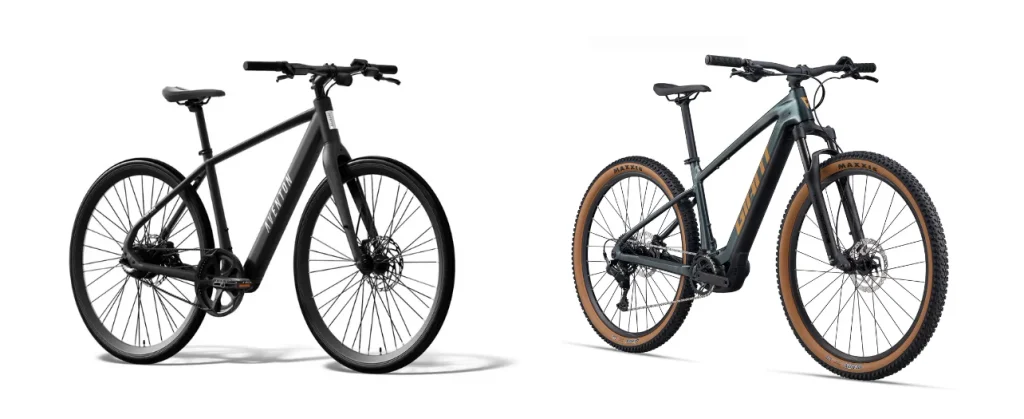
Aventon has a very clear advantage if lightweight urban riding is your priority.
The Soltera 2.5 weighs about 46 pounds and uses a 540W peak motor with a claimed range of up to 46 miles.
The Soltera 3 ADV goes even further. Aventon lists it at about 37 pounds, with a maintenance-free belt drive and up to 70 miles of claimed range.
These bikes are much easier to handle than many large electric bikes.
That’s useful if you live in an apartment, need to carry the bike up stairs, load it into a vehicle, or simply prefer the handling of a lighter bicycle.
Giant’s Talon E+ is also relatively light for an e-bike.
The current 2026 model weighs about 21.7kg, or roughly 47.8 pounds, in a size medium. It uses a 430Wh battery, 75Nm SyncDrive Sport 2 motor, and 100mm suspension fork.
But the Talon is fundamentally a hardtail trail bike.
The Soltera is much more directly aimed at lightweight urban riding.
Winner: Aventon
For riders specifically looking for a lightweight city e-bike, the Soltera family is a more direct fit.
Fat-Tire E-Bikes: Aventon Aventure 3 vs Giant
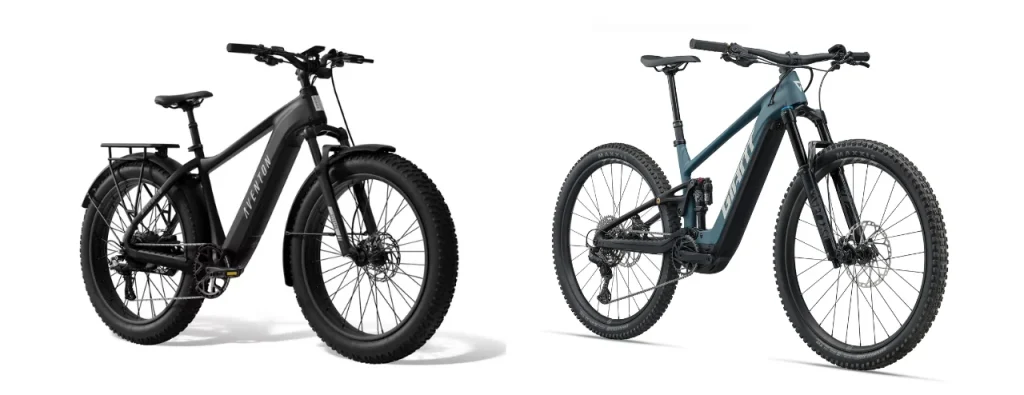
This is one category where there isn’t a true direct Giant equivalent.
The Aventure 3 is a dedicated 4-inch fat-tire electric bike.
It uses a 750W hub motor, up to 1,440W peak power, 80Nm of torque, a 733Wh battery, and a claimed range of up to 65 miles. It also has torque sensing and connected anti-theft features.
Giant’s current U.S. e-bike lineup is focused on other categories.
The Talon E+, Stance E+, Reign E+, Explore E+, Revolt E+, and Defy Advanced E+ Elite cover trail, enduro, trekking, gravel, and road riding rather than offering a direct 4-inch fat-tire commuter/adventure platform.
The closest Giant models depend on what you actually want to do.
If you want rough-terrain capability, a Talon E+ or Stance E+ may be more appropriate than a fat-tire bike.
If you want flotation on sand, snow, loose terrain, and rough pavement, however, those bikes are not direct substitutes for a 4-inch fat-tire design.
Winner: Aventon
Not because Giant makes poor off-road e-bikes, but because Aventon actually offers the category.
Folding E-Bikes: Aventon vs Giant
This is another category where a direct comparison doesn’t really exist.
Aventon’s Sinch 2.5 is still visible in the company’s comparison system, but Aventon marks it as discontinued. It therefore shouldn’t be treated as a current folding model when comparing the 2026 lineups.
Giant’s current U.S. lineup also isn’t centered around folding e-bikes. Its current catalog is focused on hardtails, trail bikes, enduro bikes, adventure bikes, and road e-bikes.
That means neither brand has a strong current folding option to recommend as a direct head-to-head.
If folding is your primary requirement, it makes more sense to look at brands specializing in that category.
Our guide to the best folding electric bikes is a better starting point.
Winner: Neither
Cargo E-Bikes: Aventon Abound vs Giant
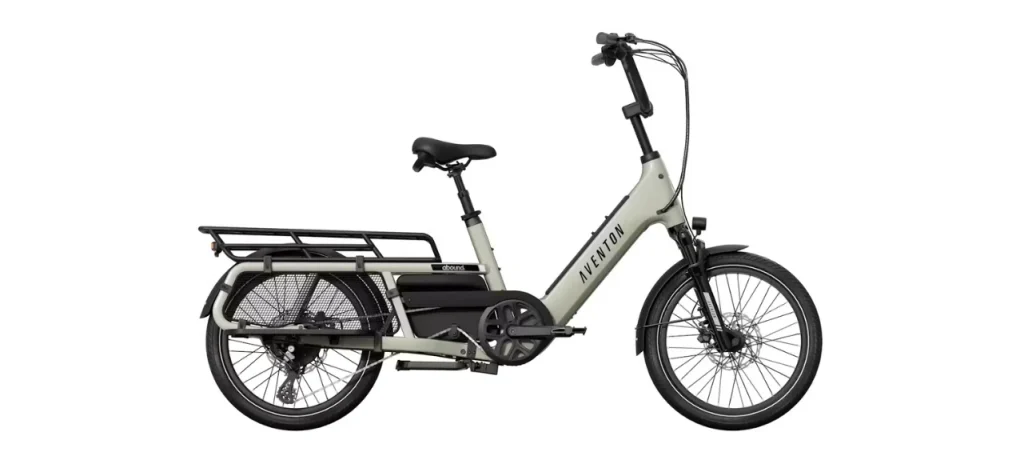
Aventon has a clear advantage here because it offers a dedicated cargo-bike family.
The current Abound range includes the Abound SR and Abound LR.
Both use a 750W hub-drive motor, 733Wh battery, 80Nm of torque, and a 440-pound total payload rating. The major difference is the frame and cargo layout, with the LR providing a longer rear platform for carrying passengers and cargo.
That’s a purpose-built cargo platform.
Giant’s current U.S. lineup does not offer a direct long-tail cargo-bike equivalent.
That doesn’t mean Giant bikes cannot carry cargo.
The Explore E+, for example, has a MIK HD rear rack rated to 27kg, a trailer mount, integrated lights, and a 156kg total system capacity.
But there is a difference between a trekking bike that can carry cargo and a cargo bike designed around carrying people and loads.
For grocery runs, school trips, passenger carrying, or serious utility use, the Abound is the more direct solution.
Winner: Aventon
Where the Two Brands Stop Overlapping
This is where the Aventon vs Giant comparison becomes much more interesting.
Aventon has expanded considerably beyond basic commuter e-bikes.
The current lineup includes the Level 4 ADV, Aventure M, Ramblas ADV, Current ADV, and Current EXP, giving the company a stronger presence in mid-drive and performance-oriented categories than it had a few years ago.
The Level 4 ADV, for example, uses a 100Nm Ultro S mid-drive motor, an 800Wh battery, automatic shifting technology, and a claimed range of up to 110 miles.
The Current ADV and Current EXP take Aventon further into full-suspension trail riding.
Both use Aventon’s Ultro X mid-drive system with up to 120Nm of torque and a claimed range of up to 105 miles. The Current ADV uses an aluminum frame, while the Current EXP uses a carbon frame and higher-end components.
But Giant still goes much further into traditional performance cycling.
Its current lineup includes the Stance E+ and Reign E+ for mountain riding, the Revolt E+ for gravel, and the Defy Advanced E+ Elite for endurance road riding.
That difference matters.
Aventon is becoming more performance-oriented.
Giant is still a much broader cycling company with electric versions of several specialized bicycle categories.
For more context, see our Aventon vs Specialized and Aventon vs Trek comparisons.
Value for Money
Aventon offers a much wider range of prices than it once did.
Current listed models start around $1,199 for the Soltera 2.5 and reach $5,999 for the Current EXP. The Aventure 3 and Level 4 REC are both listed at $1,999, while the Level 4 ADV and Ramblas ADV are listed at $2,799 and $2,899 respectively.
Giant’s U.S. range extends much further upward.
The Talon E+ starts at $2,950, Stance E+ models are $4,500 to $5,500, and the Reign E+ is $6,500. The Defy Advanced E+ Elite range reaches $12,000.
That doesn’t mean Giant simply charges more for the same bike.
The Defy Advanced E+ Elite, for example, is a carbon endurance road bike with premium SRAM components, carbon wheels on higher trims, a lightweight integrated system, and a road-focused frame.
The same principle applies to Giant’s mountain bikes.
A Talon E+ and an Aventon Ramblas are not simply two different brands selling the same type of e-bike.
They are designed around different cycling categories.
For other value comparisons, check out Aventon vs Ride1Up, Aventon vs Lectric, and Aventon vs Rad Power.
Winner: Aventon for feature-rich everyday e-bikes at moderate prices. Giant offers a different value proposition when premium bicycle components and specialized performance categories matter.
Customer Support and Dealer Network
Aventon has invested heavily in physical support.
The company currently advertises 2,000+ bike shops, giving customers opportunities for test rides, service, and other in-person support.
That’s significant because Aventon originally became known primarily as a direct-to-consumer e-bike company.
Giant has always had a strong traditional retailer model.
Its website directs customers toward local Giant retailers for sizing, service, and support. For online purchases in the U.S., Giant says bikes are fulfilled fully assembled through an authorized retailer, and the purchase includes a basic fitting and a 30-day checkup.
Giant also provides a broader bicycle-shop ecosystem because its dealers handle conventional bikes, e-bikes, parts, fitting, and service.
Aventon’s dealer network has narrowed that gap considerably.
The important point is that both companies now give buyers access to physical support, although the nature of that support differs.
Winner: Giant for the traditional bicycle-dealer experience; Aventon for an e-bike-focused network that has grown to 2,000+ shops.
Aventon vs Giant: Category Winners
Here is how I would break down the comparison after looking at the current lineups.
| Category | Our Take | Why |
| Practical motor performance | Aventon | Strong output across commuter and utility models |
| Motor variety | Giant | Wider range of motor systems across cycling categories |
| Torque-sensor riding | Split | Both use sophisticated sensor systems |
| Range | Split | Both have long-range models |
| Everyday comfort | Aventon | Strong focus on comfort-oriented e-bike design |
| Lightweight city riding | Aventon | Soltera models directly target this category |
| Fat-tire e-bikes | Aventon | Current 4-inch Aventure platform |
| Cargo | Aventon | Dedicated Abound family |
| Electric mountain biking | Giant | Much broader eMTB lineup |
| Electric road biking | Giant | Defy Advanced E+ Elite |
| Electric gravel biking | Giant | Revolt E+ |
| Smart security | Aventon | Strong emphasis on connected security |
| Traditional dealer experience | Giant | Long-established retailer ecosystem |
| Feature-per-dollar everyday e-bike | Aventon | Strong equipment and technology at moderate prices |
| Premium performance cycling | Giant | Much broader high-end bicycle range |
| Folding | Neither | No strong current direct offering |
| Overall | Depends on rider | The brands serve different priorities |
This table is deliberately not a single overall ranking.
Aventon is particularly strong in practical e-bike categories.
Giant becomes increasingly attractive as you move toward specialized cycling.
For additional brand comparisons, see Aventon vs Velotric, Aventon vs Himiway, and Aventon vs Heybike.
Who Should Choose Giant?
Giant makes more sense if you’re primarily a cyclist who wants electric assistance rather than someone simply shopping for an electric bike.
Choose Giant if:
- You want an electric road bike.
- You want an electric gravel bike.
- You want a dedicated trail or enduro eMTB.
- You care strongly about traditional bicycle handling.
- You want several bicycle categories from one brand.
- You prefer a traditional bike-shop relationship.
- You want access to high-end carbon e-bikes.
- You are willing to spend more for specialized bicycle components.
- You already know which cycling discipline you want to pursue.
Giant’s current lineup makes this particularly clear.
The Talon E+ targets lighter off-road riding. The Stance E+ moves into more capable trail riding. The Reign E+ is aimed at longer-travel mountain riding. The Revolt E+ covers gravel and mixed surfaces, while the Defy Advanced E+ Elite brings electric assistance to high-end endurance road riding.
That’s a very broad cycling ecosystem.
Who Should Choose Aventon?
Aventon makes more sense if your priority is a practical electric bike with a strong technology package.
Choose Aventon if:
- You want a comfortable commuter.
- You want a 4-inch fat-tire e-bike.
- You need a dedicated cargo bike.
- You want connected security features.
- You want a lightweight urban e-bike.
- You want strong motor output without immediately moving into premium bicycle pricing.
- You prefer an e-bike-focused company.
- You want a broad range of practical electric bike categories.
- You want the option of a newer mid-drive Aventon without moving into an expensive traditional performance bike.
The current lineup gives buyers several distinct directions.
The Soltera 2.5 and Soltera 3 ADV target lightweight city riding. The Aventure 3 handles fat-tire riding. The Level 4 lineup focuses on commuting. The Abound handles cargo. The Ramblas and Current models cover increasingly serious off-road use.
For shorter riders, our 10 Best Electric Bikes for Short Person in 2026 also includes the Aventon Soltera 2.5, Abound SR, and Ramblas ADV among the models discussed.
Aventon vs Giant: Which Should You Buy?
The better choice depends on what you actually want the bike to do.
Choose Aventon if:
- You want a practical commuter.
- You want a 4-inch fat-tire electric bike.
- You need a purpose-built cargo bike.
- You want integrated connected security.
- You want a lightweight city e-bike.
- You want strong motor output in a practical package.
- You want a lot of features without immediately entering premium bicycle pricing.
- You prefer an e-bike-focused lineup.
Choose Giant if:
- You want an electric road bike.
- You want an electric gravel bike.
- You want a serious trail or enduro eMTB.
- You want a traditional bicycle dealer relationship.
- You care about discipline-specific bicycle geometry and handling.
- You want a high-end carbon e-bike.
- You want one brand covering many different cycling disciplines.
- You are willing to pay more for specialized components and frames.
If you’re still comparing brands, our Aventon vs Specialized, Aventon vs Mokwheel, Aventon vs Trek, Aventon vs Ride1Up, Aventon vs Lectric, Aventon vs Rad Power, Aventon vs Velotric, Aventon vs Himiway, and Aventon vs Heybike comparisons cover many of the other major alternatives.
You can also check the current Aventon lineup and current Giant U.S. e-bike lineup before buying, since prices, inventory, and model-year availability can change.
The Bottom Line
Aventon and Giant are both established names in electric bikes, but they are not trying to build exactly the same products.
Aventon is particularly strong when you want an electric bike built around everyday practicality.
Its current lineup covers lightweight city bikes, commuters, fat-tire e-bikes, cargo bikes, and increasingly capable mid-drive and full-suspension models. Its newer bikes also put significant emphasis on connected security and app-based features.
Giant offers a much broader cycling ecosystem.
Its current e-bike range stretches from the $2,950 Talon E+ to high-end carbon road models such as the $12,000 Defy Advanced E+ Elite 0. In between, there are trail, enduro, trekking, and gravel options.
That’s why I wouldn’t call one brand universally better.
If you’re buying a comfortable commuter, lightweight city e-bike, fat-tire bike, cargo bike, or technology-focused everyday e-bike, Aventon deserves a very close look.
If you’re buying an electric road bike, gravel bike, trail bike, or enduro eMTB, Giant’s broader cycling range becomes much more relevant.
The biggest difference isn’t the motor wattage.
It’s the philosophy behind the bike.
Aventon makes the electric bike the center of the product. Giant makes the bicycle category the center of the product and integrates electric assistance into it.
Once you decide which of those approaches fits your riding, the Aventon vs Giant decision becomes much easier.