
If you’re comparing Aventon vs Cannondale in 2026, you’re looking at two very different approaches to the electric bike market.
Aventon has built its reputation around feature-rich e-bikes, competitive pricing, connected technology, and practical everyday designs.
Cannondale comes from a much longer traditional cycling background. Its electric lineup covers urban, fitness, touring, cargo, road, gravel, and mountain bikes.
Both make genuinely interesting electric bikes.
The real question is what you’re paying for.
Aventon gives you things like powerful motors, large batteries, GPS security, and useful commuter features at relatively accessible prices.
Cannondale puts more emphasis on bicycle engineering, integrated systems, premium components, specialized designs, and dealer support.
That difference shows up everywhere, from motor systems and ride feel to comfort and pricing.
So which one should you choose?
There isn’t one answer for every rider. It depends on your budget, where you ride, and whether you want maximum equipment for the money or a more traditional premium bicycle experience.
Aventon vs Cannondale: How We Evaluated
We compared Aventon and Cannondale based on the things that matter when you’re actually shopping for an electric bike.
That includes motor performance, torque sensing, battery size, claimed range, comfort, build quality, security features, model variety, value, and dealer support.
We also looked at individual bikes rather than relying entirely on brand-level assumptions.
That’s important here.
Aventon’s current lineup includes lightweight city bikes, commuters, fat-tire e-bikes, cargo bikes, and mid-drive electric mountain bikes. Its current comparison tool lists models including the Soltera 2.5, Aventure 3, Aventure M, Level 4 REC, Level 4 ADV, Abound LR, Abound SR, Ramblas ADV, Current ADV, and Current EXP.
Cannondale covers a wider range of traditional bicycle categories, including electric city bikes, cargo bikes, touring bikes, road and gravel bikes, and electric mountain bikes.
For additional brand comparisons, see our Aventon vs Trek, Aventon vs Specialized, and Aventon vs Giant guides.
We also focused on current manufacturer specifications rather than older model-year information.
Aventon vs Cannondale: Quick Comparison
| Category | Aventon | Cannondale |
| Overall approach | Feature-rich, technology-focused, value-oriented | Traditional bicycle engineering with premium electric systems |
| Best for | Commuting, city riding, utility, value-focused buyers | Urban riding, touring, cargo, road, gravel, and premium eMTBs |
| Motor options | Hub and mid-drive | Bosch, Shimano, Fazua and other systems depending on model |
| Torque sensing | Common across current models | Common across many current models |
| Lightweight options | Soltera 2.5, Soltera 3 ADV | Quick Neo, Quick Neo SL, Treadwell Neo |
| Commuter options | Level 4 REC, Level 4 ADV | Mavaro, Tesoro family |
| Fat-tire options | Aventure 3, Aventure M | No direct 4-inch fat-tire equivalent |
| Cargo options | Abound LR and Abound SR | Cargowagen Neo and Wonderwagen Neo |
| Mid-drive eMTBs | Ramblas ADV, Current ADV, Current EXP | Moterra, Moterra SL, Moterra LT, Habit Neo |
| Smart technology | 4G/GPS and anti-theft on compatible models | Bosch connectivity and SmartSense on selected models |
| Dealer support | 2,000+ bike shops | Established Cannondale dealer network |
| Price positioning | Mainstream through premium | Premium through high-end |
| Value approach | More equipment at lower price points | Premium systems and bicycle engineering |
There isn’t a universal winner.
Aventon generally makes more sense if you want a lot of features without immediately moving into premium-bike pricing.
Cannondale becomes increasingly relevant as you move toward premium urban bikes, touring, cargo, gravel, road, and electric mountain bikes.
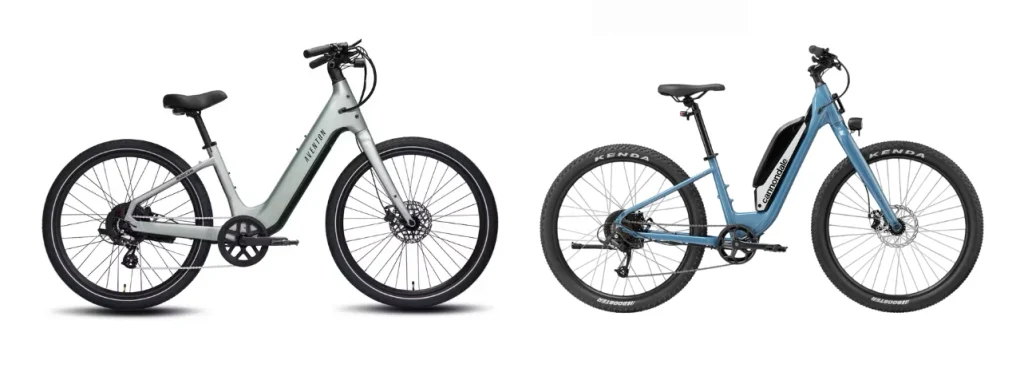
What’s the Difference Between Aventon and Cannondale?
The easiest way to understand Aventon vs Cannondale is to look at their approach to electric bikes.
Aventon built its reputation in the modern e-bike market. Its current lineup combines direct sales with a growing physical dealer network, while many models emphasize integrated batteries, connected technology, practical accessories, and strong motor output.
The current Aventon range includes models such as the Soltera 2.5, Aventure 3, Aventure M, Level 4 REC, Level 4 ADV, Abound LR, Abound SR, Ramblas ADV, Current ADV, and Current EXP.
That gives Aventon a surprisingly broad lineup.
Which Aventon Electric Bike Is Best for You? is a useful starting point if you’re already leaning toward Aventon.
Cannondale has a much longer history in traditional cycling.
Its current electric range includes urban models such as the Mavaro and Treadwell Neo, cargo bikes such as the Cargowagen Neo, touring models such as the Tesoro family, and electric mountain bikes such as the Moterra.
Cannondale also goes further into road and gravel riding with models such as the Synapse Neo and Topstone Neo.
That means Cannondale isn’t simply trying to compete with Aventon on price.
It’s bringing electric assistance into a much broader traditional bicycle portfolio.
And that’s probably the biggest difference between these brands.
Aventon tends to emphasize how much useful technology and performance it can put into an e-bike at a particular price.
Cannondale tends to design the electric system around the type of bicycle and riding it is intended for.
Motor Power: Aventon vs Cannondale
This is one category where you need to look beyond the wattage printed on the motor.
Aventon’s current hub-drive models include powerful 750W systems.
The Aventure 3, for example, is listed with up to 1,440W of peak power and a claimed range of up to 65 miles. The Level 4 REC also uses a 750W hub-drive motor with up to 1,440W peak power.
Aventon also has increasingly capable mid-drive models.
The Aventure M uses a 100Nm mid-drive motor, while the Ramblas ADV uses Aventon’s A100 mid-drive system with up to 100Nm of torque.
The Level 4 ADV uses an Ultro S mid-drive motor with up to 100Nm of torque. Aventon’s current comparison tool lists all three models.
Cannondale takes a different approach.
Many of its electric bikes use Bosch, Shimano, or other drive systems matched to the intended use of the bike.
The Mavaro 4, for example, uses Bosch’s Active Line Plus motor.
The Cargowagen Neo uses a Bosch cargo-oriented system.
The Moterra uses Bosch drive systems designed for electric mountain biking.
That makes direct wattage comparisons difficult.
Aventon often gives you impressive motor numbers at a lower price.
Cannondale puts more emphasis on matching the motor, frame, drivetrain, suspension, and geometry to a particular category.
If you’re comparing 750W models specifically, our guide to how fast a 750W electric bike can actually go explains why motor wattage alone doesn’t tell you how an e-bike will perform.
Winner: Split
Aventon has an advantage if your priority is high motor output at a lower price.
Cannondale has an advantage when the entire bicycle is designed around a specific drive system and riding style.
Torque Sensors and Ride Feel
Torque sensing is common across both brands, but the riding experience depends on the specific motor and tuning.
A torque sensor measures how hard you’re pushing the pedals and adjusts assistance accordingly.
Aventon uses torque sensing across many current models.
That gives its newer electric bikes a more natural pedal-assist feel than older cadence-only systems.
Cannondale also uses sophisticated sensor systems across several current electric platforms.
The Mavaro 4 uses Bosch’s Active Line Plus system, while other Cannondale electric models use different drive systems depending on their intended purpose.
On a good torque-sensing system, the motor responds to your pedaling effort rather than simply waiting for the pedals to turn.
That’s especially noticeable when climbing.
You can push harder and receive more assistance, then ease off and get a more controlled response.
Our guide to what pedal assist is on an electric bike explains the difference between torque and cadence sensing in more detail.
Winner: Split
Both brands offer current models with sophisticated pedal-assist systems.
The specific motor matters more than the brand name.
Range and Battery Size
Battery capacity varies considerably within both brands.
Aventon’s current lineup includes batteries from relatively compact city-bike packs to large batteries designed for long-distance commuting and trail riding.
The Soltera 2.5 is rated for up to 46 miles.
The Aventure 3 is rated for up to 65 miles.
The Level 4 REC is rated for up to 75 miles, while the Level 4 ADV is rated for up to 110 miles.
The Current ADV and Current EXP are also rated for up to 105 miles.
Cannondale offers similarly wide variation.
The current Mavaro 4 listed on Cannondale’s U.S. site uses a 500Wh Bosch PowerTube battery and is rated for up to 110km of assisted range.
The Cargowagen Neo uses a 545Wh battery and can be configured with a second battery for riders who need additional capacity.
Road and gravel models take a different approach, prioritizing lower weight and road performance rather than simply fitting the largest possible battery.
So neither brand can really be called a “short-range” or “long-range” brand.
The exact model matters much more.
And advertised range should always be treated as a maximum.
Actual range depends on:
- Rider weight
- Terrain and hills
- Wind and temperature
- Tire pressure
- Assist level
- Average speed
- Throttle use
- Cargo weight
- Battery condition
If you’re a heavier rider, our guide to the best electric bikes for heavy riders is worth reading because payload can have a significant effect on real-world range.
Winner: Split
Both brands have models capable of long-distance riding.
Aventon tends to offer larger batteries and long claimed ranges at lower price points, while Cannondale offers different battery strategies depending on the bicycle category.
Comfort and Ride Quality
Both companies take comfort seriously, but they get there in different ways.
Aventon uses familiar comfort features such as suspension forks, suspension seatposts, upright geometry, wide tires, and step-through frames.
The Level 4 REC is a good example.
It combines commuter-oriented geometry with a suspension fork and suspension seatpost.
The Aventure 3 takes a different approach with 4-inch fat tires and front suspension.
Cannondale takes a more model-specific approach.
The Mavaro 4 uses a 63mm suspension fork, comfort-oriented handlebars, wide tires, integrated lighting, fenders, and a rear rack.
The Cargowagen Neo is designed around utility, with cargo-specific geometry and equipment.
Then there are bikes such as the Topstone Neo, which brings Cannondale’s gravel-oriented frame and suspension concepts into the electric category.
This is an important distinction.
Aventon often uses familiar comfort components across its commuter lineup.
Cannondale tends to build the ride around the intended use of each bicycle.
Winner: Split
Aventon offers a lot of straightforward comfort for the money.
Cannondale offers more specialized approaches for riders who want a bike designed around a particular type of riding.
Build Quality and Durability
Both brands build serious bicycles.
But a higher price doesn’t automatically mean one bike will last longer.
Aventon has improved its frame integration and overall fit and finish considerably.
Current models feature integrated batteries, hydraulic brakes on many bikes, internal cable routing, and increasingly sophisticated electronics.
Cannondale has a much longer history of developing bicycle frames and components.
Its current lineup includes aluminum and carbon platforms, along with specialized designs for different riding categories.
That’s particularly noticeable in premium bikes such as the Moterra and other performance-oriented models.
Cannondale also uses model-specific frame engineering rather than simply applying one basic frame concept across its entire lineup.
That doesn’t mean every Cannondale is automatically more durable than every Aventon.
It means the two companies make different decisions about frame design, components, and price.
Weight is another factor.
If portability matters, check the actual weight of the specific bike rather than assuming one brand is lighter.
Our guide to how much the average electric bike weighs explains why e-bike weight varies so dramatically.
And if you’re comparing braking systems, our guide to mechanical vs hydraulic disc brakes on electric bikes explains the differences.
Winner: Cannondale for premium bicycle engineering
Cannondale has a broader selection of premium frame and component packages.
Aventon, however, remains very competitive when price is part of the equation.
Security and Smart Features
This is one area where Aventon has a particularly clear identity.
Select current Aventon models use connected technology that can provide 4G/GPS tracking, anti-theft functions, movement alerts, and other connected features.
The Level 4 REC is a good example.
It combines 4G/GPS and anti-theft technology with a commuter-oriented platform. Aventon’s current lineup also lists these types of smart features on models including the Abound LR, Abound SR, Aventure M, and Level 4 ADV.
Cannondale takes a broader approach to connected technology.
Some current Cannondale electric bikes use Bosch’s smart system and can connect to the Cannondale and Bosch ecosystems.
Other models use SmartSense technology, which can combine lighting and rear-facing radar to improve visibility and traffic awareness.
These technologies solve different problems.
Aventon’s connected features are particularly relevant to theft prevention and bike tracking.
Cannondale’s SmartSense and connected systems are more focused on riding information, visibility, and integration.
Winner: Aventon for anti-theft connectivity
If GPS tracking and connected anti-theft functions are your priority, Aventon has the more direct solution on compatible models.
Commuter E-Bikes: Aventon Level 4 REC vs Cannondale Mavaro 4
This is one of the most useful comparisons between the two brands.
The Aventon Level 4 REC is designed around value, power, comfort, and connected technology.
The Cannondale Mavaro 4 takes a more traditional premium urban-bike approach.
| Specification | Aventon Level 4 REC | Cannondale Mavaro 4 |
| Motor | 750W hub drive | Bosch Active Line Plus |
| Torque | Up to 80Nm | Up to 50Nm |
| Battery | 733Wh | 500Wh |
| Claimed range | Up to 75 miles | Up to 110km |
| Suspension | Suspension fork + suspension seatpost | 63mm suspension fork |
| Drivetrain | Shimano 8-speed | Shimano Nexus 5-speed internal hub |
| Belt drive | No | Gates carbon belt |
| Brakes | Hydraulic disc | Shimano MT200 hydraulic disc |
| Smart technology | 4G/GPS, anti-theft | Bosch Smart System |
| Lighting | Integrated | Integrated front and rear |
| Main advantage | Power, battery and connected features | Low-maintenance urban design |
The Level 4 REC gives you considerably more motor output and a larger battery.
It also brings connected security features to the commuter category.
The Mavaro 4 is more refined in its traditional bicycle design.
The Gates belt drive is quiet and low-maintenance. The internal gear hub keeps the drivetrain protected from the elements.
Cannondale also equips the Mavaro 4 with a rear rack, full-coverage fenders, integrated lights, and a 63mm suspension fork. Its current U.S. specification lists a Bosch Active Line Plus motor producing up to 50Nm of torque and a 500Wh battery.
This is a classic example of the Aventon vs Cannondale difference.
The Aventon gives you more headline specifications for the money.
The Cannondale gives you a more traditional, low-maintenance urban-bike package.
For more commuter comparisons, see Aventon vs Specialized and Aventon vs Trek.
Winner: Split
Choose the Level 4 REC if power, battery capacity, price, and connected security are priorities.
Choose the Mavaro 4 if belt drive, internal gearing, integrated equipment, and a Bosch-powered urban platform matter more.
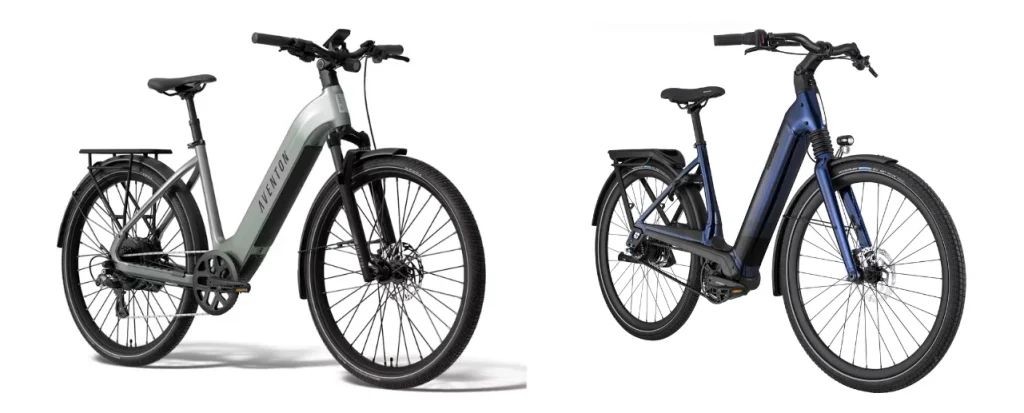
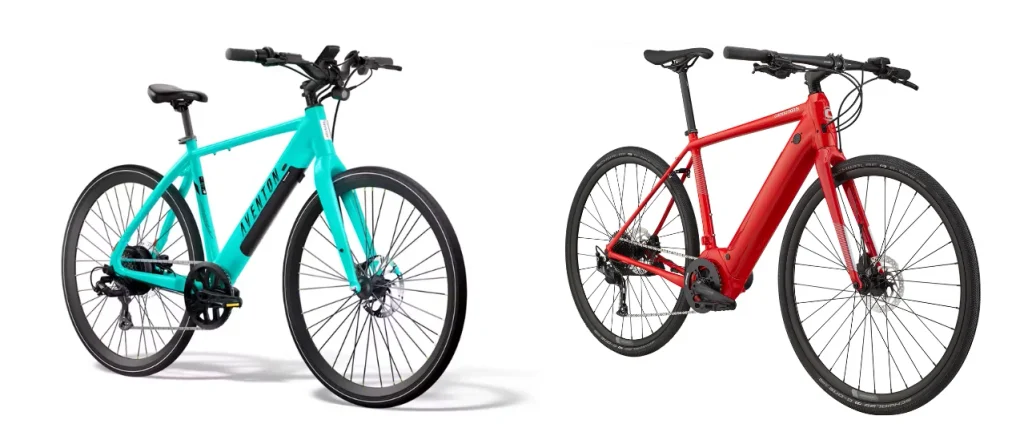
Lightweight and Urban E-Bikes: Aventon Soltera 2.5 vs Cannondale Quick Neo
This comparison is interesting because both bikes aim to preserve more of the feel of a conventional bicycle.
The Soltera 2.5 is one of Aventon’s lighter current e-bikes.
It weighs about 46 pounds, uses a Shimano 7-speed drivetrain, and has a 540W peak motor. Aventon lists a claimed range of up to 46 miles and a $1,199 price.
Cannondale’s Quick Neo takes a similar fitness-oriented approach.
It is designed for riders who want electric assistance for workouts, everyday transportation, and recreational riding without moving into the heavier, more utility-focused side of the e-bike market.
Cannondale also has the Quick Neo SL, giving buyers another lightweight fitness-oriented option.
Rather than using a single Quick Neo specification for every current market, it’s better to compare the riding philosophy of the two families.
| Feature | Aventon Soltera 2.5 | Cannondale Quick Neo family |
| Design | Lightweight city/fitness e-bike | Fitness and urban e-bike |
| Motor approach | Rear hub | Model-specific electric system |
| Weight | About 46 lbs | Varies by model |
| Claimed range | Up to 46 miles | Varies by model |
| Drivetrain | Shimano 7-speed | Model-specific |
| Riding position | Fitness/urban | Fitness/urban |
| Main advantage | Price and simplicity | Traditional fitness-bike design |
The Soltera 2.5 is especially attractive if you want a relatively light e-bike without spending several thousand dollars.
That’s one of its biggest advantages.
The Quick Neo family is more interesting if you already like the feel of a traditional fitness bicycle and want electric assistance integrated into that kind of platform.
Winner: Aventon for value
The Soltera 2.5 gives you a straightforward lightweight electric bike at a much more accessible price.
Cannondale’s Quick Neo family is worth considering when the bicycle itself and its fitness-oriented design are more important than minimizing the purchase price.
For more lightweight options, see the best electric bikes for short people.
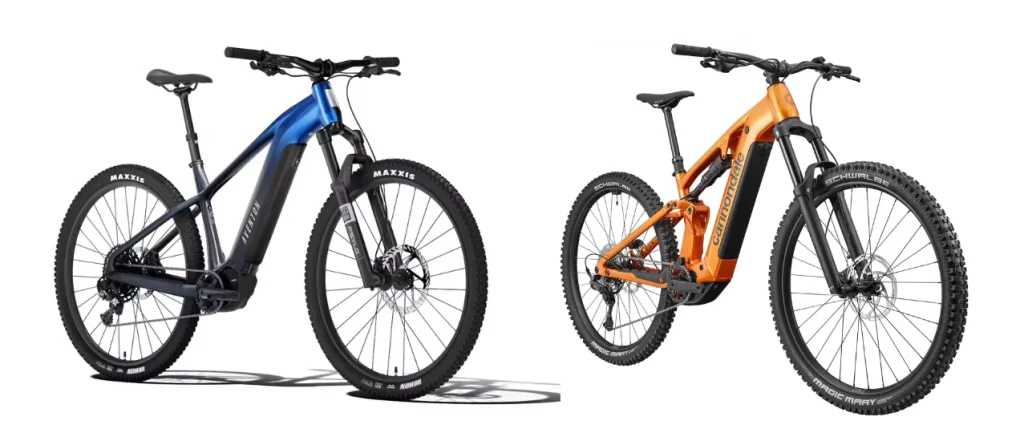
Electric Mountain Bikes: Aventon Ramblas ADV vs Cannondale Moterra
This is where the difference between the brands becomes much more obvious.
The Aventon Ramblas ADV is a hardtail electric mountain bike.
It uses Aventon’s A100 mid-drive motor with up to 100Nm of torque, a large battery, a 12-speed drivetrain, and a suspension fork. Aventon currently lists the Ramblas ADV with a claimed range of up to 90 miles.
Cannondale’s Moterra family takes electric mountain biking further into full-suspension territory.
The current Cannondale range includes Moterra models such as the Moterra 4, while the wider Moterra family also includes higher-spec configurations.
| Feature | Aventon Ramblas ADV | Cannondale Moterra family |
| Motor | Aventon A100 mid-drive | Bosch system, model-dependent |
| Torque | Up to 100Nm | Model-dependent |
| Battery | 708Wh | Model-dependent |
| Suspension | Hardtail | Full suspension |
| Rear suspension | None | Yes |
| Front suspension | 130mm | Model-dependent |
| Drivetrain | 12-speed | Model-dependent |
| Riding style | Trail and cross-country | Trail and more aggressive mountain riding |
| Main advantage | Mid-drive performance at a lower price | Full-suspension platform and premium components |
The Ramblas is impressive because of what it offers for its price.
You get a genuine mid-drive eMTB with serious torque and a large battery without moving into the same price territory as many premium electric mountain bikes.
The Moterra is a different proposition.
It’s designed around full-suspension mountain-bike performance and gives riders more options as they move toward demanding trails.
If you’re interested in Aventon’s approach specifically, our Aventon Ramblas ADV review goes deeper into the bike.
Winner: Split
The Ramblas is compelling if you’re looking for mid-drive trail performance at a lower price.
The Moterra makes more sense if full suspension and premium mountain-bike equipment are priorities.
Where the Two Brands Stop Overlapping
This is probably the most important section in the entire comparison.
At a certain point, Aventon and Cannondale simply stop competing for the same buyers.
Cannondale goes much further into road and gravel riding
Cannondale currently offers electric road and gravel platforms including the Topstone Neo and Synapse Neo families.
These bikes are designed around road and gravel riding rather than the more utility-oriented categories that dominate much of Aventon’s lineup.
Aventon doesn’t currently have a direct equivalent to these models.
If you want an electric gravel or road bike, Cannondale has a much broader selection.
Both brands have serious cargo options
Aventon offers the Abound LR and Abound SR.
The Abound LR is designed to carry up to two passengers, while the Abound SR is designed around carrying one passenger. Aventon’s current product listings confirm both models.
Cannondale also has serious cargo options.
The Cargowagen Neo is currently part of Cannondale’s electric city lineup.
Cannondale also lists the Wonderwagen Neo in its cargo range.
So the difference isn’t that one brand has cargo bikes and the other doesn’t.
It’s how they approach them.
Aventon’s Abound models bring cargo utility into a more accessible price range.
Cannondale’s cargo bikes are built around premium electric systems and a more traditional bicycle-industry approach.
Our Aventon Abound SR review covers Aventon’s cargo platform in more detail.
If you use an e-bike for work, our guide to the best electric bike accessories for delivery drivers is also worth reading.
Cannondale has a much deeper traditional cycling range
This is where Cannondale has a natural advantage.
The brand’s current electric lineup includes city, fitness, touring, cargo, gravel, road, and mountain bikes.
Aventon’s current lineup is broad within the modern e-bike market, but it remains more concentrated around commuters, city bikes, cargo bikes, fat-tire models, and eMTBs.
That difference matters if you’re a cyclist first and an e-bike buyer second.
For comparisons with other major brands, see Aventon vs Himiway, Aventon vs Heybike, and Aventon vs Mokwheel.
Value for Money
This is where Aventon has a particularly strong case.
The current Aventon lineup includes the Soltera 2.5 at $1,199, Aventure 3 at $1,999, Abound SR at $1,899, Abound LR at $1,999, Level 4 REC at $1,999, Aventure M at $2,899, Level 4 ADV at $2,799, Ramblas ADV at $2,899, and higher-end Current ADV and Current EXP models. Aventon’s current product listings confirm these models and their current positioning.
That means Aventon isn’t simply a budget brand anymore.
It has products ranging from affordable city bikes to premium full-suspension models.
Cannondale’s pricing varies much more widely because its lineup extends into premium bicycle territory.
You’re paying for things such as Bosch or Shimano drive systems, premium frames, specialized suspension designs, higher-end drivetrains, dealer setup, and category-specific engineering.
That doesn’t automatically make Cannondale better value.
It means the two companies are often selling different types and levels of bicycle.
If you’re trying to understand why premium electric bikes cost so much, our guide to why electric bikes are so expensive explains where some of that money goes.
For budget-conscious buyers, our best electric bikes under $2,000 guide is also useful.
Winner: Aventon
If your definition of value is how much equipment and capability you get for your money, Aventon has the advantage.
Customer Support and Dealer Network
This category has become more competitive.
Aventon is no longer simply a direct-to-consumer company with no physical presence.
Its current website advertises 2,000+ bike shops, giving customers access to local test rides and service through its dealer network.
Cannondale has a much longer-established dealer ecosystem.
Its traditional retail model puts authorized retailers at the center of sales, setup, service, and warranty support.
That can be particularly useful with premium e-bikes.
A complex full-suspension eMTB or cargo bike isn’t always something you want to assemble yourself.
A local dealer can also help with fitting, drivetrain adjustments, suspension setup, troubleshooting, and long-term maintenance.
Aventon’s growing dealer network narrows that gap considerably.
Still, Cannondale’s traditional dealer model remains more deeply integrated into the ownership experience.
Winner: Cannondale
Cannondale’s long-established dealer model remains an advantage, particularly for buyers purchasing premium or technically complex e-bikes.
Aventon vs Cannondale: Category Winners
| Category | Winner | Why |
| Motor performance | Split | Aventon emphasizes output and value; Cannondale emphasizes system integration |
| Torque sensing | Split | Both offer current models with sophisticated sensor systems |
| Range and battery | Split | Both have models designed for long-distance riding |
| Comfort | Split | Aventon offers accessible comfort; Cannondale has more model-specific designs |
| Build quality | Cannondale | Broader premium frame and component selection |
| Commuters | Split | Level 4 REC for value; Mavaro 4 for premium urban riding |
| Lightweight/urban | Aventon | Soltera 2.5 combines low weight with accessible pricing |
| Electric mountain bikes | Split | Ramblas for value; Moterra for full-suspension performance |
| Specialty formats | Cannondale | Broader road and gravel electric lineup |
| Cargo | Split | Abound emphasizes accessibility; Cannondale offers premium cargo platforms |
| Smart security | Aventon | More direct emphasis on connected anti-theft technology |
| Value for money | Aventon | More equipment and motor output at lower price points |
| Dealer support | Cannondale | Long-established traditional dealer ecosystem |
There isn’t a single brand dominating every category.
That’s because Aventon and Cannondale are increasingly targeting different types of riders.
Who Should Choose Cannondale?
Cannondale makes sense if you want:
- A traditional bicycle-company ownership experience
- Bosch, Shimano, or other premium electric systems depending on model
- Premium urban and touring models
- A serious cargo bike such as the Cargowagen Neo
- Electric gravel or road bikes
- Full-suspension electric mountain bikes
- Premium frame and component integration
- A long-established dealer network
- Specialized bicycle engineering
- Professional dealer setup and local support
Cannondale becomes especially interesting when your riding gets more specialized.
If you want an electric road bike, gravel bike, premium cargo bike, or full-suspension eMTB, the current Cannondale range gives you more choices.
Who Should Choose Aventon?
Aventon makes sense if you want:
- Strong specifications without immediately moving into premium-bike pricing
- A lightweight city bike such as the Soltera 2.5
- A powerful fat-tire bike such as the Aventure 3
- A commuter such as the Level 4 REC
- A mid-drive commuter such as the Level 4 ADV
- Integrated GPS and anti-theft technology on compatible models
- A dedicated cargo platform
- A relatively affordable mid-drive eMTB
- Large batteries at mainstream price points
- The convenience of online shopping plus an expanding service network
Aventon is particularly compelling for riders who want an e-bike that feels like a modern connected product.
The combination of motor power, battery capacity, useful technology, and price is difficult to ignore.
For other Aventon matchups, check out Aventon vs Lectric, Aventon vs Rad Power, and Aventon vs Ride1Up.
Aventon vs Cannondale: Which Should You Buy?
So, Aventon vs Cannondale: which should you buy?
Start with your budget and the type of riding you actually do.
If you’re shopping around the $1,200 to $2,000 range, Aventon gives you several current options.
The Soltera 2.5 gives you a lightweight city e-bike.
The Aventure 3 gives you a powerful fat-tire platform with a large battery and anti-theft technology.
The Level 4 REC gives commuters a large battery, suspension, torque sensing, and connected security.
Move into the $2,800 to $3,000 range and Aventon still has interesting choices such as the Level 4 ADV, Aventure M, and Ramblas ADV.
Cannondale becomes increasingly relevant as you move toward premium urban, touring, cargo, gravel, road, and mountain bikes.
The Mavaro 4 gives you a Bosch-powered urban platform with a Gates belt drive and internal gearing.
The Cargowagen Neo gives you a serious cargo platform.
The Moterra family takes you into full-suspension electric mountain biking.
The Topstone Neo and Synapse Neo families give Cannondale options that Aventon doesn’t currently offer.
So don’t choose the brand first.
Choose the type of bike first.
Then compare the specific models that actually fit your riding.
If you’re still comparing Aventon against the wider market, see our guides to Aventon vs Velotric and Aventon vs Himiway.
For speed categories, our guides to the best Class 2 electric bikes and the best Class 3 electric bikes can also help narrow your options.
The Bottom Line
Aventon and Cannondale are not trying to build exactly the same kind of electric bike.
Aventon focuses heavily on accessible pricing, connected technology, strong motor specifications, commuter practicality, cargo capability, and modern security features.
Cannondale brings a much longer traditional cycling background, premium electric systems, specialized frame engineering, dealer support, and a broader selection of road, gravel, touring, cargo, and mountain bikes.
If you’re shopping mainly on price and specifications, Aventon deserves a serious look.
If you’re looking for a premium bicycle platform with specialized engineering and established dealer support, Cannondale offers a different proposition.
The most important thing is not to assume that one brand is automatically right for everyone.
Look at the motor.
Look at the battery.
Look at the weight.
Look at the geometry.
Look at the range.
Look at the service network.
And most importantly, look at how you’re actually going to ride the bike.
For some riders, that will lead to Aventon.
For others, it will lead to Cannondale.
And that’s exactly why the Aventon vs Cannondale comparison is more useful at the model level than at the brand level.