
If you’re comparing Aventon vs Engwe in 2026, you’re looking at two e-bike brands with plenty in common, but very different approaches.
Both offer commuter, cargo, fat-tire, and performance-oriented electric bikes. But Aventon has built a more focused lineup around comfort, torque sensing, connected technology, security, and dealer support.
ENGWE takes a broader approach. Its lineup includes folding e-bikes, dual-battery models, full-suspension bikes, mid-drive e-bikes, cargo bikes, and moped-style electric bikes.
So which brand makes more sense?
I compared the current lineups across motor power, torque sensing, range, comfort, build quality, security, commuting, lightweight riding, mountain riding, fat tires, and cargo.
The goal isn’t simply to pick one brand.
It’s to show you where each one makes the most sense.
How We Evaluated
For this Aventon vs Engwe comparison, I focused on current manufacturer specifications, available models, technology, practical riding needs, and how the two brands differ.
I also looked beyond motor wattage.
Battery size, torque, suspension, weight, geometry, drivetrain design, security, and intended use can matter just as much.
If you’ve already read our comparisons of Aventon vs Himiway, Aventon vs Specialized, or Aventon vs Ride1Up, you’ll recognize the approach.
Aventon vs Engwe: Quick Comparison
| Category | Aventon | ENGWE |
| Best for | Commuters, security, connected technology | Variety, battery capacity, hardware value |
| Motors | Hub and mid-drive | Hub and mid-drive |
| Torque sensing | Common across current models | Available on newer models |
| Commuters | Strong | Strong |
| Lightweight | Strong | Strong |
| Mountain | Dedicated eMTB options | More all-terrain focused |
| Fat tires | Strong | Strong |
| Cargo | Abound SR/LR | LE20 |
| Dual batteries | Limited | Major strength |
| Moped-style | Limited | Major strength |
| Smart security | Strong | Available on newer models |
| Dealer support | 2,000+ bike shops | Primarily direct-to-consumer |
| Lineup | More focused | Much broader |
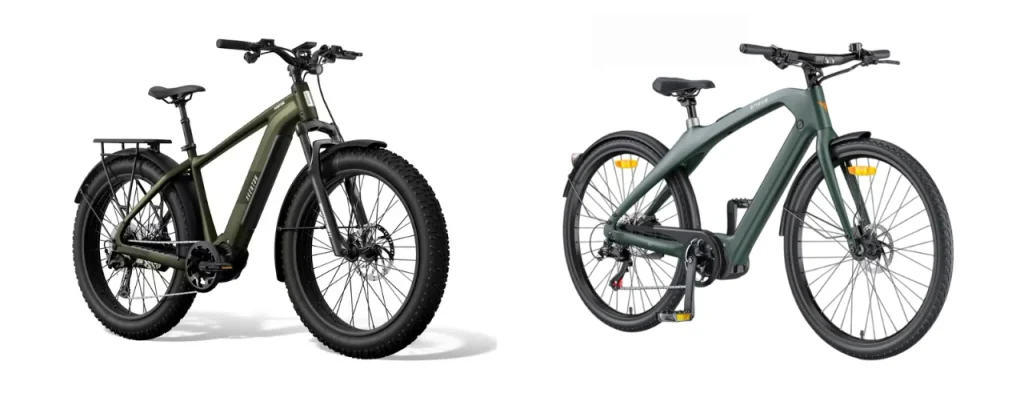
What’s the Difference Between Aventon and Engwe?
The easiest way to understand Aventon vs Engwe is to look at their overall philosophies.
Aventon has a relatively focused lineup.
The brand covers lightweight city bikes, commuters, fat-tire bikes, cargo bikes, and increasingly capable mid-drive models.
The Level 4 REC is built around commuting and connected technology. The Abound SR and LR focus on cargo. The Aventure M is a premium fat-tire mid-drive bike, while the Ramblas ADV is a dedicated electric mountain bike.
ENGWE is much broader.
The L20 3.0 Pro combines a folding frame, full suspension, 20 x 3.0-inch tires, a 250W Mivice mid-drive motor, 100Nm of torque, and a 720Wh battery.
Then there’s the M20 3.0, which moves into a completely different category with a 750W-rated hub motor, 3,300W peak output, 120Nm of torque, full suspension, and dual-battery capability.
So, the basic distinction is simple:
Aventon is more focused. ENGWE is more diverse.
Motor Power
Motor power is one of the easiest categories to compare badly.
A high-output hub motor isn’t automatically better for commuting than a lower-rated mid-drive motor.
Motor type, torque, gearing, battery capacity, controller tuning, bike weight, and intended use all matter.
Aventon offers both hub-drive and mid-drive systems.
The Level 4 REC uses a 750W hub motor, while the Ramblas ADV and Aventure M use Aventon’s A100 mid-drive motor with up to 100Nm of torque.
ENGWE covers a wider performance range.
The L20 3.0 Pro and E26 3.0 Pro use 250W Mivice X700 mid-drive motors with 100Nm of torque.
The M20 3.0 goes much further with a 750W-rated hub motor, 3,300W peak output, and 120Nm of torque.
That gives ENGWE more extreme options.
Winner: ENGWE
If raw output and unusual performance formats are your priority, ENGWE has the broader selection.
Torque Sensors and Ride Feel
Torque sensing can make an e-bike feel much more natural.
Instead of simply turning the motor on when you pedal, the system responds to how hard you’re pedaling.
Our guide to What Is Pedal Assist Electric Bike explains the difference between torque and cadence sensing.
Aventon uses torque sensing extensively across its current lineup.
ENGWE is more mixed, although several newer models use torque sensors. The L20 3.0 Pro and E26 3.0 Pro are good examples.
Cadence sensors aren’t necessarily bad. They’re simple, predictable, and often less expensive.
But torque sensing generally gives you a more proportional riding experience.
Winner: Aventon
Aventon’s more consistent use of torque sensing gives it the edge.
Range and Battery Size
Battery capacity is one of ENGWE’s strongest areas.
The Aventon Level 4 REC uses a 733Wh battery and is rated for up to 75 miles. The Aventure M reaches up to 85 miles, while the Level 4 ADV is rated for up to 110 miles.
ENGWE offers larger and more flexible battery configurations.
The L20 3.0 Pro uses a 720Wh battery and has a manufacturer-listed maximum range of up to 160km.
The LE20 is offered in single- and dual-battery configurations depending on market.
The M20 3.0 can use one or two 60V 20Ah batteries, with ENGWE listing up to 180 miles of PAS 1 range for the dual-battery version under its test conditions.
Real-world range will obviously vary.
Rider weight, hills, wind, temperature, tire pressure, speed, assist level, and cargo can all make a significant difference.
If weight is a concern, see our Best Electric Bikes for Heavy Riders guide.
Winner: ENGWE
If maximum battery capacity and dual-battery flexibility matter most, ENGWE offers more choices.
Comfort and Ride Quality
Comfort isn’t just suspension.
Frame geometry, tires, saddle, seatpost, riding position, wheel size, and suspension tuning all contribute.
Aventon takes a relatively consistent approach.
The Level 4 REC combines commuter geometry with a suspension fork and suspension seatpost.
ENGWE is more model-dependent.
The L20 3.0 Pro has full suspension. The E26 3.0 Pro adds an adjustable fork and rear air shock.
The X26 goes even further with triple suspension.
So ENGWE can produce a very comfortable bike, but the experience varies more between models.
Winner: Aventon
Aventon gets the edge for consistency.
Build Quality and Durability
Aventon’s smaller lineup helps it maintain a consistent design language.
Current models commonly feature integrated batteries, internal cable routing, hydraulic brakes on many bikes, and increasingly sophisticated electronics.
ENGWE has also improved significantly, particularly with newer models such as the L20 3.0 Pro and E26 3.0 Pro.
But its much larger catalog means build characteristics vary more from one model to another.
Weight also matters when you’re considering long-term practicality.
Our guide to How Much Does an Electric Bike Weigh? explains why large batteries, motors, suspension, and cargo frames can add substantial weight.
Winner: Aventon
Aventon’s more focused lineup gives it the edge in consistency.
Security and Smart Features
This is one of Aventon’s clearest strengths.
Current Aventon models can include 4G/GPS connectivity, movement detection, notifications, electronic locking, and app-based controls.
The Level 4 REC is a good example of how deeply Aventon integrates security into the bike.
ENGWE has become more competitive.
The L20 3.0 Pro includes GPS, 4G, and Bluetooth connectivity, while the E26 3.0 Pro offers GPS and anti-theft features.
The difference is consistency.
Aventon’s connected ecosystem is more established across its current lineup.
Winner: Aventon
If connected security is important, Aventon has the stronger overall approach.
Commuter E-Bikes: Aventon Level 4 REC vs ENGWE L20 3.0 Pro
The Level 4 REC and L20 3.0 Pro are both practical commuters, but they’re very different bikes.
Aventon Level 4 REC
The Level 4 REC uses a 750W hub motor with 80Nm of torque and a 733Wh battery.
Aventon rates it for up to 75 miles.
It also gets a suspension fork, suspension seatpost, hydraulic brakes, and 4G/GPS security technology.
It’s a conventional commuter with modern connected features.
ENGWE L20 3.0 Pro
The L20 3.0 Pro uses a 250W Mivice X700 mid-drive motor with 100Nm of torque and a 720Wh battery.
ENGWE lists up to 160km of maximum range.
But the biggest difference is the folding frame.
It also has full suspension and 20 x 3.0-inch tires.
So it combines commuting with compact storage and more all-terrain capability.
For more commuter guidance, see our Best Class 2 Electric Bikes and Best Class 3 Electric Bikes guides.
Winner: Split
Level 4 REC: Better for conventional connected commuting.
L20 3.0 Pro: Better for riders wanting folding capability, full suspension, and mid-drive torque.
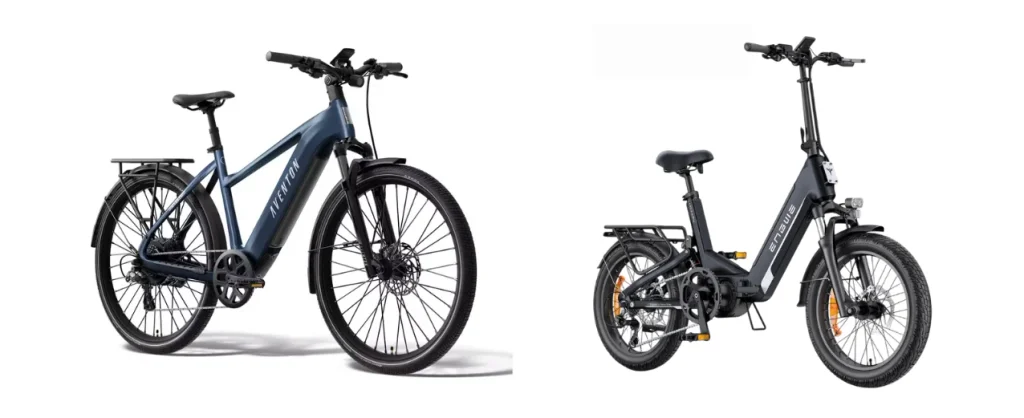
Lightweight E-Bikes: Aventon Soltera 3 ADV vs ENGWE N1 Pro
The Soltera 3 ADV and N1 Pro approach lightweight riding differently.
Aventon Soltera 3 ADV
The Soltera 3 ADV weighs around 37 pounds and uses a belt drive.
Aventon rates it for up to 70 miles.
Its biggest strength is simplicity.
It’s a relatively light urban e-bike that remains close to the feel of a traditional bicycle.
ENGWE N1 Pro
The N1 Pro uses a carbon frame and 250W mid-drive motor producing 80Nm of torque.
ENGWE lists a 360Wh battery and up to 100km of range.
It weighs around 19kg, or roughly 42 pounds.
So it’s a little heavier than the Soltera, but it brings mid-drive performance to the lightweight category.
Winner: Split
Soltera 3 ADV: Better for low weight and straightforward city riding.
N1 Pro: Better for lightweight riding with mid-drive performance.
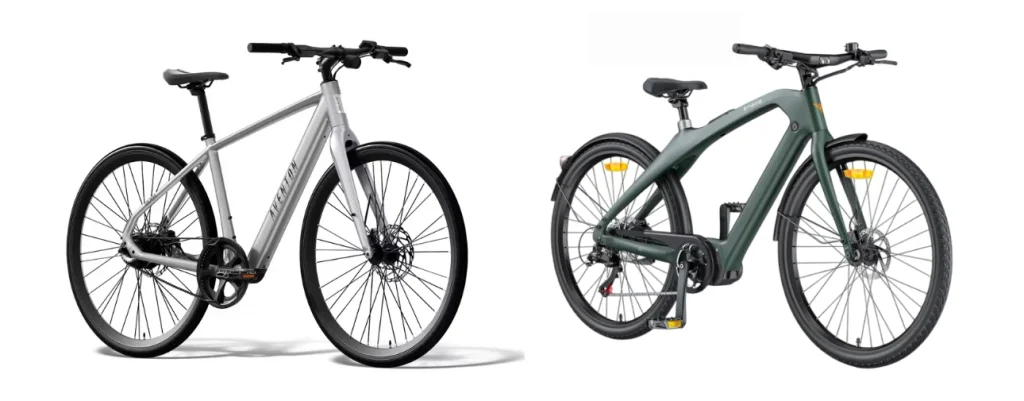
Electric Mountain Bikes: Aventon Ramblas ADV vs ENGWE E26 3.0 Pro
This comparison shows how the two brands can target different riders even when the basic specifications look similar.
Aventon Ramblas ADV
The Ramblas ADV uses Aventon’s A100 mid-drive motor with up to 100Nm of torque.
It has a 12-speed drivetrain and mountain-bike geometry designed around trail riding.
This is a dedicated eMTB rather than simply an all-terrain utility bike.
Our Aventon Ramblas ADV Review covers its motor, drivetrain, and trail-focused design in more detail.
ENGWE E26 3.0 Pro
The E26 3.0 Pro also uses a 100Nm mid-drive motor.
It adds a 720Wh battery, full suspension, 26 x 3.0-inch tires, GPS, and a 330-pound maximum load.
That makes it more of an all-terrain utility bike.
It’s comfortable and versatile, but not as specifically trail-focused as the Ramblas.
Winner: Split
Ramblas ADV: Better for dedicated trail riding.
E26 3.0 Pro: Better for mixed terrain, utility use, and riders prioritizing suspension and payload.
Fat Tire E-Bikes: Aventon Aventure M vs ENGWE E26 3.0 Pro
The Aventure M and E26 3.0 Pro are closer competitors.
Aventon Aventure M
The Aventure M uses Aventon’s A100 mid-drive motor with 100Nm of torque and four-inch tires.
Aventon rates it for up to 85 miles.
It also features automatic shifting and anti-theft technology.
It’s aimed at riders who want a premium fat-tire experience without moving into a dedicated mountain-bike design.
ENGWE E26 3.0 Pro
The E26 3.0 Pro uses a 100Nm Mivice X700 mid-drive motor and 720Wh battery.
ENGWE lists up to 135km of range.
Its 26 x 3.0-inch tires aren’t as wide as the Aventure M’s, but it adds full suspension, GPS, anti-theft features, and a 330-pound payload.
For more options, see our Best Fat Tire Electric Bikes guide.
Winner: Split
Aventure M: Better for four-inch tires, automatic shifting, and Aventon’s connected technology.
E26 3.0 Pro: Better for full suspension, battery capacity, and utility-oriented riding.
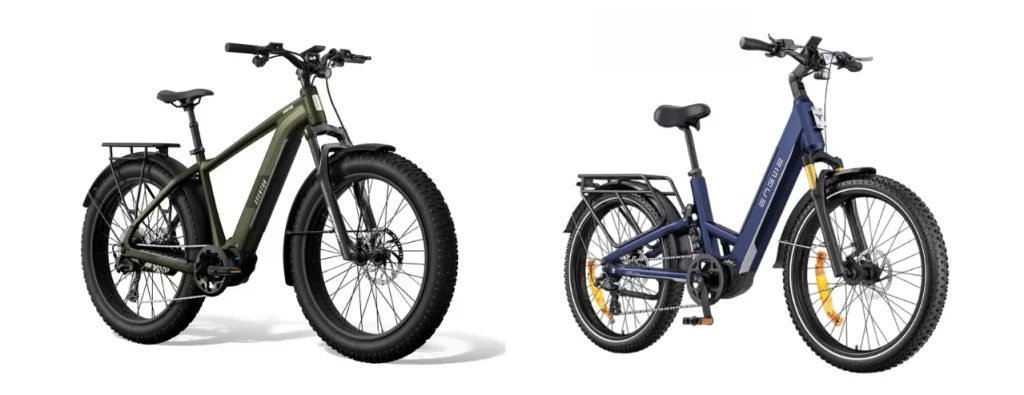
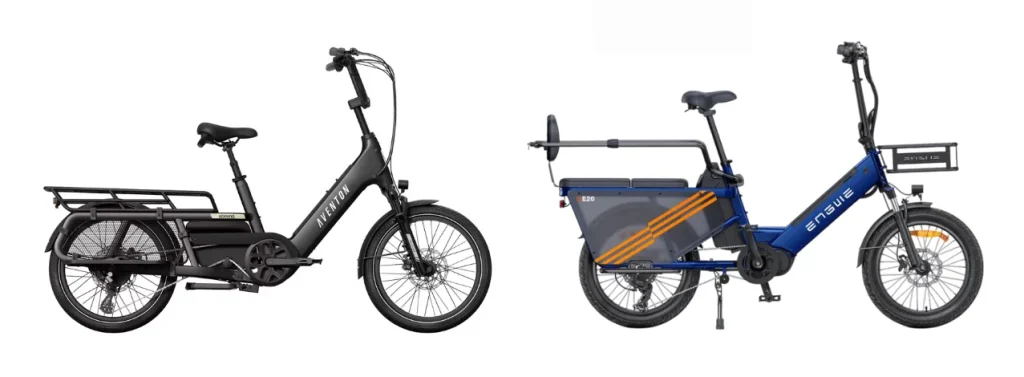
Cargo E-Bikes: Aventon Abound vs ENGWE LE20
Both brands offer genuine cargo platforms.
Aventon Abound
The Abound family includes the Abound SR and Abound LR.
They’re designed specifically for carrying passengers and cargo rather than simply adding a rack to a standard e-bike.
The platform also benefits from Aventon’s connected security features and dealer network.
Our Aventon Abound SR Review looks more closely at the platform.
For delivery riders, our Best Electric Bike Accessories for Delivery Drivers guide covers useful equipment.
ENGWE LE20
The LE20 is another dedicated cargo e-bike.
Its major advantage is battery flexibility.
Depending on market and configuration, it can be equipped with single- or dual-battery setups.
That makes it particularly interesting for long-distance utility use.
Winner: Split
Aventon Abound: Better for connected security and dealer support.
ENGWE LE20: Better for battery flexibility and long-range utility.
Where The Two Brands Stop Overlapping
At some point, Aventon and ENGWE stop competing for exactly the same rider.
ENGWE’s M20 3.0 is a good example.
It uses a 750W-rated hub motor, 3,300W peak output, 120Nm of torque, full suspension, 20 x 4-inch tires, and can accommodate two 60V 20Ah batteries.
ENGWE also lists a manufacturer off-road mode reaching 40 mph, while its factory default is 20 mph.
Because classification and speed laws vary, riders should check local regulations.
Aventon takes a different path with the Ramblas ADV.
It’s a dedicated hardtail eMTB with a 100Nm mid-drive motor and mountain-bike components.
Aventon’s lineup also includes other mid-drive models such as the Level 4 ADV, Aventure M, Current ADV, and Current EXP.
If you’re comparing Aventon with other established brands, see Aventon vs Trek, Aventon vs Specialized, and Aventon vs Giant.
You can also compare it with Aventon vs Mokwheel, Aventon vs Ride1Up, and Aventon vs Rad Power.
Winner: Split
ENGWE offers more unusual formats.
Aventon has a clearer identity around connected technology and dedicated mid-drive platforms.
Value for Money
ENGWE makes a strong argument when you compare specifications directly.
Large batteries, suspension, hydraulic brakes, folding mechanisms, high-torque motors, and dual-battery options appear throughout its lineup.
Aventon doesn’t always try to win that specification battle.
Instead, the company puts more emphasis on integration, connected security, dealer support, and a focused lineup.
Our guide to Why Are Electric Bikes So Expensive? explains some of the costs behind modern e-bike design.
Winner: ENGWE
If your definition of value is maximum hardware for your money, ENGWE generally has the advantage.
Customer Support and Dealer Network
This is one area where Aventon has a clear advantage.
Aventon currently advertises a network of 2,000+ bike shops.
That gives customers access to test rides, service, repairs, and local support.
ENGWE is primarily direct-to-consumer.
That can keep the buying process simple, but local dealer support isn’t as central to ownership.
For many riders, that won’t matter.
But it can matter a lot when you’re buying a heavy cargo bike or complicated full-suspension model.
Our Aventon vs Velotric comparison is also useful if you’re looking at another brand with a growing commuter lineup.
Winner: Aventon
If local service and test rides matter, Aventon has the stronger network.
Aventon Vs Engwe: Category Winners
| Category | Winner | Why |
| Raw motor output | ENGWE | More extreme high-output options |
| Torque sensing | Aventon | More consistent across the lineup |
| Range | ENGWE | Larger and dual-battery options |
| Comfort consistency | Aventon | More predictable lineup |
| Build consistency | Aventon | More focused product range |
| Commuter e-bikes | Split | Different approaches |
| Lightweight e-bikes | Split | Different strengths |
| Electric mountain bikes | Split | Dedicated eMTB vs utility |
| Fat-tire e-bikes | Split | Different priorities |
| Cargo e-bikes | Split | Security vs battery flexibility |
| Moped-style e-bikes | ENGWE | Much broader selection |
| Smart security | Aventon | Stronger connected ecosystem |
| Lineup coherence | Aventon | Easier to understand |
| Hardware value | ENGWE | More aggressive specifications |
| Dealer support | Aventon | 2,000+ bike shops |
Who Should Choose Aventon?
Aventon makes sense if you want a focused lineup and don’t want to compare dozens of radically different models.
It’s particularly suited to riders who prioritize commuter comfort, torque sensing, connected GPS and security, cargo capability, and local dealer support.
It’s also a strong choice if you specifically want a dedicated eMTB such as the Ramblas ADV or a premium fat-tire mid-drive bike such as the Aventure M.
The connected ecosystem is another major reason to consider Aventon.
Who Should Choose Engwe?
ENGWE makes sense if you want variety.
It’s particularly interesting if you’re looking for:
- A folding e-bike
- A folding fat-tire bike
- Dual batteries
- A very large battery
- High motor output
- Full suspension
- A moped-style design
- An unusual combination of features
If your shopping list says folding + fat tires + suspension + huge battery, ENGWE gives you more ways to achieve it.
Our Best Folding Electric Bikes guide is useful if folding capability is one of your priorities.
Aventon Vs Engwe: Which Should You Buy?
So, Aventon vs Engwe: which should you buy?
The answer depends on the bike you actually need.
Choose ENGWE if:
- You want folding capability.
- You want dual batteries.
- You want maximum battery capacity.
- You want a moped-style design.
- You want very high motor output.
- You want extensive suspension and hardware for your money.
- You want an unusual bike that Aventon doesn’t currently offer.
Choose Aventon if:
- You want a straightforward commuter.
- You want integrated GPS and security.
- You want a large dealer network.
- You want to test ride before buying.
- You want a dedicated cargo platform.
- You want a dedicated trail-oriented eMTB.
- You prefer a smaller, more coherent lineup.
If you’re still comparing brands, check out Aventon vs Lectric, Aventon vs Cannondale, and Aventon vs Heybike.
For delivery-focused riders, our Best Electric Bikes for Uber Eats guide can also help.
The Bottom Line
Aventon and ENGWE aren’t really trying to build the same type of e-bike company.
Aventon is more focused on creating a coherent lineup with connected technology, torque sensing, security, commuter comfort, cargo capability, and dedicated mid-drive platforms.
ENGWE is much more willing to experiment with different formats.
It offers folding bikes, fat-tire bikes, dual-battery models, cargo bikes, mid-drive bikes, and moped-style electric bikes.
So the easiest way to look at it is:
- ENGWE stands out for raw output, battery flexibility, folding options, unusual formats, and hardware-per-dollar value.
- Aventon stands out for smart security, lineup consistency, commuter refinement, dealer support, and its connected ecosystem.
But the most important advice remains the same:
Don’t pick the brand first. Pick the bike first.
If you need a folding fat-tire bike, look at ENGWE’s current folding range.
If you want a connected commuter, compare the Level 4 REC with the specific ENGWE model that fits your needs.
If you want a mid-drive e-bike, compare the Ramblas ADV, Aventure M, Level 4 ADV, L20 3.0 Pro, and E26 3.0 Pro based on the riding you actually do.
If you need cargo capacity, compare the Abound and LE20 based on payload, battery requirements, security, and local support.
And if you want something closer to a moped, the M20 3.0 is in a completely different category from most Aventon models.
The right choice isn’t necessarily the brand with the most specifications. It’s the bike that best matches the way you ride.